Sunday Sep 13, 2026
Sunday Sep 13, 2026
Saturday, 18 July 2026 05:35 - - {{hitsCtrl.values.hits}}
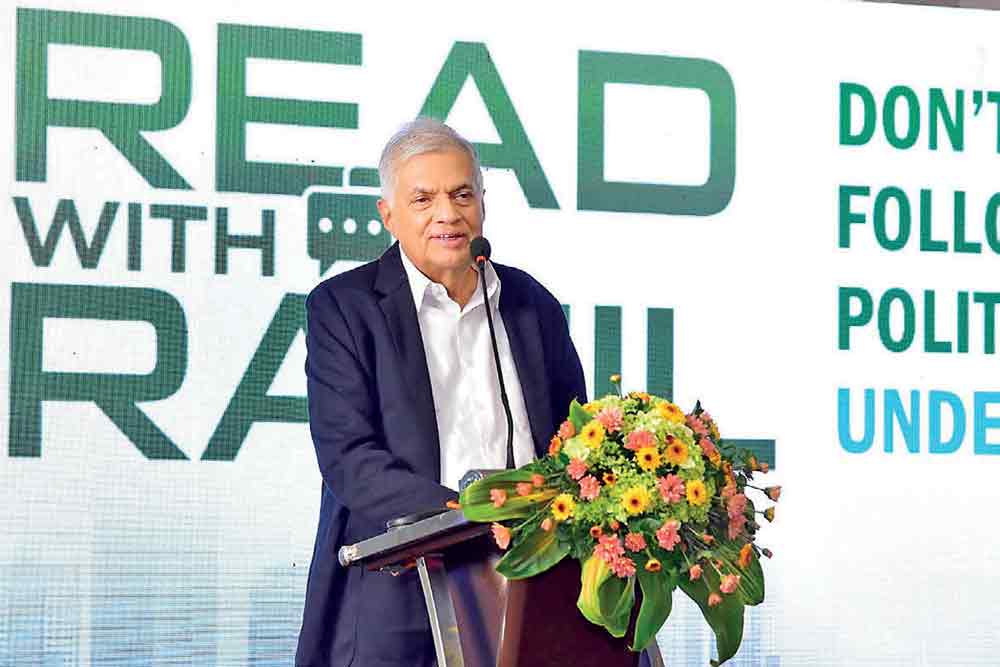
Former President Wickremesinghe
 As the world enters the Asian century, Sri Lanka needs long-term economic growth, which means embracing regional integration and structural reform to secure its future amid shifting global power, technological disruption and demographic change
Excerpts of a speech delivered by Former President Wickremesinghe at the inaugural ‘Read with Ranil’, a national youth engagement initiative organised by the Smart UNP Unit of the National Youth Front of the United National Party
When this program was first planned several months ago, none of us could have imagined how dramatically the world would change in such a short period. Events in the Middle East, continuing geopolitical uncertainty and shifting international alliances remind us that we are living through another defining moment in modern history. The pace of change is so rapid that predicting the direction of world affairs has become increasingly difficult.
Living through transformation
My generation witnessed one major transformation of the international order. Your generation will witness another, perhaps even more profound. Understanding that change is essential because Sri Lanka's future will depend not only on what happens within our borders but also on how we respond to the changing world around us.
I was born shortly after Sri Lanka gained independence. The Second World War had just ended. Europe, with the exception of Britain, had been devastated. The defeat of fascism was made possible not only by the major Allied powers but also by the contribution of countless people from Asia, Africa and countries such as Sri Lanka that were then still under colonial rule. That victory created the conditions for decolonisation, enabling many nations across Asia and Africa to gain their independence.
The decades that followed witnessed dramatic political and economic change. The Cold War divided the world between two competing ideological systems until the collapse of the Soviet Union in the late 1980s and early 1990s. That period ushered in a unipolar world dominated by the United States and the West.
Today, we are entering another historic transition.
The centre of global economic power is steadily moving away from the Atlantic towards Asia. This is not an entirely new phenomenon. Until the middle of the eighteenth century, India and China accounted for much of the world's economic output. The Industrial Revolution shifted that balance towards Europe and later North America. For over two centuries, economic power remained concentrated in the West.
That era is now drawing to a close.
Shifting world order
By 2050, Asia will once again dominate the global economy. China is projected to become the world's largest economy, with an output exceeding $ 50 trillion. India is expected to follow closely with an economy approaching $ 44 trillion, while the United States will remain among the world's leading economic powers. Whether India overtakes the United States or remains in third place is less important than the fact that the world's three largest economies will define global economic and strategic affairs for decades to come.
Equally significant is what comes next.
Many assume that countries such as Germany, France, Britain or Canada will occupy the next position among the world's largest economies. Instead, projections suggest that Indonesia will emerge as the fourth-largest economy, with an output exceeding $ 10 trillion. Bangladesh is expected to approach $ 3 trillion, while Malaysia and Thailand will continue expanding rapidly. Vietnam, which only a few decades ago emerged from war, is expected to become one of Asia's major economic success stories.
These projections are not merely statistical exercises. They demonstrate where investment, technology, manufacturing and global trade will increasingly be concentrated. They also illustrate how rapidly Asia's economic landscape is changing.
The transformation extends beyond economics.
Strategic influence in the coming decades will rest on the interaction between economic and military power. Economically, China, India and the United States will dominate. Militarily, the United States, Russia and China will continue to possess the world's most significant nuclear capabilities.
As these relationships evolve, the balance of international power will also change. Relations between Washington and Beijing, Washington and Moscow, Beijing and Moscow, and perhaps most importantly between India and China, will shape global stability throughout this century.
Recent developments already demonstrate this transition.
President Donald Trump has openly acknowledged that the world is increasingly defined by the interaction between the United States and China. His approach towards Europe has reflected that changing assessment of global priorities. Whether one agrees with his methods or not, the underlying reality remains that international attention is increasingly focused on Asia.
The war in Ukraine, tensions involving Russia, instability in the Middle East and developments surrounding Iran all illustrate the complexity of today's international environment. Conflicts can continue for years despite overwhelming military power being deployed. History reminds us that military superiority alone does not always determine political outcomes.
 The challenge now is far greater than overcoming the immediate crisis. The challenge is ensuring that Sri Lanka generates sufficient economic growth to meet its future obligations while raising living standards for its people. This is where many discussions about the economy fail to focus on the central issue
The United States once believed it could defeat North Vietnam through overwhelming force. Instead, North Vietnam ultimately unified the country under its own Government. Afghanistan provides another example. The Taliban survived both Soviet intervention and later the American-led campaign, eventually returning to power. These experiences demonstrate that international conflicts rarely produce simple or predictable outcomes.
For Asian countries, these developments carry an important lesson.
The Asian century
For decades, many governments assumed that the United States would remain the principal guarantor of regional stability. That assumption is becoming increasingly uncertain. Asian nations must now take greater responsibility for managing their own security and diplomatic relationships.
This does not mean abandoning existing partnerships. Rather, it requires developing a more independent understanding of regional interests while building constructive relationships with all major powers.
Sri Lanka, situated at the centre of the Indian Ocean, cannot afford to view these developments from the sidelines. Geography has always shaped our history, and it will continue to shape our future.
At the same time, another continent is preparing for its own transformation.
If the twenty-first century belongs to Asia, the latter half of the century is likely to belong increasingly to Africa. Population growth, expanding infrastructure and rising investment are already transforming large parts of the continent. China has recognised this reality and has invested heavily in African transport networks, ports, railways and industrial development.
The competition for influence in Africa demonstrates that economic opportunity increasingly follows long-term strategic planning rather than short-term political calculations. Countries that recognise future trends early will be better positioned to benefit from them.
Sri Lanka must adopt the same perspective.
Instead of focusing only on immediate political debates, we must understand where the world is heading over the next quarter century. Our policies, education system, infrastructure, trade relationships and investment strategies should all be designed with that future in mind.
The next generation will not inherit the world that my generation entered. It will inherit a far more competitive, technologically advanced and economically interconnected Asia.
Whether Sri Lanka prospers in that environment will depend on the choices we make today.
The changing world order is only one part of the challenge before us. Equally significant are two forces that will transform every society, every economy and every workplace over the next quarter century: climate change and artificial intelligence.
Climate change and AI
Climate change is no longer a distant environmental concern. It is becoming an economic issue, a social issue and ultimately a national security issue. By 2050, every country will have to adapt to changing weather patterns, increasing temperatures, water scarcity and higher energy demands.
Even developed countries are beginning to confront these realities. Britain, where air conditioning was once considered unnecessary, is now grappling with rising cooling requirements and the infrastructure needed to support them. Governments everywhere will have to rethink how they manage water resources, electricity generation and urban development. These are not challenges unique to developing countries; they are global challenges that will reshape public policy.
Alongside climate change comes the rapid advancement of automation and artificial intelligence.
This technological revolution will affect almost every profession. Lawyers, accountants, engineers, administrators and countless other occupations will increasingly rely on AI. Some jobs will disappear altogether. Others will require entirely different skills. Factories will become more automated, requiring fewer workers but greater investment in technology.
 Our external debt repayments will increase significantly after 2028. By around 2030, Sri Lanka could face annual repayments of between $ 5 billion and $ 6 billion. These obligations cannot be ignored or postponed indefinitely. How do we repay them? Certainly not by borrowing more. Borrowing to repay existing debt merely increases the overall debt burden. That is not a sustainable solution. The only durable solution is faster economic growth
China provides an interesting example. As its population ages and begins to decline, automation offers a solution to maintaining productivity despite a shrinking labour force. Other countries facing demographic change are likely to follow the same path.
Sharing wealth
But AI and automation together create a much deeper economic challenge. They increase productivity while reducing the number of workers required to produce goods and services. Those who possess capital and technology will benefit disproportionately, while opportunities for labour may become increasingly limited.
For more than two centuries, political and economic debate centred on one fundamental question: how should wealth be shared between capital and labour? The Industrial Revolution gave rise to competing economic philosophies that shaped politics throughout the twentieth century.
Today, that debate itself is changing.
If technology enables capital to replace labour on an unprecedented scale, many of our traditional assumptions about employment, wages and economic distribution may no longer hold true. Some of the theories developed during the Industrial Revolution will become increasingly less relevant in a world dominated by artificial intelligence.
Governments are therefore beginning to examine entirely new policy frameworks. Discussions on universal basic income, new forms of social protection and broader public ownership of productive assets are no longer academic exercises. They are becoming practical policy questions that many countries will have to address as technology transforms labour markets.
These are developments that today's young generation must understand because they will define your working lives far more than they defined ours.
Against this global backdrop, let us consider Sri Lanka.
From crisis to stability
Only a few years ago, our country faced the gravest economic crisis since independence. Production collapsed. Foreign exchange disappeared. Businesses closed. Tourism came to a standstill. Essential imports became increasingly difficult to obtain.
Stability has since returned.
Once political stability and law and order were restored, economic activity resumed. Tourism recovered. Hotels that had stood virtually empty during the crisis once again welcomed visitors. Businesses restarted production. Confidence gradually returned to the economy.
Stabilisation, however, should never be mistaken for success.
It merely creates the opportunity to rebuild.
What to rebuild, and how
The challenge now is far greater than overcoming the immediate crisis. The challenge is ensuring that Sri Lanka generates sufficient economic growth to meet its future obligations while raising living standards for its people.
This is where many discussions about the economy fail to focus on the central issue.
Our external debt repayments will increase significantly after 2028. By around 2030, Sri Lanka could face annual repayments of between $ 5 billion and $ 6 billion. These obligations cannot be ignored or postponed indefinitely.
How do we repay them?
Certainly not by borrowing more. Borrowing to repay existing debt merely increases the overall debt burden. That is not a sustainable solution.
The only durable solution is faster economic growth.
 Politics will change. Governments will come and go. International events will continue to evolve. But the fundamental challenge will remain the same. Sri Lanka must build a competitive, resilient and outward-looking economy that is capable of prospering in the new Asian century. That is the responsibility before us today. It is also the responsibility that will shape the future of the generations to come
The larger our economy becomes, the easier it will be to service debt while continuing to invest in education, healthcare, infrastructure and social protection. Without sustained growth, an increasing share of national income will simply be diverted towards debt repayments.
That is why economic growth is not merely a macroeconomic objective. It is directly connected to the daily lives of every citizen.
Growth determines whether young people can find rewarding employment. It determines whether families can purchase homes, own vehicles and provide better educational opportunities for their children. It determines whether future generations will enjoy a higher standard of living than their parents.
Unless we expand our economy significantly, these aspirations will become increasingly difficult to achieve.
The experience of our neighbours should serve as both a warning and an inspiration.
Bangladesh was considerably poorer than Sri Lanka only a few decades ago. Vietnam emerged from a devastating war with an economy far smaller than ours.
Today both countries have pursued sustained export-led growth, industrial expansion and economic reforms that are transforming their societies. By 2050, Vietnam's economy is projected to approach $ 2 trillion. Bangladesh's per capita income may well equal or exceed Sri Lanka's if current trends continue.
These developments should not discourage us.
Rather, they should remind us that sustained growth is possible when countries pursue consistent long-term policies.
Sri Lanka possesses considerable advantages. Our strategic location, educated workforce and maritime position provide opportunities that many countries do not enjoy. But these advantages must be translated into investment, productivity and exports.
Another challenge we cannot ignore is demographics.
For decades, Sri Lanka benefited from a growing working-age population. That demographic dividend is now beginning to reverse.
Birth rates have declined significantly in recent years while life expectancy continues to increase. Within the next generation, a smaller number of working-age citizens will be required to support a much larger elderly population.
Countries such as India continue to benefit from expanding younger populations entering the workforce. Sri Lanka does not have that advantage.
Our response must therefore focus on increasing productivity through technology, education and higher-value industries while ensuring that economic growth remains sufficiently strong to support an ageing society.
At the same time, we must recognise the strategic importance of our geographical location.
The Bay of Bengal is rapidly becoming one of the world's most dynamic economic regions. India, Bangladesh, Myanmar, Thailand, Malaysia and Indonesia are all expanding their economic influence. New connectivity projects, including transport corridors linking western China through Myanmar towards the Bay of Bengal, will reshape regional trade over the coming decades.
Sri Lanka sits at the centre of these maritime routes.
If we position ourselves correctly, we can become a logistics, services and commercial hub serving one of the fastest-growing regions in the world.
During my tenure, we sought to strengthen cooperation with India while advancing regional initiatives such as the Colombo Security Conclave because economic opportunity and regional security are increasingly interconnected.
Our relationship with India deserves particular attention.
When Sri Lanka experienced its deepest economic crisis, assistance arrived from many international partners. The IMF played an essential role in restoring macroeconomic stability through its program.
However, immediate survival depended upon support that arrived well before IMF financing became available.
India extended approximately $ 4 billion in assistance when Sri Lanka needed it most. The World Bank and the Asian Development Bank provided additional financial support. Bangladesh also extended assistance. USAID, under Samantha Power, supplied fertiliser that proved critical for agricultural production during the harvest season.
These contributions enabled Sri Lanka to bridge the most difficult period of the crisis.
We should remember those who stood by us during our moment of greatest need.
Ultimately, however, no country can depend indefinitely on external assistance.
Sri Lanka's future will depend upon its own ability to compete in a rapidly changing world.
The questions before us are therefore straightforward.
How do we build an economy capable of sustaining high growth?
How do we prepare our young people for artificial intelligence and automation?
How do we adapt to climate change?
How do we use our strategic location in the Bay of Bengal to our advantage?
And how do we ensure that the next generation enjoys greater opportunities than the present one?
These are the issues that should dominate our national conversation.
Politics will change. Governments will come and go. International events will continue to evolve.
But the fundamental challenge will remain the same.
Sri Lanka must build a competitive, resilient and outward-looking economy that is capable of prospering in the new Asian century.
That is the responsibility before us today. It is also the responsibility that will shape the future of the generations to come.




