Friday Oct 02, 2026
Friday Oct 02, 2026
Wednesday, 17 June 2026 06:23 - - {{hitsCtrl.values.hits}}
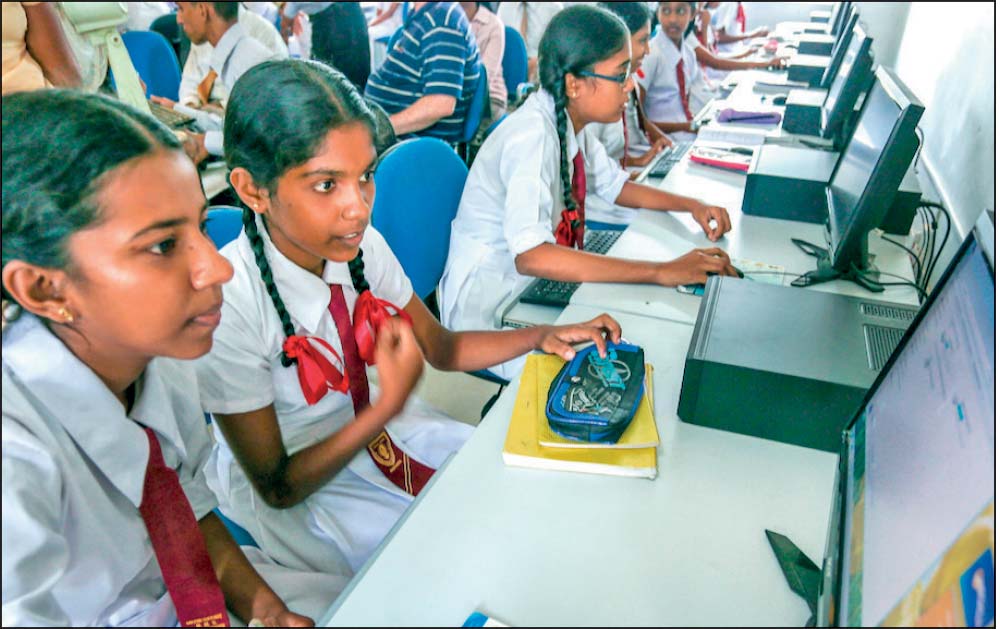
 Sri Lanka has, despite everything, an unusual asset in its teaching workforce. The teachers who stayed through the crisis are among the most resilient anywhere
 Sri Lanka's school system has carried more than its share of weight over the past five years. The pandemic. The economic crisis. The interrupted school years, the textbook delays, the brain drain of teachers. That weight has, understandably, pushed conversation about new technology to the margins. Inside the classroom, however, a decision is being taken right now in every Sri Lankan school that has not yet stopped to think about it, and that decision will outlast the immediate recovery.
Posture the school adopts
The decision is what posture the school adopts towards artificial intelligence. By posture I mean the answer to one question. When a teacher sees a pupil using AI to prepare for the O Level or A Level examinations, to draft a Sinhala or Tamil composition, or to solve a mathematics problem, does the school treat that pupil as someone gaming the system, or as someone learning to think with a new instrument?
Two years of training around fifty teachers in AI literacy across three secondary schools in Sao Paulo, in a country with its own deep school inequality, have made the pattern impossible to ignore. The schools that take the policing posture end up with elaborate detection routines, anxious teachers, and pupils who learn the only lesson policing reliably teaches, which is how to evade detection. The schools that take the building posture end up with teachers who can name what good and bad use of AI looks like in their own subject, and with pupils who can articulate when they used a tool and why.
The Sri Lankan version of this question has three specific weights. The first is the central role of the O Level and A Level system. Any school posture that does not make peace with how pupils use AI in preparation for those examinations is, in effect, no posture at all. The second is the urban-rural gap. The schools in Colombo and Kandy have a different conversation in their staff rooms than the schools in Hambantota or Mannar. The policing posture, applied uniformly, does not produce equal harm across that gap. It produces unequal harm. The third is the diaspora effect. Many pupils in better resourced Sri Lankan schools have cousins abroad and access to AI tools through family networks that pupils in less well-resourced schools simply do not have. That gap is being widened, school by school, by every policing posture adopted in silence.
The building posture costs nothing. It does not require new platforms, new budgets, or even national policy, although policy would help. It requires, at school level, one conversation. The head of a subject department, with one or two colleagues, sits down and writes three sentences. The first names a use of AI that the department considers desirable and wants pupils to learn, with a concrete example from this term's syllabus. The second names a use that is acceptable when declared, and gives the form of declaration. The third names a use that is not acceptable in any form, and says why, in language a sixteen year old can understand.
Three sentences. The point is not the sentences. The point is the conversation that has to happen to write them, between the head of department and the staff, between the school and the parents at the next parent meeting. That conversation is the posture being adopted consciously. Without it, the posture is being adopted by default, classroom by classroom, and the default in any system under stress is anxiety.
Daily FT readers are precisely the people whose schools are watched and copied by smaller schools across the country. The frame this paper sets for the AI question over the next year will shape how thousands of others decide. The dominant frame so far, the binary between embrace and restriction, helps no one. Posture as the real variable gives a school its first useful question, and it can be answered this term
Teaching workforce
Sri Lanka has, despite everything, an unusual asset in its teaching workforce. The teachers who stayed through the crisis are among the most resilient anywhere. Asking them to write three sentences for their subject is a small ask, and it gives them, for the first time in this conversation, institutional authority on a question that has so far been left to them to navigate alone.
Daily FT readers are precisely the people whose schools are watched and copied by smaller schools across the country. The frame this paper sets for the AI question over the next year will shape how thousands of others decide. The dominant frame so far, the binary between embrace and restriction, helps no one. Posture as the real variable gives a school its first useful question, and it can be answered this term.
(The author is a PhD candidate in pure mathematics at IME-USP and an IB mathematics teacher at Colegio Sao Luis, Sao Paulo)



