Monday Sep 28, 2026
Monday Sep 28, 2026
Tuesday, 2 June 2026 00:00 - - {{hitsCtrl.values.hits}}
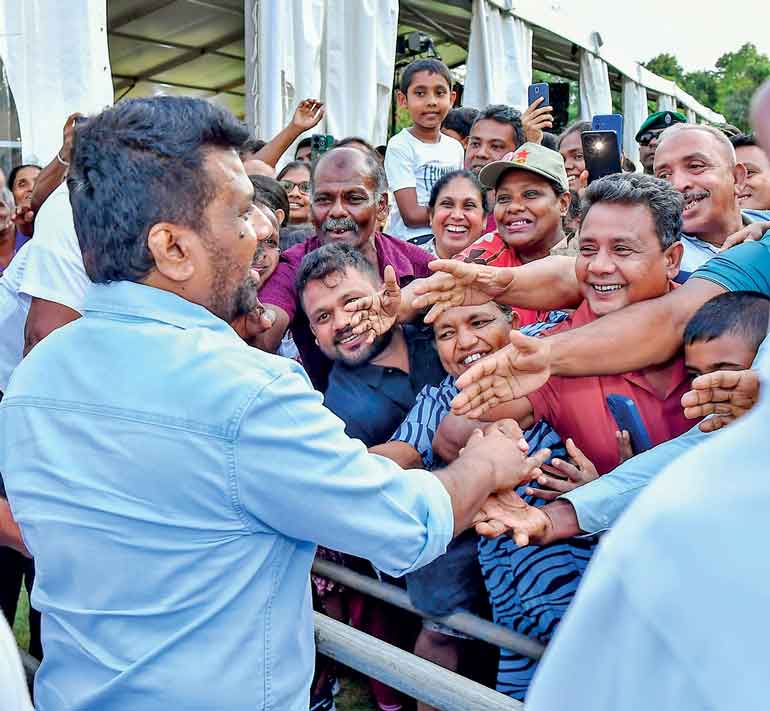
President Anura Kumara Dissanayake being greeted by people during a public visit
 The 2024 victories of AKD as Sri Lanka’s new President and NPP/JVP coalition’s landslide sweep at the general election were events of great significance in the political history of Sri Lanka. These victories creditably belonged to a new generation of Sri Lankans who were getting tired of witnessing a handful of families governing in succession in the name of democracy.
The 2023 Aragalaya with the twin demand “Gotha Go Home” and “No 225” was in fact represented the new generation’s cry for system change. Nepotism, corruption and politicisation of the judiciary had made separation of powers meaningless, widened ethnic divisions and class differences, and driven the national economy to the point of financial bankruptcy. AKD’s presidential campaign promising “clean governance” with an end to family rule while stabilising the economy without destroying the open economy framework and via a “social revolution” reflected the mood of the time and captured the aspirations of a new generation of voters. In essence, a system change was what this generation wanted and what the new leaders promised. The two elections stamped that popular demand.
But promises are one thing and honouring them is quite another. It is regarding the latter that criticisms against AKD and the coalition are mounting. However, there are certain elementary facts that should be kept in mind by the critics.
Charisma of AKD
Firstly, it is unfair for anyone to call for a Balance Sheet from the new leadership in just over a period of eighteen months in a five-year term. Secondly, there is the problem of the learning curve whether steeply or flatly it is declining. One of the problems with the new team is its lack of experienced personnel in the art of governing. Both elections were won simply on the charisma and oratory of AKD, and little scrutiny was done on the quality of candidates to represent the coalition. Quantity does not guarantee quality. And thirdly, the natural disaster inflicted by Ditwah and the worldwide economic paralysis engendered by Trump’s mercantilist trade policy and war-driven inflation had made promise delivery difficult especially within the IMF financial parameters. Despite the radical orientation of the JVP comrades AKD had to choose pragmatism as the guiding principle in tackling the issues confronting the Government.
However, one area where AKD and the new Government promised to act quickly was to clean up the rotten state of national governance where corruption, nepotism and accumulation of power in the hands of an Executive President had made the country’s democracy virtually a family rule. The spiralling record of loss-making state-owned enterprises was the product of this misgovernance. It even prompted the IMF to insist on privatising SOEs to make them profitable ventures, and it raised that issue with the then stopgap President Ranil Wickremasinghe, who invited the IMF in the first place. But he did nothing, and RW himself is now facing corruption charges in the court of law.
It is unfair for anyone to call for a Balance Sheet from the new leadership in just over a period of eighteen months in a five-year term. Secondly, there is the problem of the learning curve whether steeply or flatly it is declining. One of the problems with the new team is its lack of experienced personnel in the art of governing
Rooting out corruption and independent judiciary
Ending corruption and forcing the corrupt to face the full force of the law require an independent judiciary free of political interference. Separation of powers is the constitutional pillar on which a healthy democracy is built and functions. This was not there under the previous regimes. Therefore, AKD’s resolve to end corruption and introduce clean governance is conditional upon strict adherence to the boundaries of power demarcated by the constitution to the legislature, executive and judiciary respectively. Already, there are rumblings about cabinet ministers over reaching their executive boundaries, and party leaders making ministerial decisions. Inexperience may be one of the reasons for this shortcoming, and because of inexperience ministers are compelled to depend on the advice of bureaucrats who may have their own agenda. Several of the top bureaucrats are appointees of former political leaders and the advice provided by these bureaucrats especially on issues originating from the past may not be free of bias.
New constitution
System change needs a new constitution, and it should be one founded on principles of secular democracy while recognising the country’s multiethnic and multireligious polity. No number of conferences, dialogues and utterances on ethnic reconciliation could achieve the desired outcome unless the constitution guarantees that supreme objective. There is a long way to go to reach this target, but it is time for the current President and Government at least to make the preparatory ground by appointing a committee of constitutional experts to work on this project.
Economic arena
But the greatest and immediate challenge facing the coalition is in the economic arena. Having accepted the IMF framework as a pragmatic solution the time has arrived for a more innovative program to incentivise the local production sector to tackle the worsening cost of living crisis and counter the cost-push inflationary effects of (a) the two regional wars in Europe and the Middle East, (b) Donlad Trump’s mercantilist tariff policy and (c) climate crisis. This cost push inflation cannot be controlled by monetary instruments alone. It needs a systemic approach with a coordinated program that would drive the economy towards self-sufficiency in peoples’ basic needs at least.
It is the Government’s performance in the economic arena that would determine the longevity of the JVP-NPP coalition. Currently, it is the absence of a better alternative from the Opposition parties that keeps the coalition prospects positive and strong. But to make it stronger, performance must improve
Cost of living is a pandemic and is skyrocketing in several developing nations. In Sri Lanka, it is the middle and low-income families that are bearing the full brunt of the crisis except the ones that are fortunate enough to secure employment at least for one or two of their members in the Middle East. With almost US$8 billion in 2025 foreign remittances from expatriate labour have become a life saver to the national treasury. But even that source may become restricted if the US-Israel war against Iran remains unresolved peacefully. Already, escalating fuel and fertiliser prices had made transport costs unaffordable and food scarcity acute. Financial allocation to incentivise local production should therefore receive priority in forthcoming national budgets. In that regard it is time for the coalition to look seriously at reforming the current tax structure. The IMF would continue insisting on its preference for tax broadening, but the situation demands tax increase on the rich and high-income earners, and in that regard, even accounting firms that work for this class of income earners need scrutiny on their tax reduction techniques. In the end, it is the Government’s performance in the economic arena that would determine the longevity of the JVP-NPP coalition. Currently, it is the absence of a better alternative from the Opposition parties that keeps the coalition prospects positive and strong. But to make it stronger, performance must improve.




