Sunday Sep 13, 2026
Sunday Sep 13, 2026
Saturday, 28 February 2026 00:00 - - {{hitsCtrl.values.hits}}
Introduction
 The contents of this article are excerpts from an address delivered by the undersigned on 31 January 2026 at the Sri Lanka Student Association of Japan at the Embassy of Sri Lanka under the auspices of the Conference Chair, Sr. Prof. N. S. Cooray of International University of Japan and graced by the Chief Guest, Ambassador of Sri Lanka to Japan, Prof. Pivithuru Janak Kumarasinghe as well as other distinguished speakers.
“Sustainable Development is the development that meets the needs of the present without compromising the ability of future generations to meet their own needs” - Gro Harlem Brundtland, former Prime Minister of Norway, Director General of WHO and Chair of the World Commission on Environment and Development (WCED).
Geo-political and
Geo-economic developments
Today, the world is confronted and tested by geo-political, geo-economic and geo-strategic issues and developments, which one could state a period of unprecedented volatility and instability, probably, most experienced during the last 80 years. Many use the terms geo-political and geo-economic without knowing the genesis or the specific meaning of those terms. In the beginning of the 20th Century, the term geo-economic was used but it was Edward Luttak, US Grand Strategist, who popularised the term in 1990s. The term geo-politics too entered the English lexicon during the same period of beginning of 20th century coined by Swedish political scientist, Rudolf Kjellen. It is imperative to observe that both these attributes, which have become omnipresent in intellectual and political discourse today, most often coincide and intersect, which is being leveraged by more powerful nations to advance and to attain their intrinsic utility at the cost of less powerful nations. The concept of “Economic Statecraft” in the sphere of geo-economics, was credited to David Baldwin in his seminal work in 1985. Today, without much surprise, one could witness both highly advanced and less endowed smaller nations executing or responding to “Economic Statecraft” to varying degrees and reach vis-à-vis export and import controls, tariffs, sanctions, finance and technology, trade agreements, migration, energy supply and investments, amongst others. Since the end of WW II, this craft or pivot has been used more widely and with greater scope instead of military force. Again, it is lucidly understood that the more powerful and advanced nations could attain their inherent national objectives with greater ease and with lesser cost by employing Economic Statecraft, with efficacy.
The evolvement of world order during the last eight decades
One could segment the last eight decades since 1940s as follows:
This is a broad delineation or characterisation of cogent pivotal and momentous developments of these eight decades.
Necessity of multilateralism vis-à-vis sustainability
One may observe or even discern that the concept of multilateralism is losing or eroding its significance or seminal nature it once commanded in the last Century. This generally occurs when geo-political and geo-economic fragmentation and unpredictability take place. This is one of the oldest concepts of international order first used as far back as in the 17th Century in the Treaty of Westphalia. Simply, multilateralism is the practice of engagement, collaboration or/and coordination of member nations in order to resolve global or regional challenges and provocations, which a single nation is unable to resolve. This course of action, further, assures and establishes greater understanding, trust, affinity, rapport and solidarity let alone regional or global stability.
Strategies to attain global sustainability
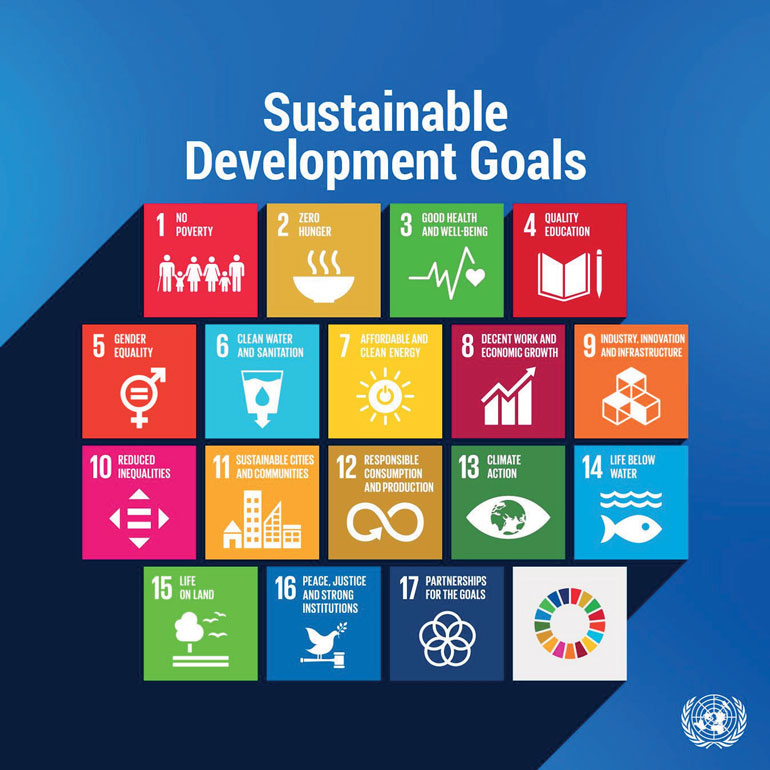
Sustainability beyond national boundaries or more importantly to attain the 17 Sustainable Development Goals (SDGs) by 2030, a dynamic and robust multilateral system on a global basis is critically vital and imperative. The UN does play a central and deciding role in endeavoring to navigate a pragmatic path to attain the SDGs before 2030 or has less than 1,800 days since SDGs were adopted by all UN members in 2015. For all record purposes, the 17 Goals of SDGs could create an “Utopian or Idealised” world if comprehensively and totally achieved and fulfilled, which in reality, is far from reality. The UN addressed the so-called “Common Agenda” in 2021, which was to explore a path or inculcate “kinetic energy” to members to attain the SDGs, given the seminal nature and exigency. This led the UN to host the “Summit of the Future” in September of 2023 but was not satisfactory since many nations lacked interest, sagacity, pertinacity, grit and commitment to acknowledge and recognise the global necessity. Unfortunately, the SDGs have relegated to the status of a back-burner or to an extent as an insignificant priority, amongst many nations. Further, most nations and populous, including leading policy makers and politicians, are not well cognisant or conversant of the colossal benefits and utility, in all spheres and provinces, to any given nation, mostly to developing nations such a Sri Lanka.
Key tangible benefits of SDGs including to Sri Lanka
Today, approximately 800 million are in poverty or roughly one out of ten persons in the world. Further, 450 million children are unable to attend school due to numerous challenges ranging from poverty, displacement, conflicts to lack of schools. According to noted US economist and former Director of Earth Institute, Prof. Jeffrey Sachs, it costs just around $65 billion to send every child in the world to school. If this figure, even though compellingly large, placed in perspective, it would only be 2.5% of global annual defense expenditure. In 2024, the global defense expenditure was around $2.8 trillion or $2,800 billion or larger than the GDP of a G-7 nation i.e. Italy. On the same note, in order to obliterate poverty from the face of the earth, it would cost around $400 billion or $500 per person annually to elevate the overall living conditions of 800 million, who are in poverty today. The author wishes to accentuate that $400 billion, is indeed, an astronomical amount, but yet again is less than 15% of total defense expenditure. In other words, it is only 0.33% of total global GDP, which is around $118 trillion in 2025 or the annual revenue of the 10 largest corporates in the world ranging from Wal-Mart ($680 billion) to Berkshire Hathaway ($390 billion) respectively. If the 38- member OECD countries duly contribute the agreed 0.7% of GDP for ODA, it would translate to over $400 billion annually as the total combined GDP of OCED countries was close to $70 trillion in 2025. Of course, the total cost of natural disasters and catastrophes which took place in the world, last year, accounted to around $2.3 trillion, still less than the total defense spending. The author is convinced that anybody can slice and dice the numbers but the most critical issue is if the OCED countries do contribute 0.7% of GDP for ODA, whether the developing and least developed nations would execute and implement those contributions in the most efficacious and realistic manner with transparency and accountability. Another question which will give rise to any discerning mind is whether the world today is any safer than five decades ago which such unprecedented defense spending. It has become fashionable for political leaders and policy makers to state “If you want peace, prepare for war”. This statement in realistic sense, should read as “If you want peace, prepare for peace”. It maybe felicitous to state perspicacious words with regard to war and defense spending by one of the most respected and trusted journalists of last Century, Walter Cronkite, quote “War itself is, of course, a form of madness. It is hardly a civilised pursuit. It is amazing how we spend so much time (resources) inventing devices to kill each other and so little time working on how to achieve peace” unquote.
Fulfilling and attaining the 17 key and seminal SDG Goals could markedly eradicate or eliminate the challenges and suffering, which are within the human capacity and capability. These SDGs would make sustainability achievable and attainable, thus uplifting the standard of living of a large percentage of global populous with stability, peace, opportunity and sanguinity as well as predictability
Criticality of economic growth
Empirical studies and research have established the fact that if a developing or least developed nation records a declining GDP growth or minus 4% to 5% annually for a couple of years, it would lead to 15% to 20% likelihood of an internal conflict or/and instability. Even Sri Lanka witnessed this situation in 2022 and today a number of countries are experiencing such abominable internal volatility around the world. When analysing GDP and GDP growth as well as per Capita, they do not, necessarily, reflect or manifest the human progress, standards of living, human rights and socio-economic advancement comprehensively and exhaustively. It is crucial to fathom that the inequality, the world over, has risen to an unprecedented degree which the recorded history has not witnessed. This is stated in the context that the average GDP per Capita (Global GDP/population) is around $14,200 and the entire South Asia and South East Asia are less than the stated average. The GDP per Capita of South Asia is less than $2,900 whilst the 10 – member ASEAN in South East Asia is around $6,000. It maybe intriguing to note that the wealthiest person on the planet has a net worth of around $800 billion, which is approximately the total GDP of the entire South Asia, without India, consisting of nearly 500 million. Of course, the most valuable corporate in the world, NVIDIA, touched a market cap of $4.5 trillion, in the 4th quarter of 2025, was larger than the total GDP of Germany, India or Japan. Understandably, market caps. and GDPs cannot be compared as the formations and source are disparate but it does portray and present the woeful degree of inequality in the world today. Related to inequality, the most accepted methodology to calibrate inequality is the Gini-Coefficient, introduced by the Italian Statistician, Carrado Gini, in 1912. In 2024, the Gini-Coefficient reached the highest ever index, globally, of 68%. (Zero denotes perfect equality and 100% denotes perfect inequality).
Conclusion with observations
In conclusion, the world is neither utopian nor dystopian but the nations, mostly developing nations, should aspire to impel the pendulum toward the scale of ‘utopia’, which would be beneficial to the entire global populous. In order to have a world, particularly developing nations such as Sri Lanka, fulfilling and attaining the 17 key and seminal SDG Goals could markedly eradicate or eliminate the challenges and suffering, which are within the human capacity and capability. These SDGs would make sustainability achievable and attainable, thus uplifting the standard of living of a large percentage of global populous with stability, peace, opportunity and sanguinity as well as predictability. If the comity of nations, party to the SDGs, expends only 1% of global GDP to attain the 17 SDG Goals, the world would witness a new era, new chapter and new page of peace and prosperity beyond the most optimistic imaginations and hopes of anybody. It is often being stated that the world at large can well afford or well positioned to commit 1% of the GDPs to attain the SDGs, but what is dolefully lacking is the resolve, will, tenacity and unwavering commitment.
The author wishes to conclude with the judicious and politic words of Ralph Bunche, a founding member of the UN and Nobel Peace Laureate as well as the first person of African descent to be awarded the Nobel Prize in 1950, stated over eight decades ago, quote “Peace is not whether people or countries are fighting or not fighting. Peace, to have meaning for many who have known suffering in both peace and war, must be translated to bread and rice, shelter, health and education as well as freedom and human dignity – a steadily better life. If peace is to be secure, long suffering and long starved, forgotten peoples of the world, the underprivileged and undernourished, must begin to realise without delay the promise of a new day and a new life” unquote.
(The author is a former career Ambassador, Visiting Professor and Examiner on International Economics, Board Member and Strategic Advisor. He earned the MBA from San Francisco State/University of California and PhD from Indian Institute of Technology (IIT) Delhi and is a Senior Fellow at Harvard. He could be contacted on [email protected])




