Thursday Oct 01, 2026
Thursday Oct 01, 2026
Tuesday, 14 July 2026 04:48 - - {{hitsCtrl.values.hits}}
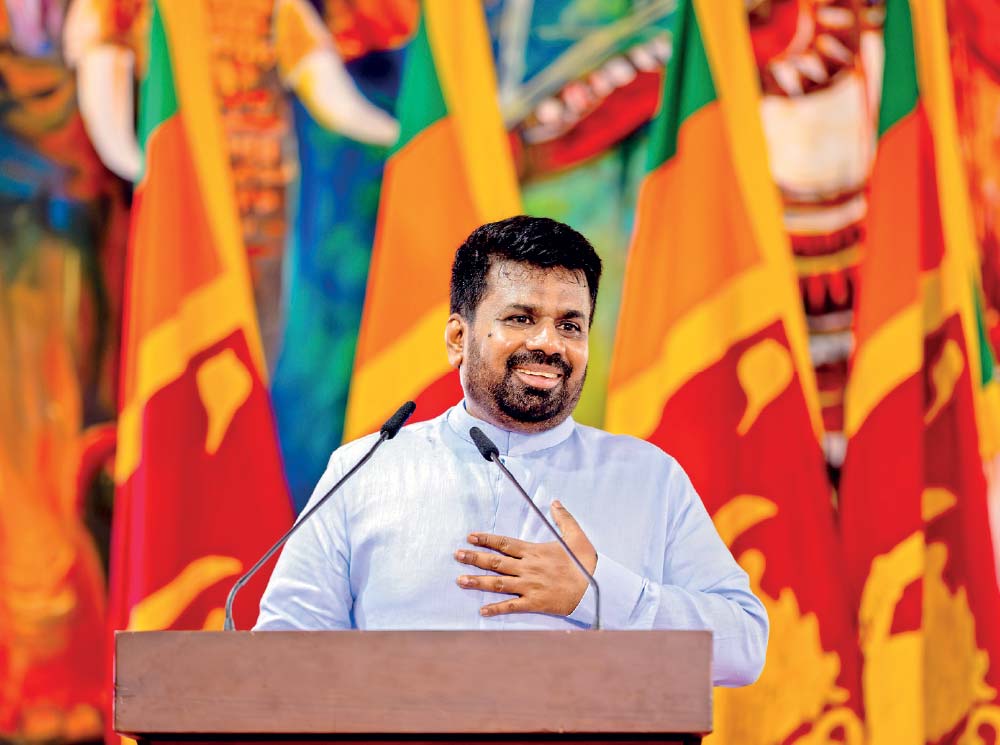
President Anura Kumara Dissanayake
 Organisations routinely use vast resources to formulate elegant, macro-level strategies. Yet blueprints collapse if they fail to account for harsh operational realities. True competitive advantage is forged in the trenches of execution. The Sri Lankan Team did not just plan for the environment. They built the specific, tactile capability to master it and execute it
 A strategy provides value only when it is executed. By itself, it is worthless.
The world of national and corporate leadership is rife with masterful strategic plans that have gathered dust because there was a lack of courage and belief to execute them. It is time that leaders killed the poetry, stopped waiting for the syntax to be perfect or for the stars to align. They must throw themselves into the chaotic, self-satisfying, brilliant fire of ‘action’. A flawed action taken with relentless fury will always outperform a flawless strategy left on the shelf. The magic is not in the concept, but in the execution. Great military leaders like Genghis Khan, Alexander the Great, and Napoleon rarely worshipped the map at the expense of territory. A perfect strategy can never fail if it is never applied. It stays immortal by remaining unborn. But a single, committed step forward teaches you more than a lifetime of immaculate maps. The world does not reward what you intend to do, nor does it remember the elegance of your spreadsheets or the holism of your strategy. History is written by those who bled in the arena, not by those who drew up the blueprints from the stands. Execution is where the soul enters the machine. It is the violent, necessary act of dragging a thought out of the ether and slamming it into reality. It is messy, unforgiving, and exhausting. Where a plan speaks smoothly, execution speaks in scars, pivots, and sweat. It does not care about the poetry of your vision; it cares about your stamina at the height of battle when everything collapses, and you must rebuild from the mud.
The 1996 Cricket World Cup final is a legendary masterclass in operational execution. While pundits celebrate Sri Lanka’s revolutionary powerplay batting, the championship was won on a granular detail: preparing for the evening dew in Lahore, Pakistan. Coach Dav Whatmore and captain Arjuna Ranatunga planned to bowl first if they won the toss. This was tactical heresy. No team had ever won a World Cup final while chasing. However, they knew heavy evening dew would turn the ball into a slippery soap bar, neutralising Australia’s potent bowling attack. A brilliant strategy is useless without the capability to execute under pressure. To bridge the gap between formulation and execution, Whatmore introduced an unconventional drill: soaking cricket balls in buckets of water during practice. This meticulous simulation forced Sri Lanka’s spinners to adapt their grips, conditioned fielders to handle a slippery ball, and prepared batsmen to face a slicker, faster-skidding projectile. By simulating the worst-case environment, Sri Lanka transformed a conceptual theory into earned muscle memory and operational confidence. When Ranatunga won the toss and fielded, Australia faced dewy conditions they had not prepared for. Sri Lanka was mentally prepared for all eventualities and cruised to a historic victory.
This triumph remains a powerful leadership paradigm. Organisations routinely use vast resources to formulate elegant, macro-level strategies. Yet blueprints collapse if they fail to account for harsh operational realities. True competitive advantage is forged in the trenches of execution. The Sri Lankan Team did not just plan for the environment. They built the specific, tactile capability to master it and execute it.
Suffering from "planning fallacy"
Sri Lanka is a nation possessed of brilliant talent and imagination. Yet it is paralysed by its own hands. We are a culture of master architects who somehow forget how to mix the mortar. If you walk into any ministry, think tank, or corporate headquarters in Sri Lanka, you will be met with well-articulated, carefully crafted, multi-coloured strategy documents. They feature pristine charts, sophisticated terminology, and grandiose titles promising to transform the island into a regional hub, a digital paradise, or an export powerhouse. Yet, as the ink dries, these visions consistently collapse under their own weight. The gap between what is planned and what is delivered is not just a minor operational lag; it is a systemic crisis.
We Sri Lankans, seduced by enticing blueprints, suffer from "planning fallacy", this being a tendency to underestimate the time, costs, and risks of future actions while overestimating the benefits. In Sri Lanka, this fallacy is elevated to a form of national art. We treat the creation of a strategy as if it were the achievement of the goal itself. Sri Lanka is famous for committees. It often has a committee to oversee another committee! When a committee finishes a 250-page policy framework, there is a feeling of euphoria. Press conferences are called, and plaques are unveiled. The collective psyche treats the announcement as a victory. We forget that strategy is merely a statement of intent. It is worthless while it remains a strategy. Execution, on the other hand, is expensive, gritty, and profoundly unglamorous. It is often unpopular. Despite efforts to delegate and empower, it requires waking up early in the morning to handle supply chain blockages, fight archaic customs regulations, and hold people accountable for deliverables. Because planning feels intellectual and sophisticated and execution feels like manual labour, our governing elite gravitates toward the former. Thereby, the implementation of strategy is often left to the plebs.
An example of planning completely detached from execution was President Gotabaya Rajapaksa's overnight ban on synthetic fertilisers and pesticides in April 2021. The strategy was exciting on paper, positioning Sri Lanka as a premium, eco-friendly global brand while saving foreign exchange on chemical imports. It was a visionary concept that won applause in elite academic and political circles. However, the execution was catastrophic. Change management was appalling. A significant transition deficit was created when farmers were given zero transitional training on bio-fertilisers. Because the domestic production of organic fertiliser at scale was virtually non-existent, there soon appeared supply gaps. Within a short period, domestic rice production collapsed, forcing a country that was self-sufficient in rice to import its staple food amidst a foreign exchange crisis. On top of that, Ceylon Tea, our primary export earner, suffered massive crop failures. The planners mistook a decree for a process. They assumed that because a policy was morally attractive, the soil, the bugs, and the farmers would automatically comply!
The true measure of a brilliant strategy is not found in the elegance of its design, but in the fierce, unyielding satisfaction of its execution. For decades, the promise of accountability in Sri Lanka has been a mirage—words printed on paper that dissolve under the weight of institutional decay.
 While no system is flawless, the NPP has fundamentally shattered decades of political inertia. Critics may accuse the Government of political weaponisation or may cynically say that the sharks are still swimming freely. But these critiques miss a vital truth: systemic change is an incremental battle. By consistently netting the "sprats," the NPP is systematically dismantling the foundational culture of impunity that has plagued this nation for generations. This momentum and visible execution represent a monumental leap forward, far outclassing the passive complacency of past regimes. Admittedly, there are areas where the NPP’s strategic execution is poor
Turning intent into action
Against this background, it is indeed a breath of fresh air to see the National People’s Power (NPP) turn intent into action by transforming the fight against bribery and corruption from a distant campaign slogan into a live, kinetic force. To witness the law applied equally, where the powerful are held to account, and transparency illuminates illicit wealth, is to feel the ground shift beneath a nation's feet. It is music to our ears. Execution of a mandated strategy, even if the execution is somewhat flawed, restores sacred trust between the people and the state, replacing a culture of entrenched privilege with meritocracy and righteousness. While no system is flawless, the NPP has fundamentally shattered decades of political inertia. Critics may accuse the Government of political weaponisation or may cynically say that the sharks are still swimming freely. But these critiques miss a vital truth: systemic change is an incremental battle. By consistently netting the "sprats," the NPP is systematically dismantling the foundational culture of impunity that has plagued this nation for generations. This momentum and visible execution represent a monumental leap forward, far outclassing the passive complacency of past regimes. It is in that context that the NPP is encouraged to continue executing its strategic plans without fear or favour, particularly in respect of bribery/corruption and in enforcing the rule of law.
True institutional reform is an endurance sport, not a sprint. Eradicating systemic decay requires surgical precision. It may hurt in the short term. But we will be healthier in the long term. Now is the moment for citizens to match political will with civic patience. We must give NPP the breathing room to reach the sharks using the sprats as bait. We, the citizens, must trust the trajectory, hold the line, and remain patient. For the first time in history, accountability is finally in motion. Let’s celebrate it.
To compete in, and survive, a hyper-competitive global economy, the NPP Government must aggressively re-engineer its execution model through three radical shifts:> Shift from Inputs to Outputs: Replace rigid compliance-based auditing with outcome tracking
Poor strategic execution
Admittedly, there are areas where the NPP’s strategic execution is poor. The NPP’s planned capital expenditure for 2025 and 2026 was, and remains, based on a sound strategy of moving away from debt-fuelled, vanity mega-projects to those that contribute to structural economic transformation. The strategy prioritises human capital development, aggressive digitalisation, and rural economic integration as the primary pillars of long-term productivity. Significant allocations are directed toward agricultural value chains, technology-driven small and medium-sized enterprises (SMEs), and eco-friendly public transport infrastructure. By focusing public investment on digital governance and localised wealth creation, the administration envisions a transition from a highly unequal, consumer-driven economy into a competitive, export-oriented, and digitally integrated manufacturing hub capable of sustaining equitable regional growth. On paper, it is a great strategy and vastly different from past thinking.
However, the NPP Government has been ineffective in executing its capital expenditure strategy, leading to chronic underutilisation in 2025 and in 2026. According to Finance Ministry data released in June 2026, the state has deployed only 17.4% of its allocated Rs. 1,380 billion capital budget in the current fiscal year. This translates to a mere Rs. 240 billion spent to date. This sluggish trajectory follows a highly stagnant FY2025, where capital execution was just 45%, with only Rs. 591.4 billion deployed. Analysts attributed the 2025 underutilisation to deep-seated institutional friction, cumbersome procurement cycles, and early operational delays while working under a restrictive temporary ‘Vote on Account’ framework. Furthermore, severe external shocks, specifically the devastation from Cyclone Ditwah in late 2025, forced the state to divert immediate bureaucratic focus and emergency funds toward disaster response rather than public investment.
This persistent execution lag in respect of the nation’s capital expenditure is a source of great concern. It has stalled vital infrastructure, leaving major national development initiatives in limbo. The Central Expressway Project, a vital economic and logistics artery intended to link the Western Province to the central hills, is an example of a delayed project. It faces ongoing delays due to complex procurement adjustments and technical bottlenecks. Another is the Bandaranaike International Airport (BIA) Expansion (Phase II). This is a crucial project aimed at boosting passenger capacity and supporting tourism infrastructure. Tourism continues to experience gridlock despite receiving key budget allocations. While the Government anticipates a typical backloaded spike in project spending during the final quarter of the year, the slow and lethargic execution of strategy is throttling Sri Lanka’s long-term capacity to outgrow its post-default debt burden.
The execution gap in Government capital expenditure stems from deeply entrenched bottlenecks across the project lifecycle. At the upstream planning phase, structural deficiencies arise from weak project readiness. The absence of rigorous, data-driven cost-benefit appraisals allows political considerations to override economic viability. Consequently, budgets are frequently allocated to projects lacking mature feasibility studies, detailed engineering designs, or cleared land acquisition and environmental approvals, creating execution delays from day one. In the downstream implementation phase, bureaucratic inefficiencies severely restrict capital absorption. Cumbersome public procurement regulations, prolonged tender evaluation cycles, and complex multi-layered approval hierarchies stifle progress. These administrative friction points are worsened by severe operational constraints, notably the high turnover of specialised project management personnel and weak internal control frameworks that compromise accountability. Finally, fiscal and cash management deficiencies disrupt delivery momentum. Chronic mismatches between budgetary allocations and actual cash releases, driven by volatile revenues or rigid exchequer control systems, result in erratic contractor payments. This funding unpredictability triggers prolonged work suspensions, costly contractual disputes, and compounding interest penalties, ultimately translating legislative intent into systemic project slippages.
Appointing ‘Government-friendly’ generalist bureaucrats
Further, appointing ‘Government-friendly’ generalist bureaucrats to technical positions drives systemic failure. Square pegs in round holes! Misalignment of personality/expertise to role is a common failure. Appointees often lack the proven experience and mindset to oversee specific execution challenges. In the absence of ground-level leadership, workers are loath to buy-in, proving that ‘street smartness’ must prevail over loyalty. In a healthy execution culture, micro-failures are viewed as feedback. If a system rollout runs into an unexpected obstacle, the team pivots, fixes it, and moves forward. In Sri Lanka, even a minor deviation from the plan triggers an exhausting investigation. This creates an atmosphere of profound risk aversion. When a project manager spots a problem that requires an adaptive, unscripted solution, they rarely take the initiative. Instead, they write a memorandum to a superior, who forwards it to a committee, effectively burying the problem in paperwork for six months.
We cannot lay the blame entirely at the feet of politicians and bureaucrats. There is a deep cultural issue that reflects our everyday social behavior. In Sri Lankan parlance, everything can be “shaped up’ i.e. ‘shape ekayn’, translating roughly to “let’s get by”. While elegantly empathetic in social settings, ‘shape ekayn’ is toxic to execution. Execution requires commitment, hard boundaries, and uncompromising standards. When a contractor delivers a road that begins to crack within three months, or a developer builds an app riddled with bugs, our cultural instinct is often to say, “It is okay, let us shape it”. We treat deadlines as polite suggestions rather than strict commitments. If a meeting is scheduled for 10:00 AM, arriving at 10:30 AM is casually shrugged off as "Sri Lankan time." If a project scheduled for completion in 2024 is completed in 2026, it is viewed as normal. This tolerance for structural lag means that by the time a strategy is finally executed, the world has moved on, the technology is obsolete, and the market opportunity has evaporated.
What we need are leaders, managers, and citizens who find their pride not in the beauty of the plan, but in the gritty, relentless work of bringing that plan to life. Until we learn to value the doer as much as we value the dreamer, our grandest ambitions will remain exactly where they are right now: gathering dust while trapped on a shelf in Colombo
Aggressive re-engineering
To compete in, and survive, a hyper-competitive global economy, the NPP Government must aggressively re-engineer its execution model through three radical shifts:> Shift from Inputs to Outputs: Replace rigid compliance-based auditing with outcome tracking. Stop asking if the bureaucratic process was followed to buy computers. Ask if citizen waiting times dropped from five days to five minutes? > Introduce "Delivery Units": Establish lean, executive-backed units solely tasked with smashing bureaucratic bottlenecks. Their mandate? Force decisions within 48 hours to unblock stalled national projects, > Professionalise Project Management: Ban treating complex infrastructure as a side-hustle for junior executives. Deploy certified professionals trained in critical path analysis and agile methodologies.
Sri Lanka does not need more visionary ideas, international consultants, or 250-page policy papers. We have enough thoughts to fill a century. What we need are leaders, managers, and citizens who find their pride not in the beauty of the plan, but in the gritty, relentless work of bringing that plan to life. Until we learn to value the doer as much as we value the dreamer, our grandest ambitions will remain exactly where they are right now: gathering dust while trapped on a shelf in Colombo.
(The author is currently, a Leadership Coach, Mentor and Consultant and boasts over 50 years of experience in very senior positions in the Corporate World – local and overseas. Visit ww.ronniepeiris.com)



