Monday Oct 12, 2026
Monday Oct 12, 2026
Monday, 12 October 2026 03:23 - - {{hitsCtrl.values.hits}}
 Sri Lanka need not choose between two extremes: either disregarding international sanctions or automatically enforcing every unilateral sanction imposed by another State. The legally and strategically sound approach is to fully comply with applicable Security Council sanctions and Sri Lankan implementing legislation, while respecting Sri Lanka’s rights and obligations under international maritime law. At the same time, Sri Lanka must recognise that US secondary sanctions can pose substantial commercial and financial risks for Sri Lankan companies, even when a particular transaction is not prohibited under Sri Lankan law. The objective should therefore be neither to facilitate sanctions evasion nor to surrender Sri Lanka’s lawful regulatory space
A Pathfinder Brief
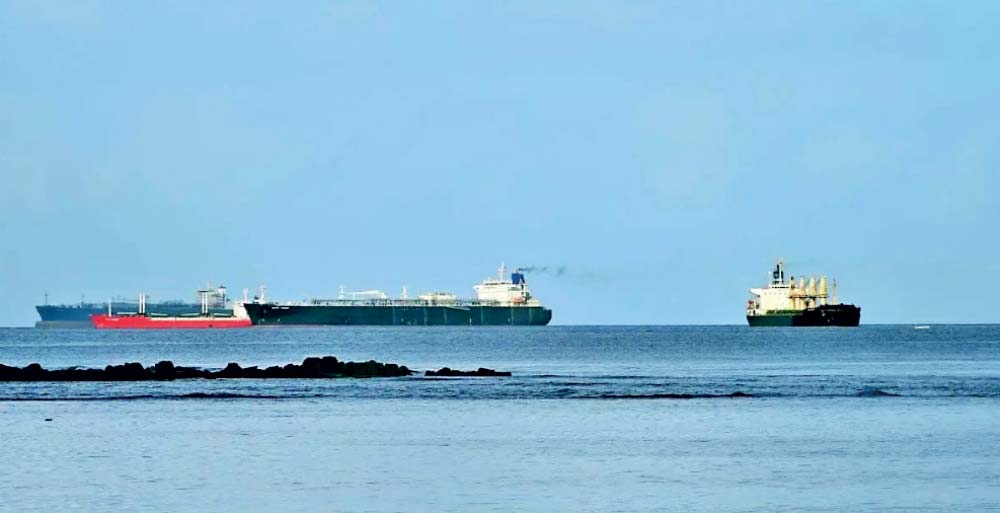
Considerable publicity has recently surrounded Iranian tankers off Sri Lanka’s southern coast, beyond the country’s territorial waters, which are affected by United States sanctions. According to Foreign Minister Vijitha Herath, Iranian authorities have asked Sri Lanka for help providing essential supplies, including food and water. The Minister has said the Government is under no obligation to do so because the vessels are outside Sri Lanka’s territorial waters, and that the private sector normally provides such supplies. He also highlighted that private companies providing services to sanctioned vessels could face US secondary sanctions, potentially lose business dealings with US companies, and may even be shut out of the US banking system.
This situation raises a wider question: what is Sri Lanka legally required to do when a foreign vessel, its owner, operator or cargo is subject to sanctions imposed by another country? The answer requires a clear distinction between United Nations sanctions, Sri Lankan law, US sanctions and Sri Lanka’s obligations under international maritime law.
UN sanctions are not the same as US sanctions
The starting point is that a unilateral US sanction does not automatically become a law binding on Sri Lanka. United Nations Security Council sanctions, however, are different.
Following the invocation of the “snapback” mechanism under Security Council Resolution 2231 on 27 September 2025, the UN Secretariat stated that sanctions contained in earlier Security Council resolutions on Iran had been reinstated. Sri Lanka subsequently issued a notification confirming the re-establishment of the relevant sanctions regime and directing institutions to apply the restrictions set out in Sri Lanka’s United Nations (Sanctions in relation to Iran) Regulations No. 1 of 2018.
Sri Lanka therefore has a domestic legal mechanism for implementing applicable UN sanctions.
The key point is that the mere fact that a vessel is Iranian, Iranian-flagged, Iranian-owned, or carrying Iranian petroleum does not necessarily answer every legal question. The precise status of the vessel, its owner and operator, its cargo, and the transaction or service involved must be established.
The status of the vessel matters
A tanker may be:
These circumstances may have very different legal consequences.
Sri Lankan authorities should therefore avoid a blanket policy of refusing all services to Iranian vessels. Each case should first be examined against the applicable UN sanctions and Sri Lankan implementing legislation.
What does UNCLOS require?
Sri Lanka’s obligations under the United Nations Convention on the Law of the Sea (UNCLOS) are also relevant.
Article 17 recognises the right of ships of all States to innocent passage through the territorial sea. Article 18 permits stopping or anchoring when necessary by force majeure or distress, or for the purpose of rendering assistance to persons, ships or aircraft in danger or distress.
Article 24 places limitations on the coastal State. Sri Lanka must not impede innocent passage except as provided for in UNCLOS, and must not discriminate against ships of a particular State or those carrying cargo to, from, or on behalf of a particular State.
This does not mean that Sri Lanka must provide commercial services to every foreign vessel. Nor does it remove Sri Lanka’s authority over its ports and internal waters. Entry into Sri Lankan ports is subject to substantially greater regulatory control, including lawful conditions imposed by the coastal State.
The important point is that Sri Lanka should be cautious about using its territorial-sea jurisdiction simply to enforce unilateral US sanctions against a foreign vessel.
Commercial services and humanitarian assistance are different
Another important distinction is between ordinary commercial services and assistance required to protect life and maritime safety.
International maritime law does not impose a general obligation on Sri Lanka to supply food and water to every foreign merchant vessel that requests them. If a vessel is simply seeking ordinary commercial provisions, the refusal of a private supplier does not necessarily create a legal obligation for the Sri Lankan Government to intervene.
The situation changes, however, if the lack of food, potable water or other necessities places the crew in genuine distress or creates a serious threat to life or health.
In such circumstances, humanitarian and maritime-safety considerations become significantly more important. Sri Lanka should be prepared to take reasonable steps to facilitate or provide necessary assistance, particularly where there is an immediate danger to life.
This should not be confused with an unrestricted obligation to supply a sanctioned vessel or facilitate its commercial operations.
The problem of US secondary sanctions
This is where the issue becomes particularly difficult for Sri Lankan businesses.
The United States maintains an extensive sanctions regime against Iran. The US Office of Foreign Assets Control (OFAC) makes clear that certain activities by non-US persons can result in sanctions exposure. For example, services such as bunkering for certain Iranian vessels may create sanctions risks for non-US companies.
A Sri Lankan company may therefore lawfully conclude that the commercial consequences of providing a particular service are too severe to justify accepting the business. But that is not the same as concluding that Sri Lankan law prohibits the service.
This distinction is fundamental. The Government should identify what Sri Lankan and UN law requires, while allowing individual companies to assess the additional commercial and financial risks arising from US sanctions.
A Sri Lankan company may choose not to provide a service because it fears losing access to the US financial or commercial system. That is a commercial decision. It should not automatically be presented as an obligation imposed by Sri Lankan law.
What if food and water become a humanitarian emergency?
A more difficult situation could arise if several vessels reported that their stocks of food and potable water were dangerously low, while Sri Lankan suppliers refused to assist because of concerns about US sanctions.
In such a situation, Sri Lanka should distinguish between an ordinary commercial request and a genuine humanitarian emergency.
If credible evidence shows the crew faces serious risks to health or life, Sri Lankan authorities should establish the facts and consider appropriate assistance. In such a situation, they should not assume that the only possible response is to leave the matter entirely to private suppliers.
At the same time, humanitarian assistance should be carefully separated from activities that could facilitate sanctioned commercial trade.
The United States itself has recognised this distinction. OFAC has authorised narrowly defined transactions involving blocked vessels in circumstances involving safe docking, crew health and safety, emergency repairs and environmental protection. Its current licensing policy also recognises risks to life, limb and environmental safety.
If a genuine humanitarian situation involving several vessels arose, Sri Lanka could seek clarification from OFAC or request an appropriate general humanitarian authorisation. Such an arrangement could be narrowly confined to food and potable water necessary for crew health and safety, while excluding cargo operations, bunkering, financial transactions, or other activities facilitating sanctioned trade. Surveillance of vessels and their activities will be essential to determine whether the claims reflect the actual situation, a role for the intelligence arm.
However, US authorisation and Sri Lanka’s international legal obligations are distinct issues. The absence of US authorisation would establish the position under US sanctions law; it would not, by itself, determine Sri Lanka’s obligations under international law or Sri Lankan law. Close liaison with US authorities through diplomatic channels will be essential to seek and obtain special authorisation to address contingencies.
Being outside territorial waters does not end the question
The fact that the vessels are outside Sri Lanka’s territorial sea is legally relevant, but it should not end the responsibility.
A Sri Lankan company does not cease to be a Sri Lankan entity merely because it provides a service offshore. Sri Lanka’s own Iran sanctions framework has addressed Sri Lankan persons and entities in relation to specified transactions and services outside Sri Lankan territory. US sanctions can likewise apply irrespective of the geographical location of a transaction when the relevant conditions are met.
Consequently, providing a service outside Sri Lankan territorial waters may alter the jurisdictional analysis, but it does not automatically eliminate either Sri Lankan legal obligations or US sanctions exposure.
There is also a broader national-security consideration. Sri Lanka should remain vigilant about vessels operating around the island and determine whether reported shortages are genuine. Claims concerning food, water, fuel or other necessities should be independently verified through the appropriate maritime and intelligence authorities.
A practical approach for Sri Lanka
A sensible policy would be to establish a case-by-case procedure before refusing or providing services to a potentially sanctioned vessel. The authorities should establish:
i. Who owns and controls the vessel?
ii. Is the vessel designated under the applicable UN sanctions regime?
iii. Are its owner, operator, charterer or other relevant parties designated?
iv. What service is being requested?
v. Is the service prohibited by Sri Lankan law or an applicable UN sanction?
vi. Does the service involve a Sri Lankan port, agent or company?
vii. Is the service necessary for safety of life, maritime safety or prevention of pollution?
viii. What US sanctions exposure could arise for the Sri Lankan party?
Only after these questions have been addressed should a final decision be taken.
Where a genuine humanitarian emergency appears possible, Sri Lankan authorities should also maintain close diplomatic contact with the United States and, where appropriate, seek advance clarification or authorisation. This would enable Sri Lanka to respond quickly if a situation affecting the health or lives of crews arises.
Conclusion
Sri Lanka need not choose between two extremes: either disregarding international sanctions or automatically enforcing every unilateral sanction imposed by another State.
The legally and strategically sound approach is to fully comply with applicable Security Council sanctions and Sri Lankan implementing legislation, while respecting Sri Lanka’s rights and obligations under international maritime law.
At the same time, Sri Lanka must recognise that US secondary sanctions can pose substantial commercial and financial risks for Sri Lankan companies, even when a particular transaction is not prohibited under Sri Lankan law.
The objective should therefore be neither to facilitate sanctions evasion nor to surrender Sri Lanka’s lawful regulatory space.
Each case should be determined by the applicable UN sanctions, Sri Lankan law, UNCLOS, the vessel’s status and cargo, the nature of the requested service, humanitarian and maritime-safety considerations, and the legitimate commercial consequences for the Sri Lankan party.
Such an approach would place Sri Lanka in a principled and defensible position: full compliance with its international obligations, the protection of maritime safety and humanitarian interests, and the preservation of its sovereign right to determine how Sri Lankan law is applied.




