Friday Mar 13, 2026
Friday Mar 13, 2026
Wednesday, 28 January 2026 00:20 - - {{hitsCtrl.values.hits}}
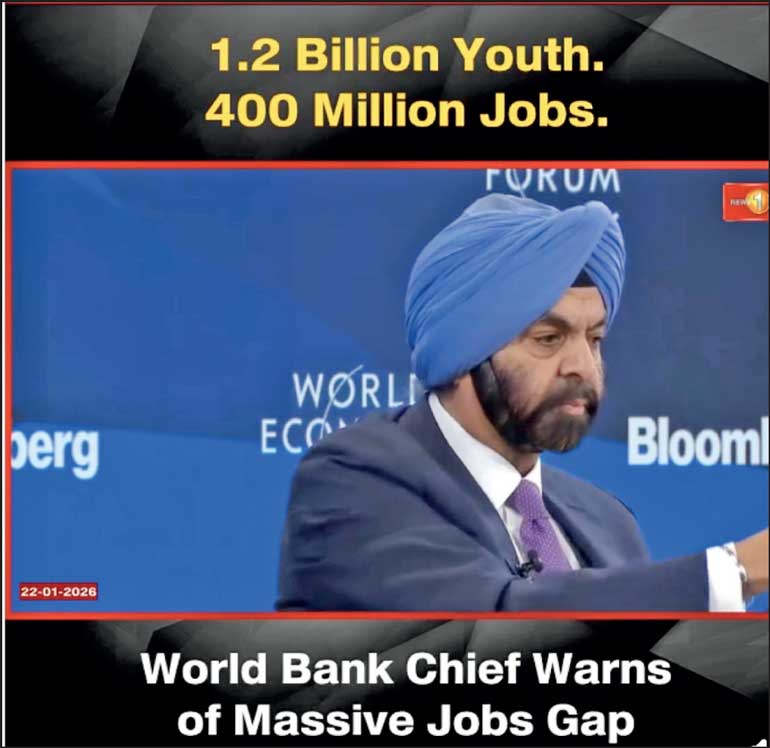
World Bank President Ajay Banga
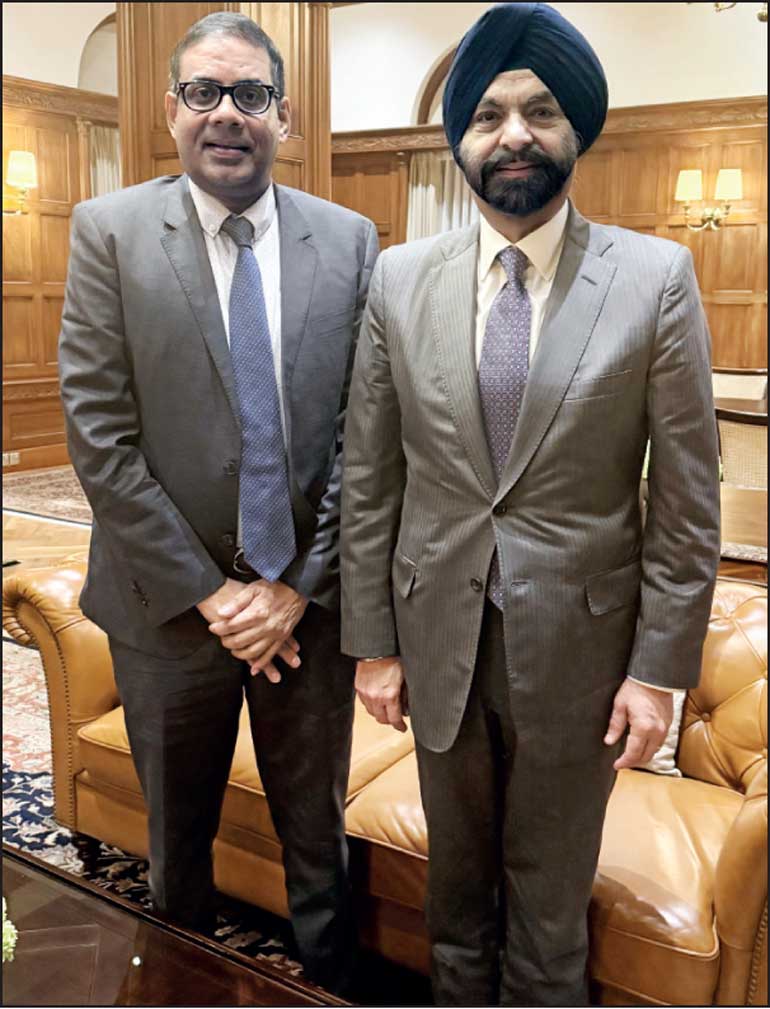
The writer with the World
Bank President
 At the World Economic Forum in Davos this year, World Bank President Ajay Banga issued a blunt warning: the global economy is heading toward a structural labour market crisis. Over the next decade, billions of young people will enter the workforce, but far fewer quality jobs will be created. Without urgent investment in skills and job creation, this imbalance threatens growth, competitiveness, and social stability. Sri Lanka does not need Davos to recognise this danger. The crisis Banga described is already unfolding at home.
Nearly one million young Sri Lankans are expected to enter the workforce over the next decade. Yet, unless decisive action is taken, the economy will not generate enough productive, well-paying jobs to absorb them. The result is a growing pool of educated but unemployed youth — a warning sign no country can afford to ignore.
This is not a failure of aspiration or intelligence. Sri Lanka has one of South Asia’s most educated youth populations. The real problem is a structural mismatch between what our education system produces and what the economy actually needs. Employers across sectors — from tourism and logistics to technology and healthcare — consistently report shortages of job-ready skills. Degrees abound; employability does not.
Human Capital Report
The Sri Lanka Human Capital Summit 2024 put this issue into sharp focus. It underscored the urgent need to move beyond ‘credentialism’ towards practical, industry-aligned skills. Vocational training, apprenticeships, hands-on learning, and continuous reskilling must replace outdated assumptions that academic qualifications alone guarantee employment. The challenge is further compounded by brain drain. As opportunities stagnate at home, skilled professionals continue to leave, shrinking the domestic talent pool and weakening productivity. At the same time, critical sectors such as tourism — a major foreign exchange earner — struggle to find trained personnel in service quality, management, and operations. This paradox of unemployment alongside skills shortages reflects a system badly out of alignment.
 AI Impact
Technology is accelerating the urgency. Fast-growing fields such as information technology, artificial intelligence, healthcare, and modern services demand adaptable, digitally literate workers. Yet these competencies remain peripheral rather than central to curricula. Without reform, Sri Lanka risks training its youth for jobs that no longer exist. The Human Capital Summit report rightly called for stronger start-up ecosystems, innovation hubs, and practical learning models to retain talent and attract investment. But these initiatives cannot remain isolated pilots. They must be embedded within a national economic strategy that treats skills as infrastructure — as critical as ports, roads, and power.
Way forward
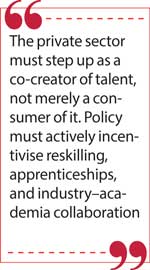
The way forward is clear, though not easy. Government, the private sector, and educational institutions must act together. Education reform must prioritise digital skills, STEM disciplines, multilingual communication, and lifelong learning. While we recognise Prime Minister and Education Minister Dr. Harini Amarasuriya’s point on the role of women in homecare and elderly care, targeted skills upgrading can significantly improve both care outcomes and livelihood returns. The private sector must step up as a co-creator of talent, not merely a consumer of it. Policy must actively incentivise reskilling, apprenticeships, and industry–academia collaboration. Sri Lanka’s strategic location offers opportunity, but geography alone will not secure prosperity. Talent will. If the country fails to skill, deploy, and retain its workforce, growth will remain fragile and inequality will deepen. This is not a long-term problem to be deferred. It is an economic emergency demanding immediate action. As Ajay Banga noted in Davos, timely decisions today determine whether tomorrow’s workforce becomes a demographic dividend or a destabilising liability.
References
https://nhrdc.gov.lk/nhrdc/index.php/publications/sri-lanka-human-capital-summit-report-2024
https://timesofindia.indiatimes.com/videos/news/ajay-banga-nilekani-warn-of-global-jobs-crunch-as-1-2-billion-youth-chase-just-400-million-jobs/videoshow/127391160.cms
https://www.worldbank.org/en/news/feature/2025/08/07/higher-education-reforms-clearherpath-to-skills-and-jobs-in-sri-lanka
https://www.ft.lk/opinion/“Despite-all-our-pleading-for-change-in-labour-laws--nothing-has-changed-for-the-better”/14-673731




