Thursday Oct 22, 2026
Thursday Oct 22, 2026
Saturday, 22 August 2026 02:59 - - {{hitsCtrl.values.hits}}
 Sri Lanka has been reclassified as an upper-middle-income economy by the World Bank Group, according to its latest country income classifications released on 1 July 2026. This marks a significant turning point in the country’s economic recovery. This article is all about the arduous journey the country went through to achieve this status since independence and future challenges.
Security apparatus In Sri Lanka after Independence
Prime Minister D.S. Senanayake, who was regarded as the father of the nation, having led the country to a peaceful transition of power from the British to the locals, wisely got into a defence pact with the British.
While Britain agreed to provide external security and military training for local armed forces under this pact the Government of Ceylon (GOC) granted the British Government to keep control of key military locations, such as the naval base at Trincomalee and the air base at Katunayake.
GOC took over a British trained police force and the specialised bodies like the Criminal Investigation Department (CID) to look after internal security.
British also agreed to help establishing and training the personnel for newly formed Ceylon Army under the Army Act in October 1949; the Royal Ceylon Air Force (RCyAF) that was founded on 2 March 1951, under the Air Force Act No. 41 of 1949; and the Royal Ceylon Navy (RCyN) that was founded on 9 December 1950, following the enactment of the Navy Act.
With this security apparatus in place, Ceylon was in the best position to attract FDIs compared to many other countries in South and Southeast Asia. Investors look for political stability, safe environments, and protected property rights before they spend money. FDIs not only provide capital but also provide industrial modernisation and technological transfer and develop skills, both in terms of labour and managerial.
 Sri Lanka should make use of opportunities available in India’s fast-growing economy
This was also the era when science and technology, which had revolutionised the lives of Europeans, North Americans and Japanese, were spreading to other parts of the world. Underdeveloped countries could acquire know-how through Foreign Direct Investment (FDI), especially if they had strong security institutions.
The tragic death of D.S. Senanayake on 22 March 1952, after a horse-riding accident at Galle Face Green, marked the end of an era of relative political consensus and triggered an immediate succession crisis.
Governor-General Lord Soulbury appointed Dudley Senanayake (Dudley) as Prime Minister to succeed his father on 26 March 1952. When criticised by leftists and others for not being an elected Prime Minister, he dissolved Parliament and called for elections. His party, the United National Party (UNP), won the election comfortably, securing 54 of 95 seats, and he became Prime Minister for the second time.
The Hartal 1953 (First Aragalaya in Sri Lanka)
Following the post-Korean War economic slump, Ceylon faced severe financial distress. Finance Minister J.R. Jayewardene introduced a harsh budget on 23 July 1953 that abolished the state subsidy on rice, overnight tripling the price of the national staple.
On the same day a large public gathering was organised at Galle Face Green by opposition parties. This was led by S. W. R. D. Bandaranaike (SWRD), the Leader of the Opposition. The leftist leaders organised a mass protest or “Hartal” on 12 August 1953. This was one of the largest political mass protests in Sri Lankan history and could be considered as the first “Aragalaya.” The Leftist parties called for a nationwide shutdown. People were urged to close shops and markets, halt public transportation, and stay home from work. Large sections of the population, including workers, farmers, transport employees, students, and fishermen, joined. In many areas, police and demonstrators clashed, and at least ten people were killed.
Dudley Senanayake resigned, and Colonel Sir John Kotelawala who was widely considered a very tough, fearless, and blunt character took over as prime minister.
The primary political beneficiary of the Historic 1953 “Hartal”
Sri Lanka experienced one of its most significant political shifts in 1956. S.W.R.D.Bandaranike ran on a platform emphasising the rights and cultural revival of the Sinhala Buddhist majority. This resonated with rural voters and Buddhist monks, helping his party Mahajana Exath Peramuna (MEP) secure a landslide victory.
Bandaranaike and his Government did not recognise the importance of a strong security system for economic development and decided to dismantle the last visible symbols of colonial control by removing the two British military bases in Sri Lanka in 1957.
 There is another area the Government should address to avoid MIT. This involves controlling and eliminating crony capitalism, which has gradually emerged since the introduction of the open economy and has worsened significantly since the end of the civil war. If unchecked political favouritism and rent-seeking distort free-market policies, they would drain state resources, leading to a severe financial and governance crisis
To reduce reliance on imports, his Government promoted import-substitution industries such as handloom textiles, small-scale manufacturing, and cottage industries. His overarching theme was to promote “economic nationalism” aligned with “cultural nationalism.”
Foreign investors seeking investment opportunities soon looked beyond Sri Lanka and moved to countries with professional defence forces, often protected by the USA or Britain.
Admiration of Ceylon by father of Singapore Lee Kuan Yew
Often, Singapore and Sri Lanka are paired in political debates when analysing Sri Lanka’s economic development failures. In my opinion, a better comparison is Taiwan. Singapore is only a city-state, half the size of Colombo. Another misnomer is that Lee Kuan Yew modelled his country on Sri Lanka (then Ceylon). No, Lee Kuan Yew did not model Singapore on Ceylon or Colombo. While he greatly admired Ceylon in the 1950s for its infrastructure and wealth, he studied its post-independence trajectory as a cautionary example, noting how internal strife and political missteps caused the country to squander its early advantages.
Taiwan or the Republic of China provides a better comparison for the economy of our country.
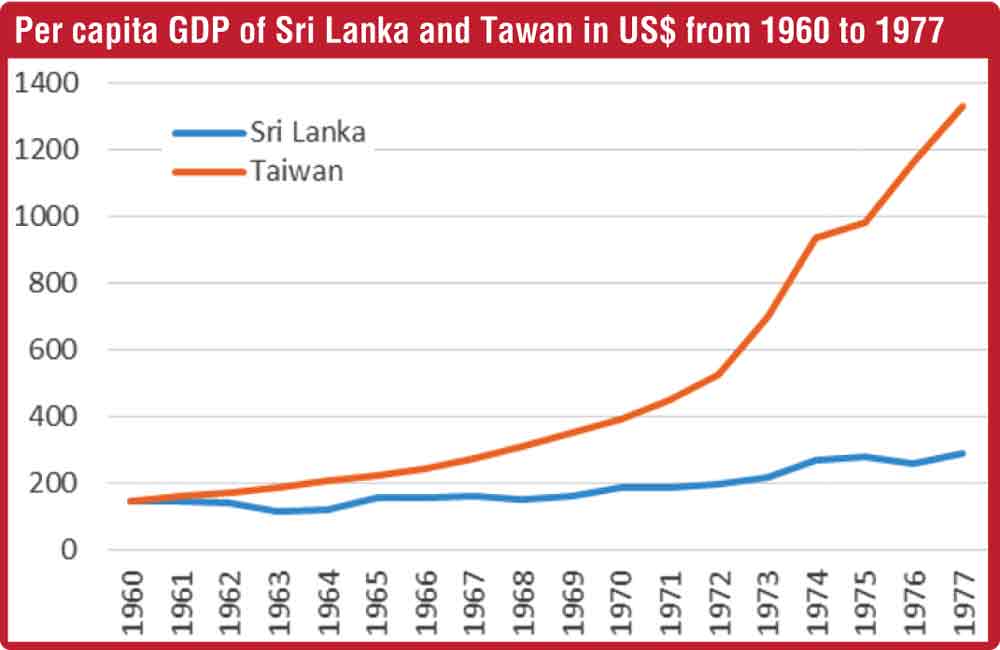
Taiwan and Sri Lanka were agrarian societies with large rural populations and comparable population sizes. In 1960 Sri Lanka's per capita GDP was $152, and Taiwan's was $149. Sri Lanka had a population of little less than 10 million and Taiwan 10.8 million in 1960. Singapore had a population of 1.6 million in the same year. While Sri Lanka has a land area of 67,240 km², Taiwan has 36,197 km². Singapore's land area was approximately 581.5 km² and population was 1.6 million in 1960.
Like Sri Lanka, Taiwan also pursued a system of import-substitution industrialisation in the early to mid-1950s. This led to a chronic shortage of foreign exchange and stagnant growth.
Let us examine per capita GDP growth from 1960 to 1977, the year Sri Lanka launched an open-market economic model.
Examination of the graph makes it clear that Taiwan’s economic growth was faster than Sri Lanka’s. The main reason is that, starting in the early 1960s, Taiwan shifted from import substitution to aggressively promoting exports, creating specialised export processing zones to attract foreign investment and technology. Sri Lanka largely maintained inward-looking policies and restrictive trade regulations.
Taiwan entered into a defence treaty with the United States on 2 December 1954, mainly to ensure protection from a communist invasion by the People's Republic of China (PRC). This "security umbrella" drastically reduced geopolitical risk for international businesses. This political stability laid the foundation for the "Taiwan Economic Miracle" by attracting FDIs.
Taiwan provides a proven blueprint for transitioning from an export-dependent agricultural economy into a global high-tech and manufacturing powerhouse.
Introduction of Open Economy in Sri Lanka
Sri Lanka’s politics from 1960 to 1977 swung back and forth between two main parties: the socialist-leaning Sri Lanka Freedom Party (SLFP) and the right-of-centre UNP.
In 1962 there was a coup attempt by the Westernised, Christian elite in the military and police who were alarmed by the country's leftward shift and rising Sinhala-Buddhist nationalism under Prime Minister Sirimavo Bandaranaike's Government.
This era featured alternating election victories, intensifying Sinhala nationalism, closed-economy controls, and a rising youth rebellion that set the stage for a total economic and constitutional reversal in 1977.
Sri Lanka elected a new Government under the leadership of J.R. Jayewardene (JRJ) in July 1977. He launched a radical policy that dismantled trade protections, opened the country to foreign capital, and encouraged private enterprise.
In July 1977, the GDP per capita was $292.15, and it dropped to $191 in 1978 largely due to changes in the exchange rate following the liberalisation of the Sri Lankan economy, rather than a sudden fall in real production or living standards. By this time, Taiwan's per capita GDP had risen to $1,331.
The JRJ Government embarked on a massive national development program. He decided to accelerate the Mahaweli Project to rapidly achieve national self-sufficiency in food, solve severe rural unemployment, and generate immediate hydroelectricity. He compressed the original 30-year phased master plan into just 5-7 years by building multiple dams simultaneously using international aid.
The international community viewed Sri Lanka's 1977 economic opening as a bold, pioneering move, making it the first South Asian country to shift from a closed, welfare-oriented system to an export-led, market economy. The World Bank, and Western donor countries strongly supported the new policies, providing critical balance-of-payments support and long-term credit.
The IMF approved a one-year stand-by arrangement of Special Drawing Right (SDR) 93 million for Sri Lanka in December 1977 to support sweeping market-oriented reforms undertaken by the new Government. This loan acted as a bridge to steady balance-of-payments issues. In 1979 an Extended Fund Facility (EFF) of $ 317 was provided for long-term structural adjustments, cutting food/fertiliser subsidies, and promoting private export infrastructure.
The Accelerated Mahaweli Scheme built multi-purpose dams that permanently solved the country's immediate power shortages and opened up vast dry zones for domestic rice production. By physically relocating over 140,000 of the "poorest of the poor" families from congested out-of-boundary districts (such as Kegalle, Kandy, and Matara), the program relieved systemic land pressure, reduced local unemployment, and eased the strain on social services in those non-Mahaweli regions.
The massive infusion of concessionary funds into the Accelerated Mahaweli Program (AMP) significantly improved the standard of living outside the immediate Mahaweli settlement boundaries.
JRJ also introduced Free Trade Zones (FTZs) in 1978 as part of his "Open Economy" policy to transition Sri Lanka away from decades of closed, state-controlled socialist economic models. By launching the first flagship zone in Katunayake, he aimed to attract FDI. Initially, light manufacturing industries, such as garment factories, were established when newly industrialised economies (NIEs) like Singapore, Taiwan, South Korea, and Hong Kong were seeking destinations to relocate their factories. They needed only cheap, trainable labour. Sri Lankan workers in lower-level technical and managerial jobs soon acquired the know-how. This helped the second Executive President, R. Premadasa, launched his 200-garment-factory program to take industries to the village in 1990.
How the economy progressed since introduction of Open Economy in 1977
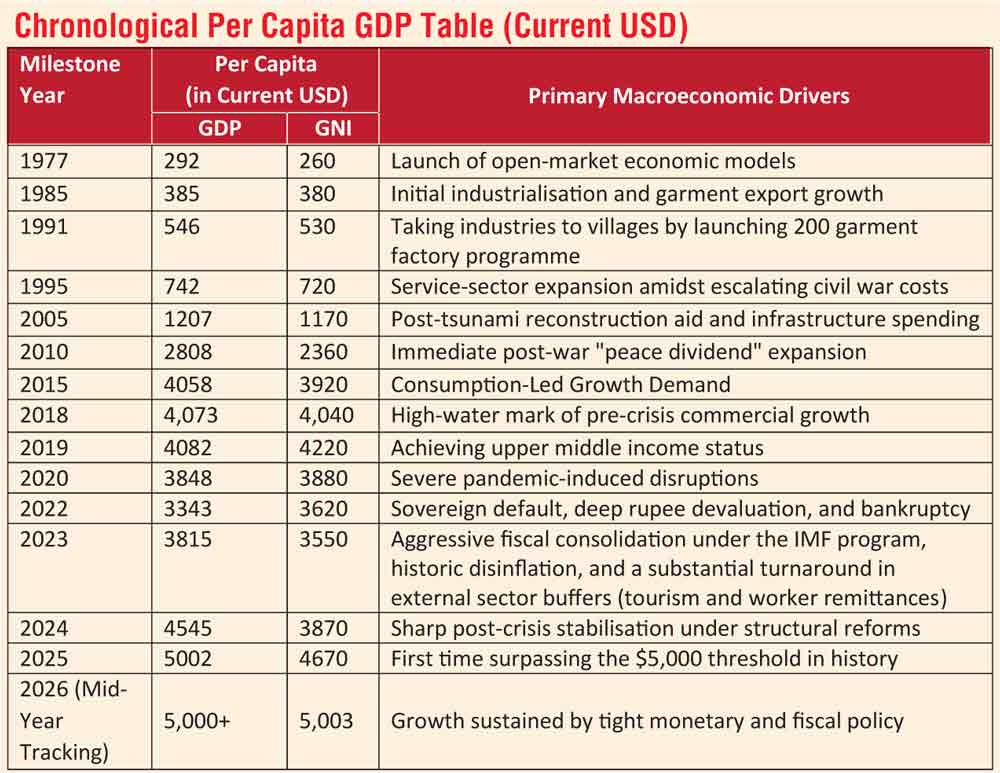
The data below represents historical records compiled by using the published World Bank Data Bank information. (While both are on current US$ basis GNI per capita is on Atlas method.)
The successive Sri Lankan Governments from Chandrika Bandaranaike Kumaratunga (1994) to the present Anura Kumara Dissanayake (AKD) did not try to abolish or fundamentally reverse the open economic system. While various administrations shifted away from pure free-market capitalism toward state-led development or protectionism, none attempted to return to the strict, inward-looking, closed socialist economy of the pre-1977 era. Instead, each leader adapted the existing framework through different ideological lenses.
In July 2026, the World Bank reclassified Sri Lanka as an upper-middle-income economy following a 5% real GDP growth in 2025 and an increase in Gross National Income (GNI) per capita to $4,670. However, local and international economists note that the country bypassed the threshold by a very thin margin, making its position highly fragile. Sri Lanka achieved upper-middle-income status once before in 2019, only to lose it a year later before cascading into the severe 2022 sovereign default and bankruptcy, the country's worst economic collapse since independence. In the meantime Taiwan achieved a per capita GNI of $33,565 in 2022.
This resulted in the historic second “Aragalaya.” Sri Lankans earned widespread global respect during this period through several remarkable actions using largely peaceful protests, art, and unity to demand governance reforms and accountability.
However Sri Lanka stabilised its catastrophic 2022 economic collapse through a $2.9 billion IMF bailout, aggressive tax hikes, and foreign debt restructuring and went on to return to “Middle Income Status” that they lost.
Sri Lanka: Avoiding the Middle Income Trap
Sri Lanka is losing its competitive edge in low-cost manufacturing, mainly because of the higher cost of living and rising living standards. To avoid the MIT and move sustainably toward high-income status, the Government and private sector must implement critical structural reforms.
For example, aggressively expand the ICT, software, and Business Process Management (BPM) industries to generate high-paying jobs for educated youth; realign university curricula toward STEM (Science, Technology, Engineering, and Math) fields to match global technological demands; reduce the public debt load (which still hovers near 100% of GDP) to free up state funds for critical infrastructure, social safety nets, and public R&D investment; and build deeper global supply chain linkages beyond textiles, moving into high-tech industrial assembly and advanced logistics.
The strategy for Sri Lanka’s fourth economic transformation was outlined by the Lanka India Business Association (LIBA) President Santosh Menon in a recent interview. The first three economic revolutions or transformations were launched in 1978 by JRJ, in 1990 by R. Premadasa, and after the end of the war in 2009 by Mahinda Rajapaksa.
Conclusion
I believe Sri Lanka should make use of opportunities available in India’s fast-growing economy as suggested by Santosh. That prescription will also avoid the MIT.
There is another area the Government should address to avoid MIT. This involves controlling and eliminating crony capitalism, which has gradually emerged since the introduction of the open economy and has worsened significantly since the end of the civil war. If unchecked political favouritism and rent-seeking distort free-market policies, they would drain state resources, leading to a severe financial and governance crisis.
(The writer can be contacted on [email protected])




