Saturday Nov 14, 2026
Saturday Nov 14, 2026
Saturday, 14 November 2026 00:00 - - {{hitsCtrl.values.hits}}
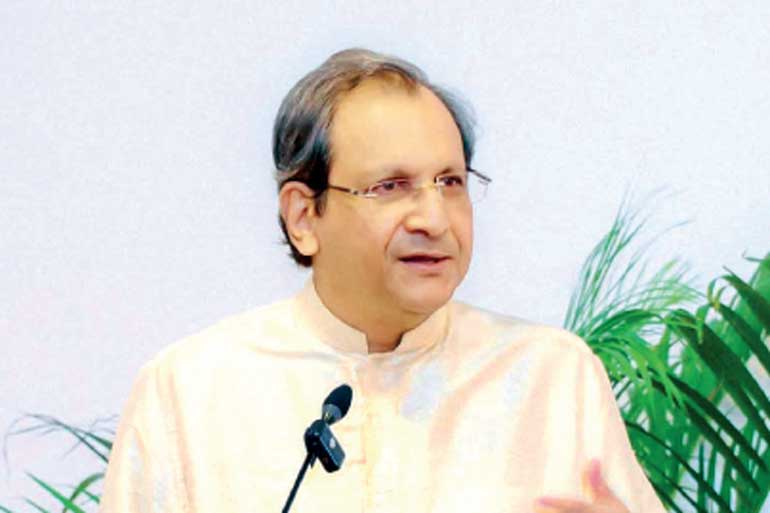
Former Foreign Secretary Ambassador Ravinatha Aryasinha
Former Foreign Secretary Ambassador Ravinatha Aryasinha has said the 21st Century paradoxes Sri Lanka’s foreign policy faces—regional geo-politics, economic development and human rights accountability—cannot be resolved simply by responding individually to satisfying the competing ‘zero-sum’ demands made by major powers, but required addressing the underlying weaknesses that have made Sri Lanka vulnerable to such external pressures in the first place.
He said, “Our strategic location should be an asset, not a source of perpetual uncertainty; our economic relationships should generate opportunities for sustainable growth, rather than deepen existing vulnerabilities; and our engagement with the international organisations should be guided by a consistent commitment to international law, rather than playing along ambiguously. This calls for a foreign policy that is informed by a broader national consensus, supported by effective institutional safeguards, and implemented through a professional diplomatic service”.
Amb. Aryasinha, who is presently the Executive Director of the Regional Centre for Strategic Studies (RCSS), made these observations when he delivered the 2026 ‘Gamani Corea Memorial Lecture’ on the theme The Paradoxes of Sri Lanka’s Foreign Policy in the 21st Century on 4 November 2026 at the BCIS in Colombo, amidst a representative gathering comprising serving and retired public figures, diplomats, entrepreneurs, academics, civil society, media and students.
Opening the event, Gamani Corea Foundation (GCF) Chairman Dr. Harsha Athurupana said the memorial lecture honoured Dr. Gamani Corea, the distinguished Sri Lankan economist and former Secretary General of UNCTAD, and noted that the GCF supports scholarly research through grants, collaborates with Universities and Institutions Dr. Corea was connected to, and also the ‘Freeda Corea Awards’ - named after his mother, supports disadvantaged women who are engaged in initiatives that enriched their communities. The speaker was introduced by GCF Board of Management Member Manjula de Silva.
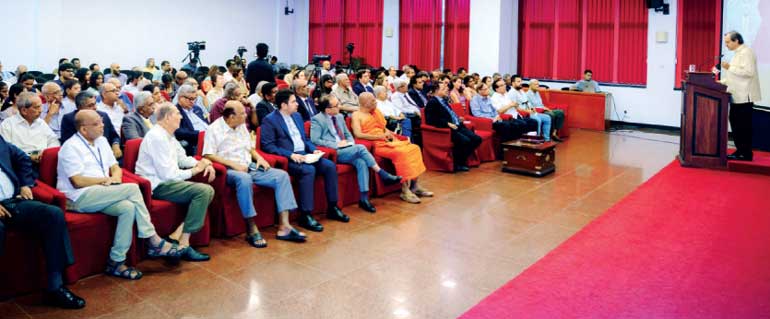
Amb. Aryasinha commencing the lecture, said “Dr. Corea’s contribution to international economic diplomacy was rooted in the conviction that developing countries, including smaller states, need not simply accept the terms of an international order shaped by others. Through the strength of his ideas, his diplomatic engagement and his work in institutions such as UNCTAD and the South Centre, he helped give collective expression to the concerns of developing countries and advance the case for a more equitable international economic system.”
In his address, Amb. Aryasinha observed that Sri Lanka’s foreign policy ever since independence was replete with paradoxes, but they were consciously faced head-on, straddled with, and to a considerable extent overcome. Despite Prime Minister D.S. Senanayaka in 1947 signing Defence and Foreign Affairs agreements with the British, UNP administrations resisted western colonialism, opposed war reparations on Japan, and went on to sign the Sino-Lanka Rubber Rice Pact. Prime Minister Sirimavo Bandaranaike a founding leader of the NAM in 1961, also demonstrated scrupulous objectivity between the West and the East. President J.R. Jayewardene though adopting the western neo-liberal economic model in 1977, nevertheless proclaimed that “non-alignment runs like a golden thread through the fabric of our country’s foreign policy”.
In juxtaposition, he said 21st Century Sri Lanka foreign policy, particularly post-2009, has lacked conceptual clarity, with contrasting ‘foreign policy postures’ adopted by alternate political administrations, with paradoxes often leading to crisis.
Regional geo-politics
He said the first paradox with respect to regional geo-politics, was that Sri Lanka’s location is both its greatest asset and its greatest risk – the more the major powers value it, the less room Sri Lanka has to choose freely. Resisting the “Zero-sum” environment Sri Lanka had been placed in, proved to be the ‘crucial test’ to Sri Lanka’s foreign policy making. Notwithstanding the material losses and emotional strain that had to be endured by the Sri Lankan polity, the IMF Extended Fund Facility (EFF) of 2022/23, provided a positive disruption in arresting this trend, albeit temporarily, as all competing powers had to come together, allowing Sri Lanka foreign policy - from ‘pendulum swinging’ to return to the centre. Sri Lanka presently stands at a crossroads, with the “strategic space” nearing its end in March 2027 and GOSL’s call whether to continue with the IMF, and if so, under what terms - no doubt a complex economic issue which requires close study, also has profound foreign policy implications. He said he sensed that the jostling for position has already begun, and that any who encourage that Sri Lanka returns to behaviour tantamount to bandwagoning with one single power - who ever that may be, are doing a grave disservice not only to Sri Lanka, but also to their preferred country, others who are over-looked, and also to a host of traditional friends, middle powers and regional blocks.
Economic development
The Second paradox he drew attention to was Sri Lanka’s long standing quest for economic development - thwarted initially by the 30 year separatist conflict, and in the immediate post-conflict period had a more competitive environment prevailed Sri Lanka may well have avoided some of the strategic mistakes and other difficulties it was to face in subsequent years. Today, while acknowledging the resilience the economy has shown amidst severe internal and external shocks—from Ditwah to the on-going war in the Middle East, and despite the anti-corruption emphasis and lessening of the diplomatic temperature - global markets are not opening up to Sri Lanka and international investors are not knocking on our door as expected. He said, structural barriers make the Sri Lankan economy uncompetitive, and it has also failed to increase export revenue, diversify its export basket and export markets adequately. According to the recent EBD Report of the first 3 quarters of 2026, while exports to India and China are up - 12% and 16% respectively, exports to our largest single market - the United States remained flat, and shipments to the UK have dropped by over 9%. While much hope had been placed on the Regional Comprehensive Economic Partnership (RCEP) to which Sri Lanka’s application for membership is pending since 2023, the region’s share in Sri Lanka’s trade, services and investment portfolio remained low. He said Sri Lanka’s Western partners could also help trade, investment and tourism flows by improving the ‘OECD Risk Rating’ on Sri Lanka which since 2021 remains at 7 - the highest possible, and also through more favourable travel advisories.
Human rights
The third paradox of concern was human rights accountability, where getting the balance right in protecting human rights, while fighting terrorism/violent extremism has been a challenge in modern times. He noted that while Sri Lanka had adopted postures of compromise, collaboration, and confrontation in the past, currently the paradox lies in the fact that the posture adopted in the HRC by Sri Lanka since 2024 can at best be described as one of ambiguity - opposing the Sri Lanka Accountability Project (SLAP) in its statements in the HRC, but being unwilling to challenge it and permitting it to be passed unopposed. Additionally, in parallel asking the HRC to do away with the ‘Çountry Specific Mandate’ targeting Sri Lanka, while the High Commissioner for Human Rights (HCHR) insists that an international mechanism is vital for confidence building of the victims, but unwilling to share the OHCHR findings. Whether the driving factor in this is Norms, Laws, or Power Politics is hotly contested the world over - and clearly evidenced in Sri Lanka, with many - including most victims on all sides, seeing it as the latter.
Amb. Aryasinha, who served as Sri Lanka’s Permanent Representative to the UN (2012-2018), noted that once placed on the HRC agenda, there was no transparent objective criteria for moving out of it, which remains a serious lacuna in contemporary human rights governance. This suggests that often being allowed to move from a confrontational to a conciliatory path has largely been for collateral purposes, rather than due to any genuine improvements perceived or achieved in country’s human rights record. If one is serious in seeking sustainable approaches to addressing human rights issues in the HRC, he said it would be reasonable to demand a realistic ‘sufficiency threshold of delivery’, as opposed to the current imprecise and changing demands being made by the multitude of external actors.
Ambassador Aryasinha said straddling and overcoming these paradoxes, calls for a foreign policy that is informed by a broader national consensus, supported by effective institutional safeguards, and implemented through a professional diplomatic service capable of anticipating developments rather than merely reacting to them. It also requires us to look beyond the immediate calculations of major-power relations, to cultivate partnerships with middle powers and regional groupings, and to make fuller use of multilateral institutions in advancing issues of common interest. Above all, Sri Lanka must recover the capacity to articulate what it seeks from the world, and to pursue those objectives with consistency, credibility and purpose. It is in this respect that the example of Dr. Gamani Corea remains so relevant.




