Monday Nov 16, 2026
Monday Nov 16, 2026
Monday, 16 November 2026 03:44 - - {{hitsCtrl.values.hits}}
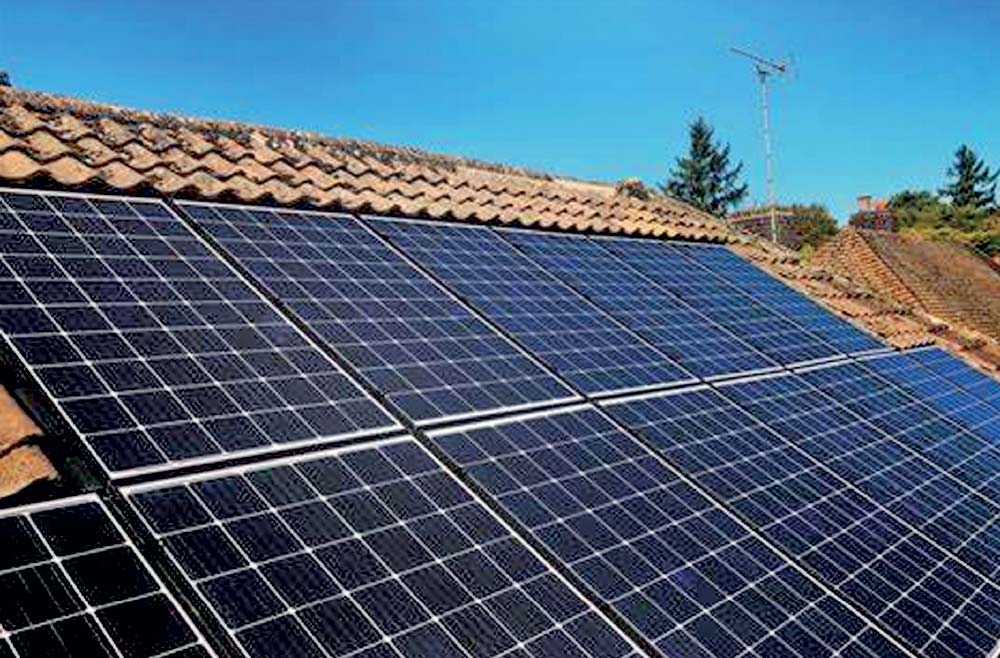
 By protecting citizen-led rooftop solar and investing in storage and grid modernisation, not only can the country reduce its dependence on imported fossil fuels and move toward energy security but also drive the much-needed equal wealth distribution that the Government touts is the foundation of prosperity. Not only the elected officials, but we, the public, also have a responsibility to ensure that administrative institutions implement democratic policy for the good of the country rather than obstructing it with ulterior motives
By Prof. Emeritus I. M. Dharmadasa, Brig. Ranjan de Silva, Eng. Vidhura Ralapanawe, and Dr. Geewananda Gunawardane
Democratic governments depend on a professional civil service to turn laws and policy goals into sustained public action. Because bureaucrats exercise substantial influence without being directly accountable to voters, tension can arise when administrative decisions diverge from elected priorities or the public interest, a problem often described as the “democratic dilemma”. Sri Lanka’s electricity sector provides a consequential example, particularly in the treatment of renewable energy and citizen-funded rooftop solar.
Drawing on four decades of experience in renewable-energy research and commercialisation, we offer these observations to the President and the public in the hope that Sri Lanka can resolve the democratic dilemma in favor of economic and social progress. A capable bureaucracy is essential to maintaining beneficial policies through frequent changes in political leadership. Sri Lanka has a clear path to energy independence, the foundation of the prosperity this Government promised, yet bureaucratic obstruction continues to slow progress. This article examines whether that failure arises from gaps in knowledge, institutional capacity, or accountability, and what must change to protect the public interest.
Three decades of resistance to renewables
While researching solar-energy conversion in UK academia and working on solar commercialisation at the British Petroleum Company, one author, IMD, concluded that the technology was mature enough to support social development. As a professor at Sheffield Hallam University, he secured funding from the UK Department for International Development to establish a Higher Education Link (HE-Link) with Sri Lanka. Launched in 1992, the program brought together the universities of Peradeniya, Colombo, Moratuwa, Kelaniya, Jaffna, and Ruhuna along with relevant industries. The British Council managed the project, while IMD coordinated it for six years and facilitated more than 35 visits by senior academics between Sri Lanka and the UK. Its goals were to strengthen collaboration among Sri Lankan universities in solar-energy research, promote clean energy for sustainable development, reduce poverty, translate political freedom, however belatedly, into economic freedom, and mitigate climate change.
During the program’s six years, the British Council, the British High Commission in Colombo, and the Ministry of Science and Technology organised high-profile conferences. IMD also promoted renewable energy directly with nearly every science and technology minister from Bernard Soysa onward, as well as two former presidents. From 2002 to 2004, while Milinda Moragoda served as Minister of Economic Reform, Science and Technology, IMD joined an expatriate scientist exchange program to advance solar-energy research and development. The collaboration involved the ministry, the Ceylon Institute of Scientific and Industrial Research (now ITI), the National Engineering Research and Development (NERD) Centre, and Sri Lankan universities.
Institutional resistance to solar-energy development emerged during these high-level discussions. At one conference, the consortium invited the Ceylon Electricity Board (CEB) to present its national energy plans. Senior policymaker Shavi Fernando delivered a PowerPoint presentation whose concluding slide, projecting rapidly increasing demand, stated: “The future of Sri Lanka is coal, coal, and coal.”
Dr Tilak Siyambalapitiya, later Chairman of CEB, also expressed opposition to renewables on many occasions. Our esteemed academic and industrial consortium members found these positions troubling because available scientific evidence indicated that Sri Lanka could achieve energy independence by properly developing its natural resources. In the authors’ view, the Energy Circular PE/DEV/03/01-RT, issued on 11 September 2026, shows that this “democratic dilemma” persists despite the current Government’s stated intentions and its structural and personnel changes.
Rise of rooftop solar and recent setbacks
Despite successive governments’ limited promotion of solar energy, the introduction of Soorya Bala Sangramaya in 2016 marked an important advance. Its net-metering, net-accounting, net-plus, and net-plus-plus schemes enabled entrepreneurs and households to expand rooftop generation. According to the Public Utilities Commission of Sri Lanka’s (PUCSL) December 2025 report, the country had 129,300 to 150,000 rooftop solar connections, representing about 1940 MW to 2,090 MW of installed capacity. Nearly 1,000 solar photovoltaic companies now support about 40,000 skilled jobs. Notably, this expansion was financed by private citizens rather than the Government.
We welcome the current Government’s support for battery installation, an approach the CEB neglected for three decades. Batteries can store surplus daytime solar generation for nighttime use, reducing reliance on exceptionally costly diesel power. The Cabinet’s approval of a $ 35 million ADB financing package for a nationwide rooftop-solar project is also encouraging. These initiatives should be aligned with policies that preserve, rather than restrict, citizen participation in rooftop generation.
The 2025 PUCSL report identifies practical measures for integrating more rooftop solar, including formal connection standards, improved monitoring, advanced inverter functions, and battery storage. The following excerpt shows that the regulator treats higher distributed generation as a challenge to be managed through technical rules and grid visibility, rather than as a reason to halt rooftop-solar expansion:
“As rooftop solar penetration grows, utilities must be guided by formalised grid connection codes and operational guidelines that define the minimum technical and service requirements for connecting rooftop systems. These should include standardised inverter settings, metering configurations, voltage regulation practices, feeder hosting capacity assessment procedures, and time-bound service delivery commitments. Establishing and enforcing such utility-level requirements will help reduce consumer complaints, minimise operational issues such as inverter tripping and voltage rise, and improve the overall quality and performance of rooftop systems.
Furthermore, as distributed generation continues to expand, improving real-time visibility and controllability of rooftop PV systems will be essential for national system stability. The integration of battery storage, advanced inverter functions, and monitoring systems will support this transition by enabling better management of mid-day surplus generation and reducing the operational burden on the national grid.”
Many CEB engineers support renewable energy, yet senior decision makers appear to discount their views while continuing to favor imported, polluting fossil fuels. Without transparent, evidence-based explanations, this pattern suggests that longstanding bureaucratic resistance persists despite restructuring and personnel changes, the “democratic dilemma” in practice. Authorities commonly argue that accommodating more rooftop solar would require a $ 4-5 billion grid upgrade taking 7–12 years or longer. Because the basis and alternatives behind that estimate have not been publicly explained here, it should be independently examined rather than treated as conclusive.
Public conundrum
When a people’s Government elected on the platform of taking power away from the entrenched elite and ensuring public good acts against its own policies, it becomes a grave concern for all. The Government’s actions appear inconsistent with its stated energy policies. Citizens are told that the grid cannot accommodate rooftop-generated electricity, while large corporate solar projects are supported on environmentally sensitive land and bodies of water. Taxes remain high on small-capacity batteries but have been completely removed for batteries used in large storage facilities. These choices raise three questions that require clear public answers: What technical and economic evidence justifies different treatment for household and large-scale projects? How will policy protect citizens who financed much of the country’s rooftop solar capacity? And does the 11 September 2026 circular shift control and economic benefits from distributed public generation toward corporate entities or monopolies?
The same policy choices also affect Sri Lanka’s ability to meet Sustainable Development Goal 7. The Sri Lanka SDG Report 2024 states that renewable energy’s share of total final energy consumption remains below the country’s 2030 ambition. Restricting distributed solar while delaying the phase-out of fossil fuels therefore risks widening the gap between national commitments and actual progress. In simple terms, the Government’s actions do not make any technical or political sense.
Unless the Government justifies its actions and discloses the evidence behind its decisions, the public cannot determine whether current policy reflects sound technical judgment or undue bureaucratic influence. Elected officials cannot be experts in every field; they depend on a professional civil service to provide accurate advice and implement policy in the public interest. The pressing issue is if the current Policy Advisory Committee is capable of providing such guidance. Based on their prior associations with the CEB hierarchy, and their policy directives, we have reason to conclude that four out of the five members are inclined to continue to support the said “The future of Sri Lanka is coal, coal, and coal” policy. When that process lacks transparency or accountability, and is not supported by data, citizens have a duty to demand evidence, oversight, and corrective action.
Sri Lanka already possesses substantial renewable resources and technical expertise; its energy future now depends on whether public institutions use them transparently, consistently, and in the national interest. By protecting citizen-led rooftop solar and investing in storage and grid modernisation, not only can the country reduce its dependence on imported fossil fuels and move toward energy security but also drive the much-needed equal wealth distribution that the Government touts is the foundation of prosperity. Not only the elected officials, but we, the public, also have a responsibility to ensure that administrative institutions implement democratic policy for the good of the country rather than obstructing it with ulterior motives.




