Sunday Oct 11, 2026
Sunday Oct 11, 2026
Friday, 22 May 2026 00:26 - - {{hitsCtrl.values.hits}}
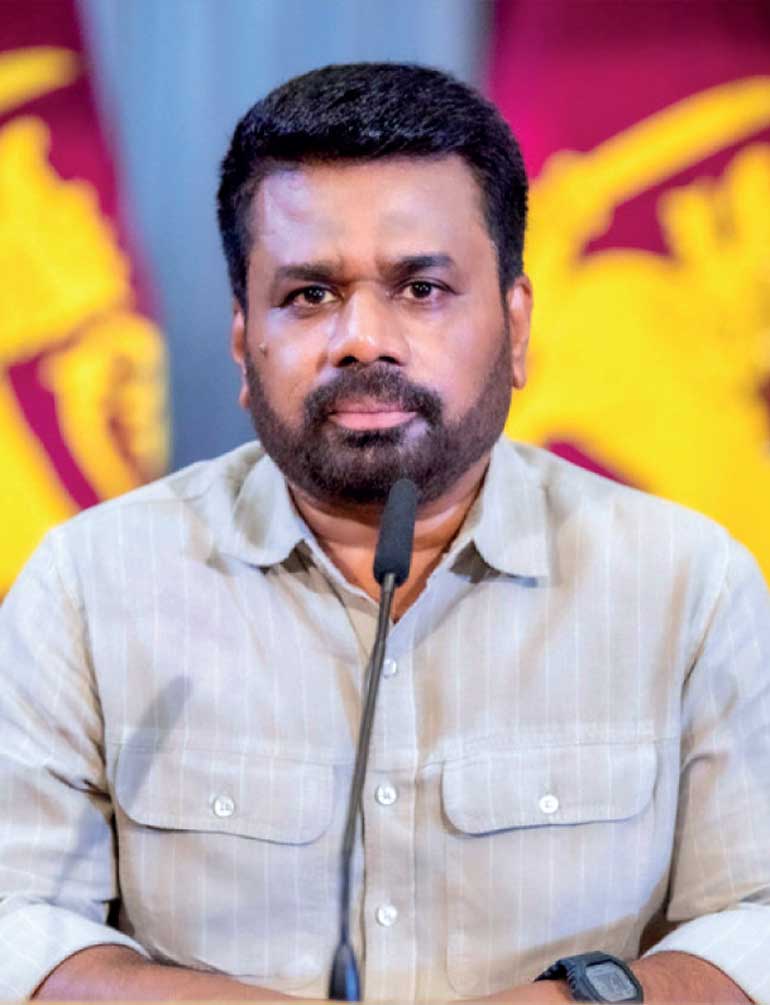
President Anura Kumara Dissanayake
 Sri Lanka today stands at a critical constitutional and political crossroads. Amid economic instability, institutional distrust, and widespread discontent, the debate surrounding the Executive Presidency has once again emerged at the centre of national discourse.
The 2024 election manifesto of the National People’s Power Government, titled “A Thriving Nation – A Beautiful Life,” was constructed around the rhetoric of “system change,” with constitutional reform presented as its defining political mission. Central to this promise was the abolition of the executive presidency and its replacement with a parliamentary framework in which the President would serve merely as a ceremonial head of state.
This pledge was politically significant because it directly appealed to widespread public frustration over decades of executive overreach, corruption, patronage politics, and democratic erosion.
Lack of commitment
Yet, despite securing power through this reformist narrative, the administration of Anura Kumara Dissanayake has demonstrated a conspicuous lack of commitment toward implementing the very constitutional changes that formed the moral and political foundation of its electoral mandate. The continued preservation of the executive presidency exposes a growing contradiction between the regime’s anti-establishment discourse and its conduct in office. Rather than dismantling entrenched structures of centralised authority, the Government appears increasingly willing to accommodate and benefit from them. This failure to pursue meaningful constitutional reform not only represents a broken promise to the electorate but also risks reducing the rhetoric of “system change” to a populist instrument for electoral mobilisation rather than a genuine democratic project. In this context, the regime’s inaction raises serious concerns about political opportunism, democratic accountability, and the enduring resilience of authoritarian institutional structures within Sri Lankan governance.
While the office was originally introduced under the 1978 Constitution with the intention of ensuring political stability, economic modernisation, and decisive governance, its long-term consequences remain deeply contested.
Pros and cons of Executive Presidency
The Executive Presidency was designed to create a strong and centralised state capable of overcoming the perceived weaknesses of the earlier Westminster-style parliamentary model.
Supporters argued that a directly elected president with a fixed mandate would provide continuity in governance and facilitate long-term economic planning.
However, over time, critics have increasingly associated the system with democratic backsliding, excessive concentration of power, weakened institutional checks, and heightened political polarisation.
The expansion of presidential authority under the 20th Amendment in 2020 intensified these concerns.
The President regained extensive powers over ministerial appointments, judicial nominations, parliamentary dissolution, and emergency governance, significantly reducing institutional oversight. Although the 22nd Constitutional Amendment of 2022 sought to restore certain accountability mechanisms, many observers contend that it did not fundamentally alter the structure of executive dominance.
Key presidential powers remain intact, particularly regarding appointments, control over ministries, and influence over independent institutions.
This has renewed calls for Sri Lanka to reconsider a Westminster-style parliamentary framework.
Advocates argue that parliamentary Government offers stronger accountability because the executive remains continuously answerable to Parliament.
Unlike presidential systems centred on a single individual, parliamentary systems operate through collective cabinet responsibility, encouraging consultation, compromise, and broader political participation. In a multi-ethnic and plural society such as Sri Lanka, this argument carries particular significance.
Critics of presidentialism maintain that highly centralised executive authority can intensify “winner-takes-all” politics, marginalising minority communities and discouraging consensus-building. Parliamentary systems, by contrast, are often viewed as more adaptable to diversity because they distribute political power more broadly and require coalition-building within the legislature.
Nevertheless, defenders of the Executive Presidency argue that Sri Lanka’s past parliamentary experience was itself marked by instability, short-term populism, and fragmented governance. They maintain that a strong executive remains necessary to ensure national unity, maintain security, and implement difficult economic reforms without excessive political obstruction.
From this perspective, the issue lies less in the constitutional structure itself than in the broader political culture and institutional weaknesses surrounding governance.
Comparative political experience suggests that neither presidentialism nor parliamentarism guarantees democratic success or failure.
Stable democracies exist under both systems. However, constitutional scholars increasingly argue that in developing and deeply divided societies, excessive concentration of executive authority may weaken democratic institutions rather than strengthen them.
The challenge, therefore, is not merely to abolish or preserve the presidency, but to design institutions capable of balancing effective governance with accountability, inclusivity, and the rule of law.
Sri Lanka’s ongoing crisis demonstrates that constitutional reform cannot be separated from broader questions of political culture, economic governance, and institutional trust.
Meaningful reform will require more than symbolic amendments; it will demand a broader national conversation on how power should be distributed within the state and how democratic institutions can be strengthened for the future.
Ultimately, Sri Lanka’s constitutional future remains uncertain. Whether the country chooses to retain, reform, or abolish the Executive Presidency, the central challenge will remain the same: building a political system that safeguards democratic accountability while ensuring stability, pluralism, and public confidence in governance.




