Friday Oct 02, 2026
Friday Oct 02, 2026
Wednesday, 30 September 2026 00:00 - - {{hitsCtrl.values.hits}}
Finance Ministry
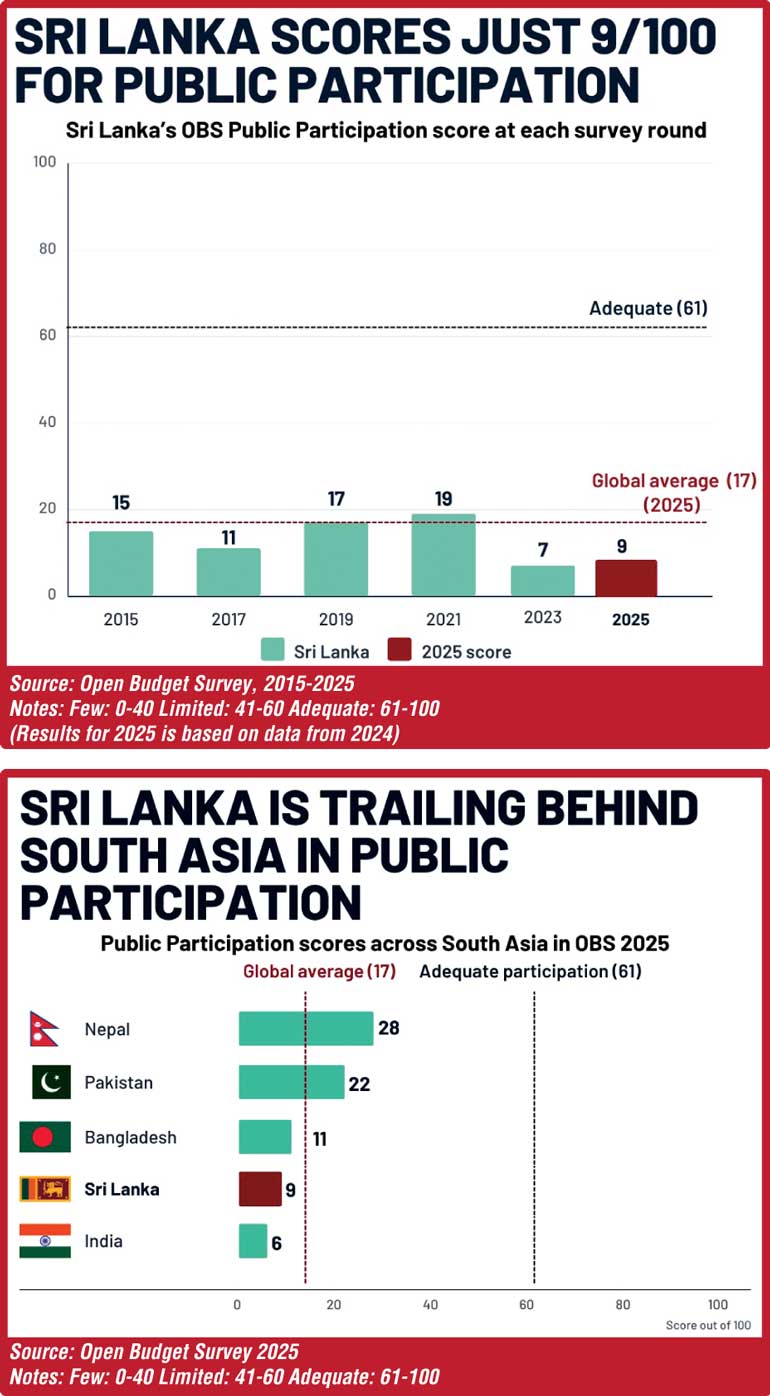
Sri Lanka scores just 9 out of 100 for public participation in the Open Budget Survey 2025. The score points to a basic weakness in the country’s Budget process: there are too few formal opportunities for the public to contribute to decisions about how public money is raised, allocated, and spent.
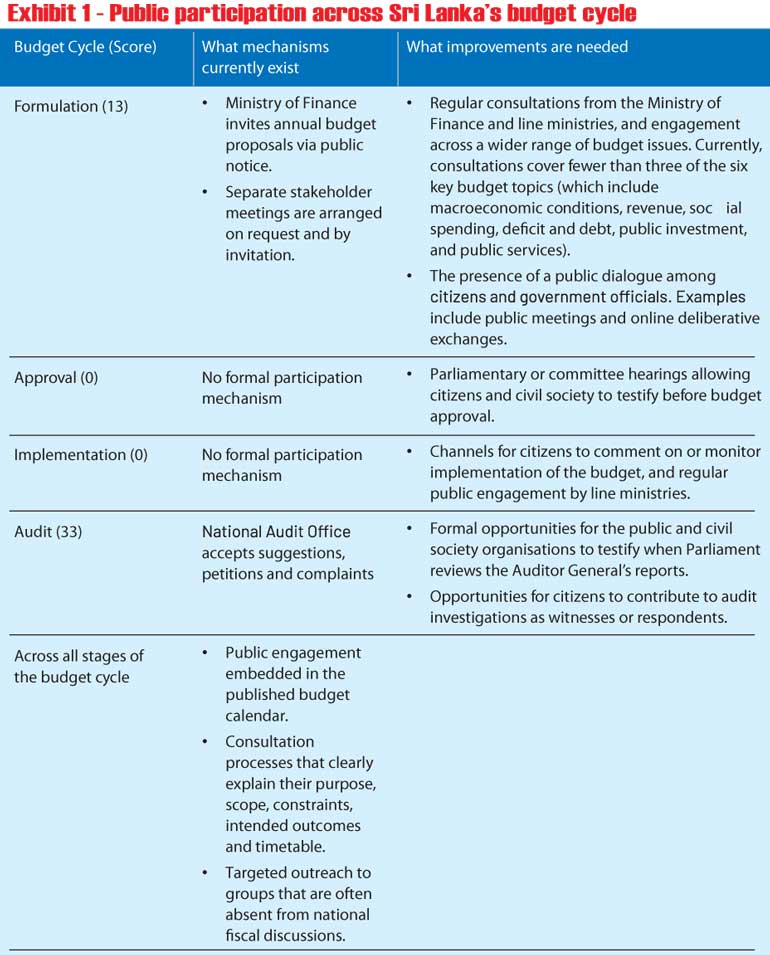
Across the four stages of the Budget cycle—formulation, approval, implementation and audit—Sri Lanka provides avenues for public input only during formulation and audit. There is no formal mechanism for participation during parliamentary approval or Budget implementation. Even where opportunities exist, they remain limited in scope and are not consistently supported by clear rules, inclusive outreach or feedback on how public input was considered.
While in more recent years, Sri Lanka has strengthened the disclosure of Budget information (particularly following the enactment of the Public Financial Management Act, No. 44 of 2024), the institutional arrangements for enabling the public to participate in Budget decisions remain weak.
Sri Lanka scores poorly on involving public in Budget
The International Budget Partnership’s Open Budget Survey (OBS) assesses national Budget systems across three dimensions: transparency, public participation and oversight. The 2025 survey, based on assessments conducted in 2024, gave Sri Lanka scores of 43 for transparency, 56 for oversight and 9 for public participation; each one out of a possible 100.
The public participation score assesses whether the public has opportunities to participate at all four stages of the Budget cycle, and whether the mechanisms available are broad, predictable, transparent, and inclusive.
Sri Lanka’s score reflects substantial gaps across the stages of the Budget cycle, with opportunities only present at the Budget formulation and audit stage. During Budget formulation, the Finance Ministry publishes an annual notice inviting individuals and organisations to submit proposals for the national Budget.
During the audit stage, the National Audit Office accepts public suggestions on subjects for audit, as well as petitions and complaints concerning public entities. In contrast, there are no formal participation mechanisms during Budget approval or implementation.
These gaps have also widened over time. Sri Lanka’s public participation score rose from 11 in 2017 to a high of 19 in 2021, before falling to 7 in 2023 and increasing slightly to 9 in 2025. At the time of the 2021 survey, some line ministries conducted consultations during budget formulation and parliamentary committees provided opportunities for public engagement around the annual Budget. These mechanisms were no longer operating during the latest assessment.
Even where avenues for public input exist, the process does not provide a clear feedback loop. The OBS assesses whether institutions explain how public contributions were considered during Budget formulation, implementation, legislative deliberations and audit planning. Sri Lanka has scored zero on all four feedback measures in every survey year. Institutions therefore do not systematically explain whether proposals influenced decisions or why particular proposals were accepted or rejected.
Integrating public needs into Budgeting builds trust and informs effective Government decisions. Public participation is essential at all stages of the Budget cycle for various reasons. During formulation, it helps incorporate local priorities and service-delivery gaps into Budget planning. In the approval phase, it gives the public a platform to raise questions about proposed fiscal decisions. During implementation and audit, it provides opportunities to examine whether public funds are used and whether they are used as intended. Additionally, increased public engagement can strengthen tax compliance by giving citizens a stronger voice in how their taxes are used.
Public participation is now also increasingly recognised as a standard feature of sound fiscal governance, including in the IMF Fiscal Transparency Code, OECD Principles of Budgetary Governance, PEFA framework, and Sustainable Development Goals 5, 10, and 16.
Nepal shows participation can be built into every stage
Sri Lanka’s limited mechanisms are not unique in a region where public participation scores remain low. However, most South Asian countries perform better than Sri Lanka. Nepal leads the region with a score of 28, compared with Sri Lanka’s 9, although Nepal itself remains below the OBS adequacy threshold of 61.
The difference between Sri Lanka and its better-performing neighbours is largely in the number and range of institutional mechanisms available.
Nepal has mechanisms for public participation in all four stages of the Budget. In the formulation stage, in addition to the public call for proposals, the Ministry of Finance conducts stakeholder consultations. In the approval stage, the federal parliament and its committees hold public hearings with selected stakeholders. During implementation, various online systems are available for Budget reporting and tracking, such as LMBIS/IPFMS, expenditure reports, and public financial data portals. Furthermore, Hello Sarkar enables citizens to submit Budget-related grievances through web, telephone, fax, or SMS, and provides a way for them to monitor Government responses. In the audit stage, Nepal has created a citizen participatory audit framework that provides guidelines/directives around public/CSO involvement in audits. In this framework, the public can propose audit subjects via steering committees and public calls; gather and verify evidence through inspections, focus groups, and interviews; feed verified information into reporting; and monitor if findings are acted on afterward.
Nepal has also prepared a national strategy for public engagement in public financial management, prepared with the Public Expenditure & Financial Accountability (PEFA) Secretariat following consultation with civil society. That strategy hopes to give participation an institutional basis where it treats public engagement as a standing component of fiscal governance rather than as an activity that depends on the discretion of individual ministries, officials or parliamentary committees.
Sri Lanka’s experience is different.
The Public Financial Management Act, No. 44 of 2024 introduced extensive requirements for publishing fiscal and Budget information. These provisions strengthen transparency by requiring Government institutions to disclose more information about public finances. But the Act creates no corresponding duty to consult the public across the Budget cycle or to explain how public input has been considered. Without such an obligation, participation remains vulnerable to changes in administrative priorities and political leadership.
Closing gaps means embedding participation in Budget calendar
Closing these gaps is particularly important in Sri Lanka’s current fiscal context. Decisions on taxation, spending restraint and competing expenditure priorities directly affect citizens, yet the formal avenues through which they can contribute to those decisions remain limited, even relative to its South Asian peers.
Sri Lanka can improve public participation by creating formal opportunities at every stage.
Finance Ministry and line ministries can expand consultation and discussions onto various platforms during Budget formulation, broaden the range of fiscal issues open for discussion, actively reach under-represented groups and create channels for public input during implementation.
Parliament and its committees can reinstate opportunities for public testimony during Budget approval and provide avenues for citizens and civil society organisations to engage when reviewing Budget implementation and audit reports.
The National Audit Office can build on its existing system for receiving public suggestions and complaints by creating formal mechanisms for citizens to contribute information during relevant audit investigations.
Across all institutions, consultation processes should clearly state their purpose, scope, constraints and timetable. Institutions should also publish feedback explaining how public contributions were considered and whether they influenced decisions.
To improve public participation in the Budget process these mechanisms should be embedded in the formal Budget calendar alongside a common institutional framework covering formulation, approval, implementation and audit.
Sources:
International Budget Partnership ‘Open Budget Survey 2025: Sri Lanka’ at https://internationalbudget.org/open-budget-survey/country-results/2025/sri-lanka [last accessed 11 September 2026].
Murray Petrie ‘What is public participation in fiscal policy and why is it important?’ Global Initiative for Fiscal Transparency 7 June 2017 at https://fiscaltransparency.net/what-is-public-participation-in-fiscal-policy-and-why-is-it-important/ [last accessed 11 September 2026].
International Budget Partnership ‘Open Budget Survey 2025: Nepal’ at https://internationalbudget.org/open-budget-survey/country-results/2025/nepal [last accessed 11 September 2026].
International Budget Partnership ‘Open Budget Survey 2023: Nepal’ at https://internationalbudget.org/open-budget-survey/country-results/2023/nepal [last accessed 11 September 2026].
Sections 11, 21, 49, 50, 51, 52 and 53 Public Financial Management Act No. 44 of 2024.



