Thursday Sep 10, 2026
Thursday Sep 10, 2026
Thursday, 26 March 2026 00:00 - - {{hitsCtrl.values.hits}}
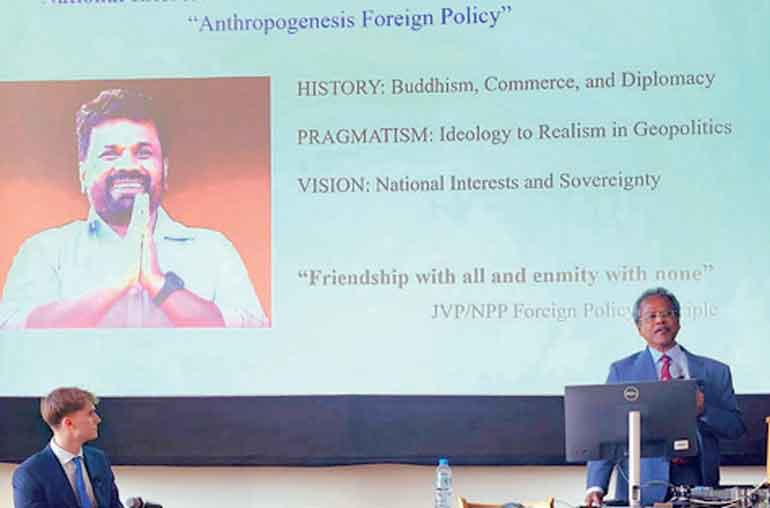
Prof. Patrick Mendis (right) speaks at the world-renowned Warsaw School of Economics
 WARSAW, Poland: Sri Lanka’s emerging foreign policy represents a “power of example” for humanity amid escalating military tensions in the Middle East — says Prof. Patrick Mendis, a Sri Lanka-born former American diplomat and distinguished visiting professor of transatlantic relations at the University of Warsaw.
Speaking at the world-renowned Warsaw School of Economics, Prof. Mendis argued that Sri Lanka’s evolving diplomatic posture demonstrates how a small island nation can navigate great-power competition while maintaining humanitarian principles.
His lecture — titled “The Grand Central Station of the Indian Ocean: What Is the Geostrategy of Sri Lanka and Its New Anthropogenic Foreign Policy in Sino-American and European Union Relations?” — came at a dramatic moment.
Only hours before the event, a returning Iranian naval vessel that had participated in an Indian-led exercise was torpedoed near Sri Lanka’s southern coast. According to Prof. Mendis, the Sri Lankan government responded swiftly by launching a humanitarian rescue mission that saved survivors and recovered the bodies of fallen sailors. Survivors were treated at Galle Hospital, while another Iranian naval vessel was escorted safely under international maritime and humanitarian law.
Friendship with all and enmity with none
For Prof. Mendis, this episode illustrated Sri Lanka’s longstanding diplomatic ethos of “friendship with all and enmity with none,” rooted in the island’s Buddhist civilisational heritage.
Historically, Sri Lanka served as a crossroads of commerce linking the Roman Empire, the Middle Kingdom, and maritime trading networks across Asia and the Middle East as early as 250 BC. The arrival of European colonial powers later transformed this flourishing hydraulic civilisation into a plantation economy producing tea, rubber, and coconut for global markets.
Prior to Portuguese, Dutch, and British rule between 1505 and 1948, the island maintained a sustainable economic system built on the tripod of sophisticated irrigation networks, rice cultivation, and Buddhist philosophical traditions.
Since independence in 1948, Sri Lanka has balanced relations between major powers — China, India, and the United States. Prof. Mendis noted that Prime Minister Sirimavo Bandaranaike maintained the historic Rubber-Rice Agreement with China, while President J. R. Jayewardene later deepened ties with Washington, famously presenting a baby elephant to U.S. President Ronald Reagan on the White House lawn — a symbolic gesture referencing the elephant emblem of the Republican Party.
Prof. Mendis himself began public service with the US Senate Foreign Relations Committee during the Reagan administration. Later, he served in both Democratic and Republican administrations at the US Departments of Agriculture, Defense, Energy, and State.
The old and the new
The United States, he observed, will celebrate the 250th anniversary of its founding this year. From its earliest days, America’s Founding Fathers envisioned a nation engaged with the wider world, guided by the principle of “trade with all, entangle with none.”
Rejecting European colonial rule, the new republic nevertheless embraced Enlightenment ideas and global commerce. In 1784, the United States sent its first official trading vessel, “Empress of China,” from New York Harbor to Canton — modern-day Guangzhou — carrying American ginseng. The ship returned with tea, porcelain, and silk, symbolising the birth of Sino-American commercial civilisation.
Sri Lanka, Prof. Mendis argued, has long embodied a similarly cosmopolitan tradition. Archaeological discoveries such as the fifth-century Anuradhapura Cross demonstrate early Christian presence on the island, while Arab, Indian, Chinese, and Persian merchants lived and traded there peacefully for centuries. The Anuradhapura Cross is now on the flag of the Catholic Bishops Conference of Sri Lanka.
He also highlighted the reign of King Parakramabahu of Polonnaruwa — his place of birth, the second capital, and now a UNESCO World Heritage Site. The king maintained active trade links with China during the 12th century, exporting rice and importing silk.
Anthropogenic foreign policy
Prof. Mendis described Sri Lanka’s current diplomatic orientation as an “Anthropogenic Foreign Policy,” reflecting a synthesis of civilisational heritage, pragmatic governance, and geopolitical awareness.
The country’s newly elected leadership, he noted, came to power without relying on traditional ethnic or religious divisions. Instead, voters from Buddhist, Christian, Hindu, and Muslim communities supported a younger generation of educated leaders who have adopted a pragmatic approach focused on national interest and sovereignty.
President Anura Kumara Dissanayake’s diplomatic outreach to China, India, and the United States demonstrates a willingness to transcend ideological alignments and engage with competing geopolitical visions — including India’s “Neighborhood First,” China’s Belt and Road Initiative (BRI), and the American concept of a “Free and Open Indo-Pacific”
President Anura Kumara Dissanayake’s diplomatic outreach to China, India, and the United States demonstrates a willingness to transcend ideological alignments and engage with competing geopolitical visions — including India’s “Neighborhood First,” China’s Belt and Road Initiative (BRI), and the American concept of a “Free and Open Indo-Pacific.”
Drawing on the foreign policy philosophy of President Thomas Jefferson — “peace, commerce, and honest friendship with all nations, entangling alliances with none” — Prof. Mendis argued that trade historically has served as a powerful force for cooperation.
China’s ancient Silk Road networks, he noted, echoed a similar logic and are reflected today in President Xi Jinping’s BRI. When the Ming admiral Zheng He visited Sri Lanka in 1409, he erected the famous Galle Trilingual Tablet in Chinese, Persian, and Tamil — a monument symbolising a vision of peaceful coexistence through commerce.
Trade for peace
History shows that trade can both unite and divide nations, Prof. Mendis acknowledged. Yet among the alternatives to religious, ethnic, and territorial conflict, he argued, economic exchange — in goods and services like educational exchange programs — remains one of the most effective pathways toward human progress.
In his book, “Trade for Peace,” he emphasises how the “Commerce Clause” of the US Constitution helped unite the original 13 American colonies into what has since grown into a federation of 50 states. A fully rules-based global trading system, he added, remains an unfinished project of the United States.
Until that vision is fully realised, Sri Lanka’s guiding diplomatic principle — “friendship with all and enmity with none” — may offer a model aligned with the founding ideals of both the United States and China, Prof. Mendis concluded.
(The author, a former Fulbright Scholar in the United States and the vice-dean of the Polish Military Academy of Sciences, is a professor of political science and international studies at the University of Warsaw in Poland. This lecture was sponsored by the “Cooperation, Integration, and Efficiency in the Anglosphere: Prospects for the Development of AUKUS and CANZUK” grant funded by the Polish Ministry of Higher Education and Science under Science for Society II Program)




