Friday Oct 09, 2026
Friday Oct 09, 2026
Friday, 9 October 2026 00:00 - - {{hitsCtrl.values.hits}}
 Sri Lanka has formally reopened its offshore waters to international oil and gas exploration. On 25 August 2026, the Government, through the Petroleum Development Authority of Sri Lanka (PDASL), launched the Sri Lanka Licensing Round 2026 (SL2026-01), offering four exploration blocks in the Mannar Basin to qualified international energy companies. It sends the clearest signal yet that Sri Lanka intends to turn a long-discussed geological promise into investment, infrastructure and, in time, home-grown energy, the Board of Investment (BOI) of Sri Lanka said.
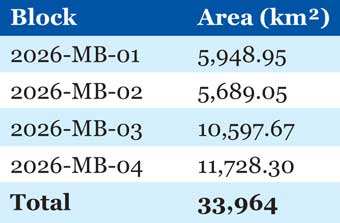
Four blocks, nearly 34,000 square kilometers
The four blocks cover a combined 33,964 km², roughly half the land area of Sri Lanka. They lie in water depths of approximately 100 metres to 3,000 metres, giving explorers substantial positions across the basin.
“The Sri Lanka Licensing Round 2026 marks an important step in the development of our country’s energy resources,” said Energy Minister Anura Karunathilaka, at the launch. “We are opening four significant exploration blocks in the Mannar Basin and invite experienced international energy companies to evaluate this opportunity and work with Sri Lanka as long-term partners in the responsible development of our natural resources.”
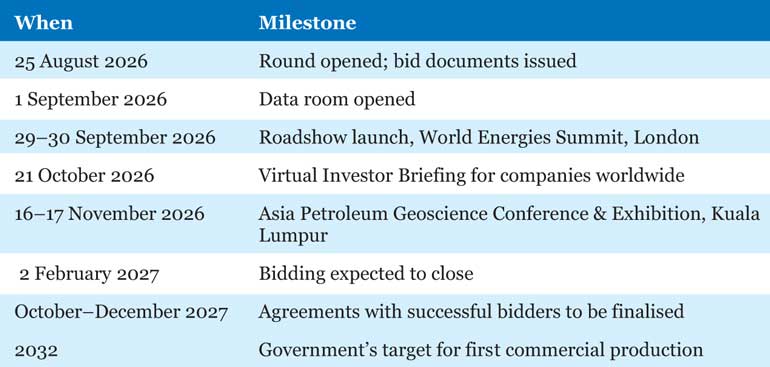
The round rests on a reformed legal footing. The Petroleum Resources Act, No. 21 of 2021 established PDASL as the upstream regulator and created a stronger institutional framework for exploration and development. Bid documents were issued on the opening day, and the data room, holding the geological and geophysical information companies need to assess the acreage, opened on 1 September 2026.
What lies beneath: a proven system, a largely untested basin
The case for the Mannar Basin begins with a fact, not a forecast. Between 2011 and 2013, Cairn Lanka drilled four exploration wells in the basin, and two of them, Dorado and Barracuda, found gas and condensate. Those were the first hydrocarbon discoveries in the Mannar Basin.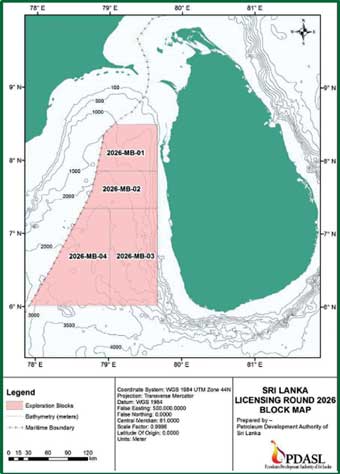
To a geologist, that matters more than any single volume. It proves that hydrocarbons were generated, migrated, and trapped beneath these waters: what the industry calls a working petroleum system.
The two discoveries have never been developed. A technical review in the Oil & Gas Journal puts their combined mid-case recoverable resource at 839 billion cubic feet (bcf) of gas and 5.88 million barrels of condensate. The Minister of Energy told Parliament in September that Barracuda alone may hold several times its current estimate.
What 839 bcf could mean: A simple illustration shows the scale. Burned in modern combined-cycle plants, 839 bcf would generate roughly 120 terawatt-hours of electricity, more than six years of Sri Lanka’s entire present demand. Used more gradually, it could fuel about 650 MW of gas-fired capacity, the size of the two combined-cycle plants at Kerawalapitiya, for around three decades.
That is an indicative calculation, not a development plan. But it explains why two modest fields, by world standards, are significant for an island economy.
The larger prize is still undrilled: The greater potential lies in what has not been tested. The Sri Lankan side of the basin spans about 42,000 km², most of it in water deeper than 1,000 meters, and only a handful of wells have ever been drilled there, all in the north. The four blocks now on offer cover some four-fifths of that area.
Broader assessments quoted in the local press have suggested the basin could hold as much as nine trillion cubic feet of gas and two billion barrels of oil. Those figures are unproven estimates, and only drilling can confirm or correct them.
Explorers will not start from a blank sheet. PDASL is offering 5700 line-kilometers of 2D seismic,2350 km2 of 3D data in the West Mannar area, well data from the earlier campaign, and about 40,000 km² of enhanced subsurface imaging.
“Previous exploration has demonstrated the presence of a working petroleum system in the Mannar Basin,” said Dr. Neil DeSilva, Director General of PDASL. “The combination of substantial available acreage, technical information and Sri Lanka’s strengthened regulatory framework provides international explorers with a compelling opportunity to take a fresh look at the basin.”
What Sri Lanka stands to gain
The benefits fall into two groups: those that arrive with exploration itself, and those that follow only if commercial production is achieved.
Energy security: Sri Lanka produces no oil, gas, or coal of its own. The fuel queues of 2022 showed what that dependence costs when foreign exchange runs short. A domestic gas supply would give the country, for the first time, a source of firm energy that does not arrive by tanker.
Relief for the Balance of Payments: The Central Bank reports that Sri Lanka spent US$ 4.07 billion on fuel imports in the first eight months of 2026, which is 61.6 per cent more than in the same period of 2025. Every unit of imported fuel displaced by domestic gas is foreign exchange retained for other national priorities.
Cheaper and cleaner power: Natural gas emits roughly half the carbon dioxide of coal in power generation and is cheaper to burn than the diesel and fuel oil now used in thermal plants. The Ceylon Electricity Board’s long-term generation plan already assumes that new firm capacity will come from natural gas, with no new coal plants.
A partner for renewables: Sri Lanka’s target is to draw 70 per cent of its electricity from renewable sources by 2030. Solar and wind need flexible back-up for still nights and dry seasons, and gas-fired plants provide it. Domestic gas would therefore support the renewable transition rather than compete with it.
Foreign direct investment at the investor’s risk: Deepwater seismic surveys and wells cost tens to hundreds of millions of dollars, and the explorer carries that risk. The Oil & Gas Journal review estimated that developing Dorado and Barracuda alone would require about US$ 1.4 billion. Capital of that order brings service contracts, port activity and demand for local supply chains.
Revenue for the State: Bidders must submit royalty, production and profit-sharing terms as part of their offers. If production follows, those terms, together with taxation, would create a new stream of public revenue over the life of each field.
Skills, technology and industry: A working upstream sector needs geoscientists, engineers, marine crews, logistics bases and environmental specialists. Over time, a reliable gas supply could also support gas-based industries that the country cannot sustain on imported fuel.
A signal to investors everywhere: A transparent, competitive round run to international standards tells the wider market that Sri Lanka can offer large, long-term projects under clear rules. That reputation benefits every sector seeking foreign capital, not energy alone.
Road ahead
PDASL is taking the opportunity directly to the industry. The international roadshow opened at the World Energies Summit in London on 29–30 September, and two further engagements follow this year.
The later dates come from the Minister’s statement to Parliament in September. He said successful bidders would have six months to mobilise and three years to explore, extendable to eight. PDASL has said that dates for notifying bidders and signing Petroleum Resource Agreements will be announced in due course.
Promise and patience
A licensing round is a beginning, not a result. The 2011 discoveries were not developed, in part because world oil prices collapsed in the years that followed and in part. After all, Sri Lanka then had no gas market, pipeline network, or infrastructure to receive the fuel.
Several of those conditions have changed. The country now has a dedicated regulator, a modern petroleum law, power plants designed to burn gas, and a far better seismic picture of the basin. What remains is the work only explorers can do: acquiring data, drilling wells, and proving that the gas can be produced at a profit.
That will take years, and success is not guaranteed. But the direction is clear. With the Mannar Basin open again, Sri Lanka has placed a credible, well-documented opportunity before the world’s energy companies, and given itself a realistic chance of producing a share of its own energy within the coming decade, the BOI concluded.




