Sunday Jul 12, 2026
Sunday Jul 12, 2026
Friday, 16 January 2026 00:24 - - {{hitsCtrl.values.hits}}
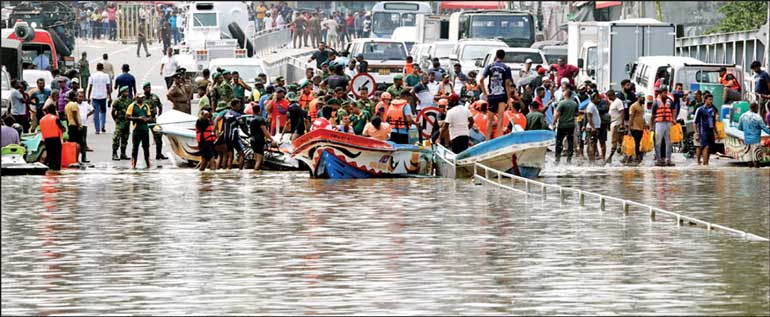
 ON 28 November 2025, Cyclone Ditwah delivered about 10% of Sri Lanka’s annual rainfall within 24 hours. Falling on already saturated catchments, the deluge overwhelmed rivers, reservoirs, and drainage systems, causing widespread damage. While emergency response efforts mobilised quickly, the episode exposed a deeper and recurring weakness: Sri Lanka remains poorly prepared to make decisive, pre-emptive choices when extreme weather is clearly forecast.
This is no longer a debate about rare “one-in-a-hundred-year” event. Climate uncertainty has rendered such assumptions obsolete. What were once tail risks (extreme, very low probability) are now part of the country’s operating environment. The real question is not whether Sri Lanka will face another catastrophic rainfall event, but whether it will have the institutional competence and courage to act in advance of it.
Natural river systems to heavily engineered hydrological landscape
Sri Lanka’s natural river systems were once moderated by dense hill-country rainforests that absorbed monsoon rainfall and released water gradually. This soak-and-trickle hydrology sustained dependable river flows and supported the island’s celebrated hydraulic civilisation, whose tank-and-canal networks worked in harmony with nature to manage both droughts and floods.
That balance was irreversibly disrupted during the plantation era when vast tracts of forest were cleared. Catchments lost their buffering capacity, runoff intensified, and downstream flood risk increased. Modern multi-purpose dams and inter-basin transfers have since restored a measure of water reliability, but they have also introduced new dependencies. In today’s heavily engineered hydrological landscape, rivers cannot simply be observed during extreme weather; they must be actively managed.
Technical competence and execution
 Sri Lanka is not short of technical competence. The country has skilled meteorologists, hydrologists, and engineers with universities capable of advanced modelling. The problem is not the absence of forecasts or data. It is the absence of an institutional mechanism that converts early warnings into timely, authoritative action.
Forecasting without decision-making authority is ineffective. Flood disasters escalate not because warnings are unavailable, but because responsibility is fragmented, decisions are delayed, and officials hesitate in the face of political and personal risk. This paralysis is most evident in reservoir management. When severe rainfall is forecast days in advance, pre-emptive water release is a known option, yet it is rarely exercised with confidence.
Sri Lanka urgently needs a small, technically led, and empowered command structure activated only when extreme weather is forecast. Its mandate should be narrow but decisive: regulate reservoir releases, optimise river and drainage capacity, and reduce downstream flood impacts. Such a body should operate under the Ministry of Disaster Management with clear legal authority during declared weather emergencies. It must resemble a command-and-control unit rather than another coordinating committee, led by a single accountable professional and insulated from post-event blame.
 Political courage is a key factor
Pre-emptive action, however, requires political courage. Reservoir drawdown ahead of a storm is inherently controversial. What if the storm weakens or shifts course and the release of water in advance resulted in farmers facing shortages during the dry season later in the year? These risks are real, but they are far smaller than the consequences of uncontrolled flooding such as loss of life, destruction of infrastructure, disruption to commerce, and long-term economic cost. In a climate-uncertain world, leadership must be judged on risk reduction, not hindsight perfection (actions critiqued after the event).
Basin-scale modelling can support such decisions. Sri Lanka’s river systems can be simulated to assess rainfall scenarios, reservoir responses, and downstream impacts. These “war-gaming” tools should define decision thresholds and action envelopes, but not substitute for human judgment. A particularly valuable exercise would be to replay recent flood events using alternative release strategies to evaluate how outcomes could have  differed. Universities should be formally engaged in this process, both as technical partners and as training grounds for future professionals.
Flood risk is urban and rural
Flood risk today is as much an urban problem as a rural one. Blocked drains, constricted waterways, and development on flood plains have amplified damage in towns and cities. These vulnerabilities are well known to engineers responsible for roads, railways, and urban infrastructure. Pre-emptive interventions - drainage clearance, slope stabilisation, and targeted evacuation - are consistently cheaper than post-disaster relief and reconstruction. Unfortunately, they remain underprioritised due to the lack of coordination and early action.
Sri Lanka takes pride in its ancient hydraulic heritage, yet too often responds to modern disasters with improvisation rather than preparation. Public displays of leadership after floods do not compensate for institutional failure beforehand.
Extreme weather is now a recurring national risk. Preparedness is therefore not a technical mystery, but a governance choice. Sri Lanka’s resilience will be defined not by how efficiently it responds after catastrophe strikes, but by whether it learns to act decisively before the waters rise.
(The author is an engineer and can be contacted at [email protected]. The article was written with research and review by Chat GPT.)



