Thursday Mar 26, 2026
Thursday Mar 26, 2026
Saturday, 14 March 2026 00:02 - - {{hitsCtrl.values.hits}}
- The Indian Ocean is not a politically neutral space. It is one of the world’s most strategically contested maritime regions, central to shipping routes, energy flows, naval competition, and the wider rivalries of major powers. In such an environment, the choices of smaller states are often constrained by external pressure, diplomatic caution, and security calculations
- Sri Lanka’s rescue of Iranian sailors was therefore more than an emergency operation. It was a small but powerful lesson in humanitarian statecraft. In an age that too often confuses power with greatness, Sri Lanka showed that true development must include something more enduring than force: the courage to place humanity first
 In today’s world, the idea of a “developed country” is too often measured by material indicators alone: military strength, advanced technology, economic scale, and impressive infrastructure. Nations that can project power, dominate strategic regions, and shape the rules of international order are frequently described as advanced or modern. Yet recent global events have repeatedly exposed the moral inadequacy of that definition. When technologically sophisticated states continue to wage wars, destroy cities, and normalise large-scale death, we are compelled to ask a more fundamental question: what does true development really mean?
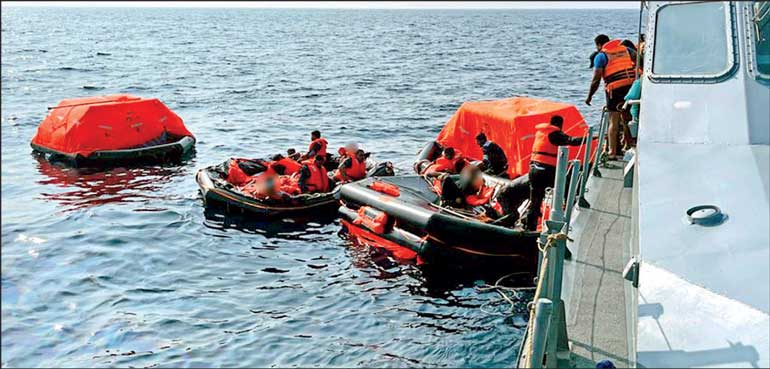
It is in this context that Sri Lanka’s recent rescue of Iranian sailors near its maritime zone deserves serious reflection. According to Reuters and AP, Sri Lankan authorities rescued survivors from the Iranian warship IRIS Dena after it was sunk off Sri Lanka’s southern coast, and also brought ashore 208 crew members from the distressed Iranian vessel IRIS Bushehr for medical treatment and border formalities. Sri Lankan officials made clear that they were responding to a distress call in accordance with humanitarian duty and maritime law.
The significance of this episode lies not only in the operational success of a maritime rescue. Its deeper importance is normative. The Indian Ocean is not a politically neutral space. It is one of the world’s most strategically contested maritime regions, central to shipping routes, energy flows, naval competition, and the wider rivalries of major powers. In such an environment, the choices of smaller states are often constrained by external pressure, diplomatic caution, and security calculations.
Yet Sri Lanka’s response demonstrated that even a relatively small state can act as a moral agent in a moment of crisis. Rather than first viewing the distressed sailors through the lens of geopolitics, military affiliation, or bloc politics, Sri Lanka treated them as human beings in urgent need of protection. Reuters and AP both reported that Sri Lankan authorities explicitly justified their actions in humanitarian and legal terms.
The meaning of development
This invites us to reconsider what “development” should mean. If development is understood only as destructive capacity, then advanced weapons, missile systems, and military platforms become the hallmark of civilisation. But that is a deeply flawed standard. The ability to destroy does not necessarily reflect ethical maturity; often, it reveals the opposite. Taking a life may require only a bullet. Saving a life requires discipline, courage, institutional responsibility, and moral will. From that perspective, Sri Lanka’s actions point to a different measure of national greatness: not the power to kill efficiently, but the willingness to protect life under dangerous and uncertain circumstances.
This is also significant from the standpoint of international relations. Small states are often portrayed as passive objects of great-power politics, compelled to adjust to the actions of larger actors. Much of mainstream realism emphasises coercive power, strategic balancing, and survival in an anarchic system. Yet Sri Lanka’s conduct suggests that smaller states can also shape international meaning through ethical practice. By acting decisively to save lives at a time when larger and more militarised powers were pursuing strategic objectives, Sri Lanka expressed a political identity grounded less in domination than in responsibility. That matters not only for Sri Lanka’s international image, but also for wider debates on small states, human security, and maritime diplomacy.
At the same time, a serious reading of the event should avoid romanticism. Humanitarian action in international politics is rarely detached from legitimacy, diplomacy, and strategic image-making. Sri Lanka’s rescue effort can also be understood as part of a broader effort to maintain the country’s standing as a responsible and relatively neutral actor in a polarised region. Reports indicate that the rescue unfolded amid a wider geopolitical confrontation after a US submarine attack sank the Dena off Sri Lanka’s coast, placing Colombo in an extremely delicate diplomatic position. In other words, this was not an action outside geopolitics, but one taken within geopolitics.
Yet that is precisely why Sri Lanka’s conduct deserves respect. It acted humanely in a setting where hesitation, procedural delay, or political caution could easily have been justified. It responded not with indifference, but with obligation. In a world where states often invoke principle selectively, Sri Lanka’s response carried a quiet but important moral clarity.
The symbolic value of this moment is also significant for Sri Lanka’s own national self-understanding. Sri Lanka has long seen itself, at least in part, as a country that values compassion, endurance, and respect for life despite limited resources and heavy historical burdens. One need not accept all national narratives uncritically to recognise that this rescue offered a contemporary example of those ideals in practice. It suggested that national dignity does not arise only from wealth, monumental construction, or military intimidation. It can also arise from the ability to recognise the humanity of the other—even amid conflict, uncertainty, and geopolitical danger.
At a time when many powerful states continue to normalise destruction while calling themselves advanced, Sri Lanka’s actions remind us that genuine progress lies not in perfecting violence but in protecting life. The moral worth of a state should not be measured only by the sophistication of its weapons or the scale of its economy. It should also be measured by the seriousness with which it responds to human vulnerability.
Sri Lanka’s rescue of Iranian sailors was therefore more than an emergency operation. It was a small but powerful lesson in humanitarian statecraft. In an age that too often confuses power with greatness, Sri Lanka showed that true development must include something more enduring than force: the courage to place humanity first.
(The author is a Professor at Fukuoka Women’s University, Japan)



