Monday Aug 24, 2026
Monday Aug 24, 2026
Friday, 5 June 2026 02:30 - - {{hitsCtrl.values.hits}}
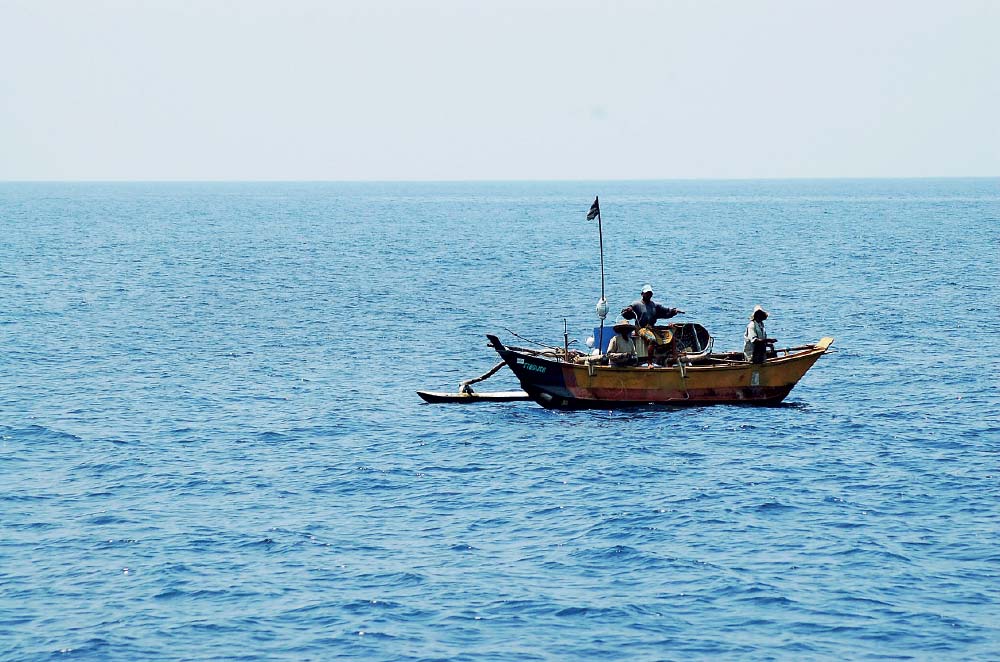
 For an island nation whose future is inseparable from the ocean, building a world-class marine science capability should not be viewed as an academic aspiration.
It should be recognised as a strategic national investment. Because ultimately, a country cannot protect, manage or defend what it cannot measure
 Sri Lanka proudly describes itself as a maritime nation. We sit astride one of the busiest shipping lanes in the world, aspire to become a regional maritime hub, promote a blue economy agenda, and seek to attract investment into ports, logistics, fisheries, offshore resources and marine tourism. Yet there is an uncomfortable reality that policymakers, industry leaders and the public must confront.
As a nation, we still lack the scientific infrastructure needed to systematically understand, monitor and defend our own marine environment. This is not merely an academic issue. It is a matter of national security, economic resilience and environmental sovereignty. The ocean surrounding Sri Lanka represents more than 80 percent of our territorial domain. It supports fisheries, shipping, tourism, coastal communities and future blue economy opportunities. However, our ability to collect, analyse and maintain long-term scientific data about that environment remains fragmented and underdeveloped.
In many respects, we are attempting to manage one of our most valuable national assets without maintaining a complete inventory of its condition.
The missing foundation: Baseline data
Whenever a maritime environmental disaster occurs, one fundamental question must be answered: “What was the condition of the environment before the incident occurred?”
Without credible baseline data, answering that question becomes difficult. Scientific claims, environmental assessments and compensation demands are only as strong as the evidence that supports them.
Many countries maintain decades of systematically collected oceanographic and environmental data. Such information allows scientists to identify changes, determine causes and quantify damages with a high degree of confidence. Sri Lanka possesses valuable marine research conducted by universities, research institutes and international collaborations. Numerous peer-reviewed studies have been published over the years. However, these efforts have often been project-based, short-term and dispersed across different institutions. What we lack is a nationally coordinated, continuously maintained marine environmental monitoring system supported by a centralised database.
Unlike meteorological records, which in some cases stretch back more than a century in Sri Lanka and provide a foundation for weather forecasting and climate analysis, our marine environmental records are not maintained in a similarly systematic manner.
The result is a patchwork of information rather than a comprehensive national picture.
Maritime ambitions require scientific capability
Sri Lanka’s maritime ambitions have expanded significantly in recent years. The country seeks to position itself as a regional logistics hub. Discussions surrounding marine conservation, offshore resources, marine spatial planning, coastal resilience and blue economy development have gained prominence.
At the same time, international shipping faces increasingly complex environmental regulations and liability frameworks. Future incidents involving hazardous and noxious substances, chemical spills, marine pollution or ecosystem damage will require rapid scientific assessment supported by internationally accepted methodologies. In such situations, scientific credibility becomes critical.
A country that cannot independently collect samples, analyse them to international standards and maintain verified environmental records risks becoming dependent on external expertise at precisely the moment when national interests are at stake. Scientific capability therefore becomes a strategic asset.
The laboratory gap
One of Sri Lanka’s most significant weaknesses lies in the lack of internationally accredited marine science laboratories. Marine environmental assessments require sophisticated analytical equipment, calibration standards and quality assurance systems.
Collecting samples is only the first step. The greater challenge lies in analysing those samples using internationally accepted protocols and producing results that can withstand scrutiny from courts, regulators, insurers, scientists and international agencies.
In ocean science, credibility is built through accreditation, calibration and traceability. Every instrument must be validated against recognised standards. Every measurement must be reproducible. Every dataset must be defensible.
Many developed countries have spent decades building such systems. Sri Lanka has talented scientists and dedicated institutions, but the infrastructure required to support world-class marine environmental science remains limited.
This gap becomes especially significant when environmental claims, legal disputes or international negotiations depend on scientific evidence.
The challenge extends beyond laboratories.
A modern marine science capability requires dedicated research vessels, oceanographic instruments, remote sensing technologies, autonomous systems and advanced computing facilities.
Researchers need access to equipment capable of measuring water quality, currents, sediment transport, ecosystem health and biological diversity. Data storage and analysis capabilities are equally important.
Today’s ocean science increasingly relies on artificial intelligence, geographic information systems (GIS), remote sensing and advanced modeling techniques. Data is no longer merely collected. It must be integrated, processed, visualised and transformed into actionable intelligence.
Without such capabilities, valuable information remains scattered and underutilised.
The question is not whether Sri Lanka can afford to invest in marine science infrastructure. What is more important to ask is whether we can afford not to. As maritime traffic increases, environmental pressures intensify and the blue economy expands, the value of reliable scientific information will continue to grow. Future environmental incidents will demand credible evidence. Future resource management decisions will require accurate data. Future economic opportunities will depend on scientific understanding
Learning from regional leaders
Sri Lanka need not reinvent the wheel. Regional examples already exist. India’s National Institute of Oceanography has spent decades building scientific capacity, conducting long-term monitoring programs and supporting national maritime objectives through research and data. India has invested heavily in ocean observation networks, calibrated instruments and continuous environmental monitoring, enabling scientists to establish reliable baselines and rapidly assess changes following incidents at sea.
Even smaller island nations such as the Maldives have developed systems to monitor fish stocks and marine ecosystems with greater consistency. Their ability to collect and maintain long-term datasets allows policymakers to make evidence-based decisions about fisheries management, conservation and resource protection.
The contrast highlights a critical challenge for Sri Lanka. In many cases, we still lack adequately calibrated instruments to measure key environmental parameters consistently. Basic oceanographic indicators such as salinity, water quality and contaminant levels are not monitored through a comprehensive national system. Without calibrated equipment, internationally accredited laboratories and continuous data collection, measurements can be questioned and findings become difficult to defend.
More importantly, without baseline data collected before an incident occurs, it becomes extremely challenging to prove what has changed afterwards. Whether the issue involves an oil spill, chemical discharge, hazardous cargo release or broader marine pollution event, any scientific assessment must be compared against pre-existing conditions. If those conditions were never systematically measured and recorded, claims regarding environmental damage, liability or compensation become far less credible.
Countries such as Australia, Norway and the United States maintain extensive ocean observation systems that continuously monitor environmental conditions. These systems support everything from fisheries management and climate forecasting to environmental protection and maritime safety.
The lesson is clear. Maritime nations that invest in ocean science gain the ability to make better decisions, respond more effectively to crises and protect their national interests.
A public-private model for the future
The scale of investment required should not discourage action. Rather than relying solely on public funding, Sri Lanka should explore a public-private partnership model for developing marine science infrastructure.
The private sector has demonstrated its ability to build and maintain sophisticated systems when commercial incentives are aligned with national priorities.
A dedicated marine science and ocean monitoring centre could potentially be established through a collaborative model involving government agencies, universities, industry stakeholders and international partners. Such a centre could provide laboratory services, environmental monitoring, data management, scientific consultancy and emergency response capabilities.
Most importantly, it would create continuity. Scientific infrastructure cannot operate on intermittent funding cycles. Equipment must be maintained, laboratories must remain accredited and skilled personnel must be retained. Long-term sustainability is essential.
The cost of inaction
The question is not whether Sri Lanka can afford to invest in marine science infrastructure. What is more important to ask is whether we can afford not to.
As maritime traffic increases, environmental pressures intensify and the blue economy expands, the value of reliable scientific information will continue to grow. Future environmental incidents will demand credible evidence.
Future resource management decisions will require accurate data. Future economic opportunities will depend on scientific understanding. In the twenty-first century, nations that control data increasingly control outcomes. For an island nation whose future is inseparable from the ocean, building a world-class marine science capability should not be viewed as an academic aspiration.
It should be recognised as a strategic national investment. Because ultimately, a country cannot protect, manage or defend what it cannot measure.
(The author [PhD (Shizuoka, Japan), MPhil. and BSc. (Ruhuna, SL), Global Fellow (Duke, USA)] is a marine scientist and a senior academic at the Ocean University of Sri Lanka. With more than 25 years of experience in ocean science, fisheries management and marine environmental assessment, he has worked extensively on marine ecosystems, coral reefs, coastal resilience and ocean governance. His work focuses on strengthening Sri Lanka’s scientific capacity to support sustainable fisheries, maritime development, environmental protection and the emerging blue economy. He could be reached via email [email protected])



