Monday Oct 12, 2026
Monday Oct 12, 2026
Saturday, 23 May 2026 04:07 - - {{hitsCtrl.values.hits}}
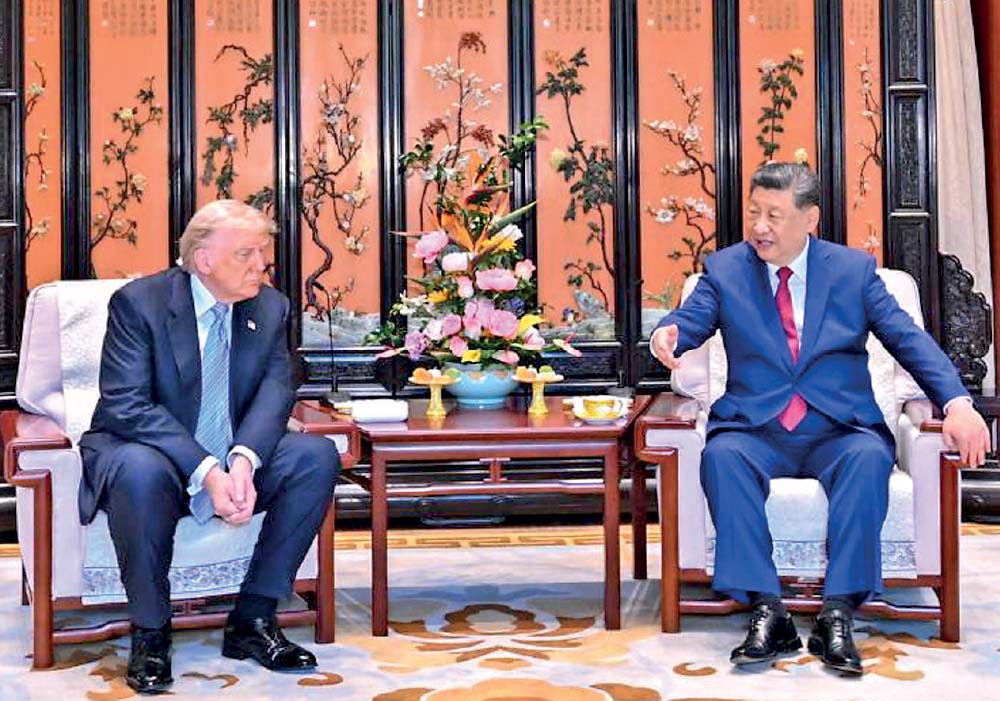
 The day before the Beijing summit began on 14 May, I published a commentary on this page titled “Winning Without Fighting,” examining the strategic role the Colombo administration may play in advancing its proclaimed National Renaissance. I argued that the modern contest between the United States and China is increasingly defined not by battlefield victories, but by strategic positioning, patience, and narrative control.
That observation deserves further examination after the two-day Beijing summit between President Xi Jinping and President Donald Trump, where symbolism, language, and choreography carried geopolitical significance far beyond diplomatic protocol and niceties.
From the Chinese side, the summit’s defining phrase — “constructive strategic stability” — was not accidental diplomacy. It was Beijing’s attempt to redefine the rules of great-power engagement and coexistence. In other words, China appears increasingly determined to shape the world’s most important bilateral relationship. Xi framed the relationship not as a zero-sum confrontation, but as a managed rivalry with guardrails, where competition remains “within proper limits” to preserve global stability and peace.
Does China rule the world?
This question is more than semantics. Chinese political language often functions as strategic architecture. This contrasts with Trump’s mercurial style, his transactional instincts, and the emotional tone of his late-night Truth Social postings at seemingly unguarded hours, including three o’clock in the morning. In all this, analysts across Asian and Western media have noted that Beijing seeks to move away from the vocabulary of “great-power competition” toward a framework in which the United States implicitly accepts China’s expanding strategic space and role in global governance.
The summit also revealed how real power is now projected visually as much as militarily. Much attention in diplomatic circles focused on the carefully staged media event at the Great Hall of the People in Beijing. Some claimed that Xi’s chair, for example, appeared visibly larger and more elevated than Trump’s, while the backdrop emphasised ancient Chinese landscape imagery and towering trees — subtle but unmistakable civilisational symbolism.
At the state dinner and guided tour, cameras also focused on Secretary of State Marco Rubio and Defense Secretary Pete Hegseth, who appeared noticeably impressed by the grandeur of the Great Hall. Trump reportedly used the occasion to explain why he wanted to construct a golden ballroom at the White House. Unlike Washington, however, Chinese state messaging repeatedly invoked long-term thinking, continuity, and endurance. While touring the coveted Zhongnanhai gardens, Xi pointedly remarked to Trump on the “age of trees,” suggesting that great powers must think in generations rather than election cycles.
Mind over matter
In Chinese political culture, trees symbolize rootedness, patience, and historical permanence. The imagery contrasts sharply with America’s shorter political rhythms, driven by electoral cycles, media pressures, and market reactions — and now policy shifts influenced by billionaires, media personalities, and digital platforms. Beijing’s message was clear: China believes time is on its side.
This symbolism matters because the contemporary Sino-American contest is increasingly psychological and economic rather than purely military. Reflecting on post-summit analyses and imagery, one finds that Beijing’s strategy essentially echoes Sun Zi’s maxim: “to subdue the enemy without fighting,” from his perennial guidebook, The Art of War.
The broader geopolitical and geo-economic context reinforces this interpretation. A growing number of American analysts of Iran and the Middle East — though controversial in tone — increasingly describe an uncomfortable reality of the 21st-century power. Modern conflict is no longer primarily about territorial conquest, such as acquiring Greenland. It is about economic exhaustion, financial isolation, technological dependence, supply-chain pressure, and narrative dominance. Wars today are fought through sanctions, currencies, shipping routes, public sentiment, and strategic fatigue. China seems to find comfort in America’s agonizing entanglements as Washington becomes increasingly consumed by internal polarization and, at times, estranged from long-standing allies and partners.
The central observation is difficult to dismiss when Xi purposefully invoked the “Thucydides Trap” — a political theory popularized by Harvard professor Graham Allison — to discuss the dangers of great-power rivalry with Trump. The theory describes a structural dynamic in which a rising power threatens to displace an established one, creating anxiety and tensions that can make war more likely. The history of empires suggests that modern powers increasingly seek victory through systemic pressure rather than outright invasion. Iran’s ongoing vulnerability, for example, stems not only from bombs and missiles, but from inflation, sanctions, social exhaustion, and institutional erosion.
The indispensable “Grand Central Station”
More importantly, China’s response to the Iran crisis revealed a strategic calculation embedded within Xi’s notion of “constructive strategic stability.” Beijing did not openly confront Washington, fully aware of Trump’s unpredictability. Nor did Beijing abandon Tehran, a strategic partner in the Middle East. Instead, China signaled a preference for controlled stability over ideological confrontation — preserving trade routes, energy flows, and global economic predictability.
This is where Sri Lanka becomes highly relevant.
Sri Lanka sits at the maritime crossroads of the Indian Ocean — a kind of “Grand Central Station” — linking the energy routes of the Middle East with the manufacturing ecosystems of East Asia. If the 21st century’s great-power competition revolves around logistics, trade corridors, digital infrastructure, and strategic connectivity rather than direct military occupation, then Sri Lanka’s significance — especially the Colombo Port City, Hambantota International Port, and Mattala Rajapaksa International Airport — inevitably rises.
Maintaining robust commercial ties with the United States means the island’s future depends on mastering a diplomatic equilibrium between Beijing and Washington rather than choosing sides. As ancient history suggests, Colombo must lead by example in trade and diplomacy. The nation can bridge both worlds by embodying US President Thomas Jefferson’s founding motto of “peace, commerce, and honest friendship with all nations,” while honoring the Chinese legacy of the ancient Silk Road commemorated by Ming Admiral Zheng He’s famous Galle Trilingual Inscription as a testament to peaceful global commerce.
Opportunity comes with danger
As noted in my May 13th Financial Times article, Sri Lanka’s strategic opportunity lies in becoming indispensable rather than aligned. That observation becomes even more compelling after the Beijing summit. Xi’s framework suggests that China increasingly values stability in the Indo-Pacific over direct confrontation. Washington, despite its rivalry with Beijing, similarly depends on uninterrupted maritime commerce and freedom of navigation across the Indian Ocean.
For Colombo, this creates both opportunity and danger.
The opportunity lies in positioning Sri Lanka as a neutral connector within a fragmented world order: a logistics hub, financial intermediary, energy-transit node, educational center, and diplomatic bridge between competing systems. Sri Lanka can benefit simultaneously from Chinese infrastructure financing, American market access, Indian security and trade cooperation, Gulf energy relationships, ASEAN connectivity, and European trade integration.
But the danger is equally real. Smaller states caught between competing systems can become arenas of proxy competition if domestic governance weakens. The experiences of strategically located states such as Myanmar demonstrate how economic instability can invite geopolitical vulnerability.
Domestic policy extends to foreign policy
That is why Sri Lanka’s internal political stability is now inseparable from its foreign and economic policy. There is genuine hope that the young and energetic leadership in Colombo, guided by national interest rather than the alleged enrichment of corrupt political families, will govern the island according to its campaign promise of ethnic and religious unity.
There is also a sobering warning: economic exhaustion may apply not only to war-torn countries such as Iran and Myanmar, but to vulnerable states everywhere. Countries do not collapse merely from external attacks; they weaken when inflation destroys public trust, institutions lose credibility, debt becomes politically corrosive, and populations grow fatigued by uncertainty. Strategic sovereignty ultimately rests on economic resilience.
This is the lesson Colombo must absorb from both Beijing and Tehran.
China’s rise over four decades was built not simply on nationalism, but on infrastructure, industrial policy, long-term planning, export competitiveness, and institutional continuity. Even the symbolism in the Great Hall reflected that self-image: China portrays itself as a civilizational state confident in its trajectory.
Sri Lanka cannot replicate China’s scale, but it can learn from strategic consistency and from the civilizational confidence of the Anuradhapura Kingdom and Polonnaruwa Kingdom periods. Shakespeare’s “what’s past is prologue” may well become the island’s classic modernization model for National Renaissance.
The island’s comparative advantage is its history and geography. The ancient port city of Mantai (near Mannar) during the Anuradhapura era and Gokanna (now Trincomalee) during the Polonnaruwa Kingdom connected the Roman Empire with China’s Middle Kingdom. More than two millennia later, nearly two-thirds of global oil shipments and a substantial portion of world container traffic pass through adjacent sea lanes. As global supply chains diversify amid Sino-American competition, Sri Lanka could emerge as a trusted transshipment, educational, and service platform — if governance reforms, legal predictability, and political stability are sustained.
At the same time, Colombo must avoid the illusion that neutrality means passivity. Non-alignment in the 21st century requires sophisticated balancing, not rhetorical ambiguity. After all, the land of Buddhist teachings and its message of the Middle Path must be reflected in governance and diplomacy. It means engaging all major powers without becoming overly dependent on any single one — adhering to the Colombo administration’s axiom of “friendship with all and enmity with none.”
Adaptive leadership challenge
Xi’s “constructive strategic stability” may therefore offer Sri Lanka a diplomatic opening. If Washington and Beijing increasingly seek managed coexistence rather than outright confrontation, smaller states gain room for strategic maneuver. But that window will remain open only if countries such as Sri Lanka maintain domestic coherence, credible institutions, and — most importantly — adaptive leadership skills.
The deeper lesson of the Xi–Trump summit may not be about who “won” diplomatically. It may instead concern how global power itself is evolving and repositioning. Strength today is increasingly measured not by conquest, but by endurance; not by domination, but by the ability to shape systems, narratives, and networks over time.
In that sense, the symbolism of the trees in Zhongnanhai may prove more important than the summit headlines themselves. Trees grow slowly. Their strength comes from deep roots, patience, and resilience against storms. Great powers now compete in much the same way — through infrastructure, finance, technology, and strategic patience.
Sri Lanka’s challenge is to ensure that, amid this shifting global landscape, it does not become merely a spectator between two great powers seated in allegedly unequal chairs. Instead, Colombo must cultivate its own seat at the table — smaller perhaps, but stable, respected, and strategically indispensable — supported by one of its most underutilized assets: its increasingly influential and prosperous diaspora network around the world.
(The author, an alumnus of the University of Sri Jayewardenepura, the University of Minnesota, and Harvard University, is the recipient of the Lifetime Achievement Award from the Sri Lanka Foundation, the International Confucius Award from the People’s Republic of China, and the Albert Nelson Marquis Lifetime Achievement Award from Who's Who in America for his leadership in higher education and global diplomacy. A former American commissioner to UNESCO at the US Department of State during the Obama administration and a presidential adviser on national security education at the US Department of Defense — appointed by the Biden White House — he is currently a distinguished visiting professor of transatlantic relations at the University of Warsaw in Poland)



