Tuesday Sep 01, 2026
Tuesday Sep 01, 2026
Tuesday, 1 September 2026 04:08 - - {{hitsCtrl.values.hits}}
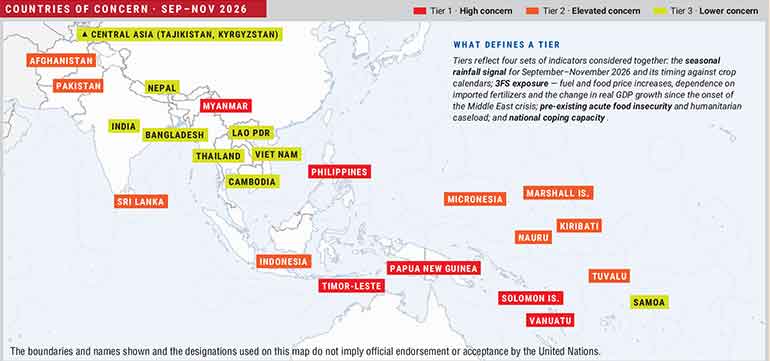
Sri Lanka has been listed within the Tier 2 Elevated Concern Group countries for El Nino and Middle East crisis as of August 2026 snapshot jointly issued by OCHA, FAO, WFP, UN Women, and the WMO.
Others in the Group include Indonesia, Pakistan and Afghanistan.
Lowest concern Tier 3 group includes countries such as India, Bangladesh, Thailand, Vietnam, Cambodia. High concern Tier 1 countries include Philippines and Myanmar.
The snapshot is structured in three parts and covers the period of September to November 2026. The three parts are climate risk outlook; convergence of pressures and from risk to action.
For Sri Lanka, as per the latest snapshot, the wetter signal becomes particularly important from October 2026 onwards, as it coincides with the Second Inter-Monsoon (October–November), typically the wettest period of the year across the country, followed by the Northeast Monsoon from December to February.
A substantial proportion of Sri Lanka’s annual rainfall is received during these latter parts of the year, and the Second Inter-Monsoon is particularly important because rainfall is widespread across much of the island and can be locally intense. As with Pakistan, the evolution of the Indian Ocean Dipole, particularly if it strengthens into a positive phase, will be important in determining wetter conditions.
The convergence risk is particularly relevant as the Maha season begins. Diesel and gasoline remain around 44% and 41% above pre- crisis levels, respectively, while headline CPI has increased by around 6%t (WFP, 2026b). Sri Lanka is also exposed to fertiliser imports and
international wheat markets, while elevated fertiliser prices during 2026 increased pressure on agricultural production (World Bank, 2026f).
These economic pressures coincide with the country’s principal rice-growing season and a wetter-than-average climate signal, creating the potential for higher input costs and possible fertiliser constraints to interact with heavy rainfall or flooding (FAO, 2026; WMO, 2026b).
The snapshot said the Asia and the Pacific is entering a period of increasingly complex and overlapping risk. El Niño conditions are strengthening, while the Indian Ocean Dipole (IOD) continues to fluctuate around neutral to positive levels but is forecast to become more consistently positive from September 2026. At the same time, renewed pressures linked to the Middle East are adding uncertainty to fuel, fertiliser, and food markets and supply chains.
The latest forecasts point increasingly towards a very strong, and potentially exceptional, El Niño — it could rank among the strongest events in the historical record and may extend well into 2027. However, its strength alone will not determine impacts. What matters is where rainfall and temperature anomalies coincide with crop calendars, water scarcity, vulnerable livelihoods and limited coping capacity.
The combined impact could result in an additional 8.2 million people facing acute food insecurity in Asia and the Pacific in just a few monitored countries, with the overall number likely higher.
The risk is already emerging, but widespread impacts have not yet materialised. This provides a critical, and narrowing, window for preparedness and anticipatory action. The most serious agricultural and food-security impacts may not emerge until late 2026 and 2027, leaving a short window to act before losses become entrenched. Humanitarian and development actors must work closely with National governments to strengthen monitoring preparedness, anticipatory action and response as early as possible.
The three Fs are creating a cascading shock where urea prices more than doubled at their peak, while fuel and food prices remain elevated, raising the risk that climate-related production losses translate into higher food insecurity in late 2026 and 2027.




