Tuesday Sep 15, 2026
Tuesday Sep 15, 2026
Saturday, 7 March 2026 00:05 - - {{hitsCtrl.values.hits}}
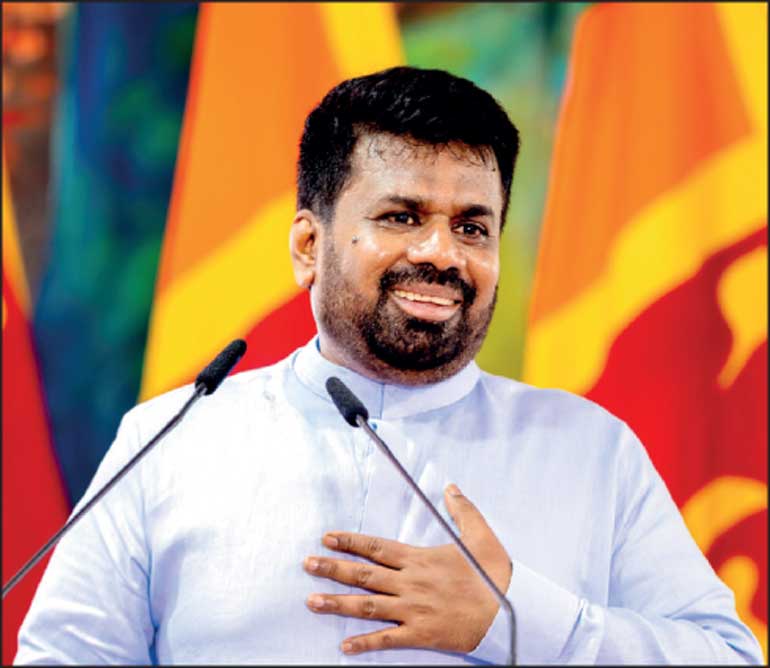
President Anura Kumara Dissanayake
 Carefully calibrated decision
In moments of geopolitical tension, the conduct of states is often measured not merely by their declarations, but by the calmness and clarity of their actions under pressure. Sri Lanka’s decision to disembark the crew of the Iranian vessel Bushehr at Colombo Port while transferring the vessel to Trincomalee reflects precisely such a moment of strategic maturity.
At first glance, the move appears humanitarian. At a deeper level, however, it represents a carefully calibrated decision at the intersection of international law, maritime security, and regional diplomacy.
The waters surrounding Sri Lanka are among the busiest maritime corridors in the world. Nearly two-thirds of global oil shipments and a substantial portion of global container traffic traverse the Indian Ocean sea lanes that pass within proximity of the island. Any incident involving a military vessel or a foreign crew in distress within this maritime space immediately acquires international strategic significance.
Sri Lanka’s response therefore had to achieve several objectives simultaneously: to uphold humanitarian obligations, maintain neutrality, reassure international partners, and prevent the escalation of geopolitical tensions in its immediate maritime environment.
The decision reflects adherence to the principles embodied in the United Nations Convention on the Law of the Sea, which obliges coastal states to provide assistance to vessels and seafarers in distress. By facilitating the safe disembarkation of the crew while transferring the vessel to the secure environment of Trincomalee Harbour, Sri Lanka demonstrated compliance with international maritime law while maintaining full sovereign control over the situation.
From a strategic perspective, this approach is significant for several reasons.
First, it reinforces Sri Lanka’s credibility as a responsible maritime state located at the centre of the Indian Ocean’s most critical sea lanes. In an era when maritime incidents can rapidly escalate into diplomatic crises, adherence to internationally accepted norms strengthens confidence among global shipping networks, naval powers, and commercial stakeholders.
Second, it demonstrates a degree of strategic balance that is increasingly rare in today’s polarised international environment.
Geopolitical fault lines
The reactions of major powers will inevitably differ, but the structure of Sri Lanka’s decision leaves little room for misinterpretation.
For the United States and its Western partners, the primary concern will be whether any action inadvertently enables Iranian strategic mobility. However, the humanitarian nature of the response, combined with transparent management of the vessel, aligns with the norms expected of responsible coastal states. The presence of the United States Seventh Fleet across the broader Indo-Pacific maritime theatre means that Washington’s priority remains freedom of navigation and maritime stability. Sri Lanka’s measured response contributes to both.
From the perspective of Israel, whose security concerns are closely tied to Iranian military capabilities, scrutiny will naturally exist. Yet a humanitarian intervention conducted within international law cannot easily be interpreted as strategic alignment. By keeping the response firmly within legal and humanitarian parameters, Sri Lanka avoids entering the geopolitical fault lines that characterise Middle Eastern rivalries.
For India, Sri Lanka’s closest maritime neighbour, the issue carries particular strategic sensitivity. The waters around Sri Lanka lie within India’s extended maritime security perimeter. Historically, New Delhi has watched developments in these waters with close attention. However, a responsible and transparent Sri Lankan response that prevents escalation is likely to be viewed positively. Stability in the immediate maritime neighbourhood ultimately serves India’s own strategic interests.
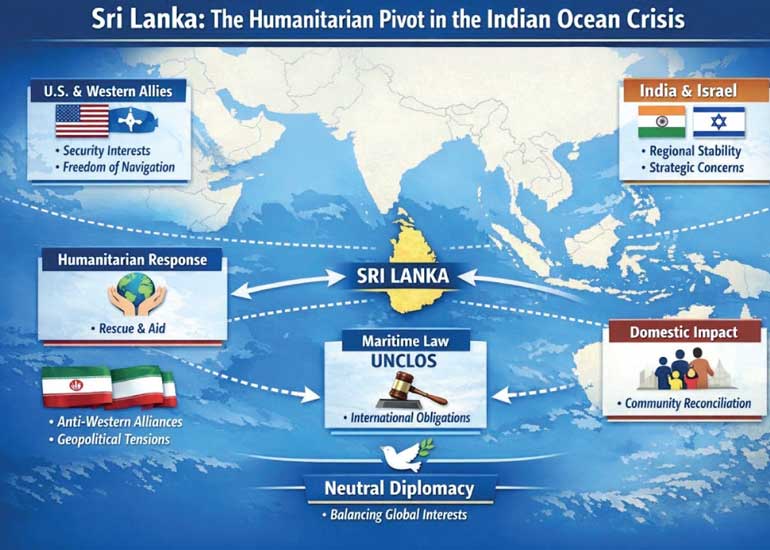
At the same time, countries that perceive the global order through the lens of Western dominance may interpret Sri Lanka’s actions differently. To them, the decision reflects sovereign independence in the conduct of foreign policy, a reminder that smaller states can act according to international law rather than geopolitical pressure.
This dual perception is precisely what makes Sri Lanka’s approach strategically effective. By acting strictly within humanitarian and legal frameworks, the country avoids being drawn into the competing narratives of global power blocs.
Rebuilding national cohesion
There is also an important domestic dimension to this development.
Sri Lanka’s internal political discourse has, at times, been vulnerable to opportunistic narratives that attempt to exploit external crises for short-term political advantage. The President’s call for restraint and unity in the face of this situation reflects an understanding that external security challenges require internal political maturity.
At another level, the humanitarian nature of the decision carries symbolic significance for Sri Lanka’s social fabric. In the aftermath of the 2019 Easter Sunday attacks in Sri Lanka, segments of the Muslim community have experienced a period of social and political unease. A response grounded in humanitarian principles toward the crew of a vessel from a Muslim-majority nation sends a subtle but meaningful signal: that Sri Lanka’s state institutions operate according to law and humanity rather than prejudice or political expediency.
Strategically, such gestures contribute to rebuilding national cohesion, an essential element of long-term security.
In the realm of intelligence and national security analysis, crises are often viewed through the concept of escalation management. The most effective responses are those that prevent an incident from becoming a catalyst for wider confrontation. Sri Lanka’s handling of this maritime episode reflects precisely such thinking.
Rather than allowing the incident to drift into the gravitational pull of global rivalries, the country has anchored its response in legal legitimacy and humanitarian responsibility. This reduces the likelihood that external actors will attempt to instrumentalise the situation for strategic advantage.
In effect, Sri Lanka has demonstrated that strategic neutrality is not passive; it requires active and carefully calibrated decision-making.
Historically, Sri Lanka has occasionally played roles larger than its geographic size would suggest. Through its participation in the Non-Aligned Movement, the island once championed the principle that smaller states could serve as bridges between competing geopolitical blocs.
The current situation offers an opportunity to revive elements of that diplomatic tradition.
By demonstrating that maritime incidents can be handled through law, humanitarian principles, and strategic restraint, Sri Lanka reinforces its identity as a stabilising presence in the Indian Ocean.
In an era where global politics increasingly appears defined by confrontation, such examples carry considerable symbolic value.
The Indian Ocean will continue to grow in strategic importance in the decades ahead. As trade routes expand and great-power competition intensifies, the stability of the sea lanes surrounding Sri Lanka will remain critical not only to regional economies but to the global system itself.
Against this backdrop, Sri Lanka’s handling of the Bushehr incident may well be remembered as a moment when the country quietly demonstrated the value of measured leadership in a volatile world.
Leadership in international affairs is not always expressed through power or influence. Sometimes it emerges through the ability to act with clarity, restraint, and humanity when circumstances demand it.
In this instance, Sri Lanka has shown that even a small state can shape the tone of regional diplomacy—not through confrontation, but through principled conduct in the service of peace and stability.
(The author is a Senior Security Analyst and Former Head of Counter-Terrorism, SIS Sri Lanka).




