Wednesday Sep 30, 2026
Wednesday Sep 30, 2026
Friday, 19 June 2026 01:19 - - {{hitsCtrl.values.hits}}
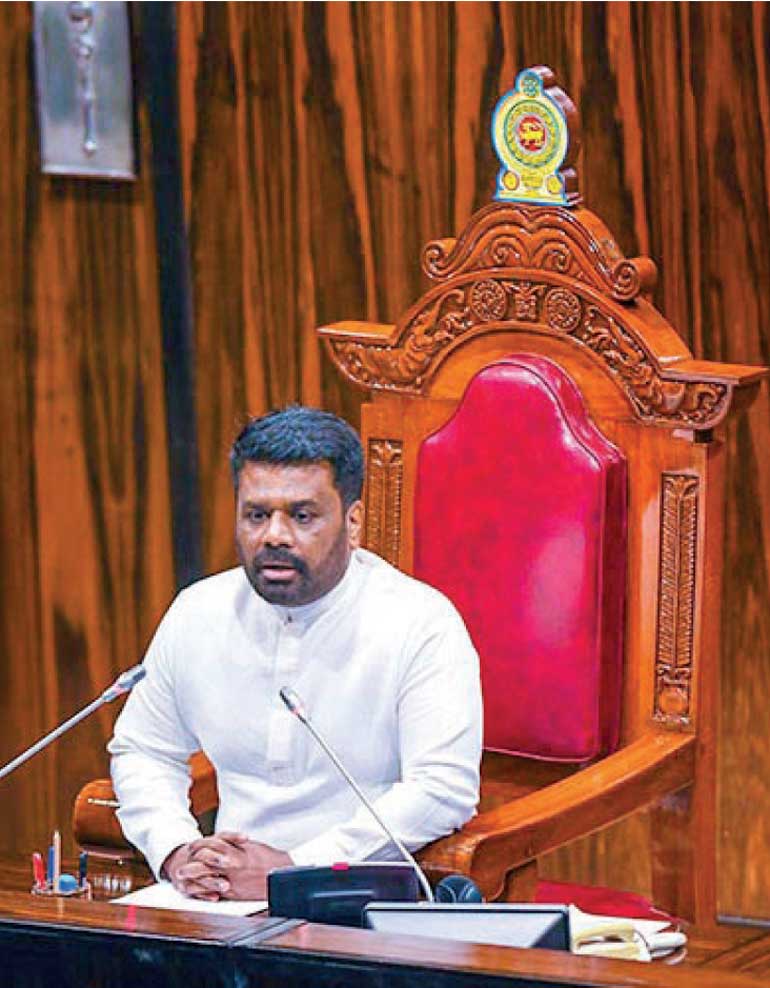
President and Finance Minister Anura Kumara Dissanayake, can his Government convert the macroeconomic gains over the last few into a more productive and prosperous economy

Sri Lanka is suffering from macro-economic myopia. Our national discourse has become so obsessed with the next IMF review, the next tax bracket, and the next debt-restructuring milestone that we seem to have mistaken survival for success. Securing macroeconomic stability is a historic necessity, but a nation cannot live indefinitely in crisis-management mood.
After years of painful adjustment and recovery, Sri Lanka stands at a critical juncture. While the immediate threat of economic collapse has diminished, the task of consolidating recent gains and building a competitive, productive, and resilient economy still lies ahead. Perhaps the more important question is not whether Sri Lanka will require an eighteenth IMF programme, but whether the macroeconomic gains over the last few years can be translated into a more productive and prosperous economy.
The IMF can help Sri Lanka avoid default, restore confidence, and buy valuable time. What it cannot do is create prosperity.
Trap of confusing stabilisation with growth
We must not confuse stabilisation with development. One is a liquidity fix; the other is a structural evolution. Fiscal consolidation, revenue mobilisation, prudent monetary policy, and debt restructuring have successfully helped stabilise the economy and restore market confidence. However, stability alone does not solve a solvency problem.
Sustainable debt reduction requires stronger exports, services, and foreign direct investment that generate non-debt foreign exchange earnings. Even if we flawlessly navigate the 2028 repayment cycle, balancing the State’s ledger through aggressive taxation and expenditure cuts alone is a math exercise, not an economic strategy. A stable ledger on a dying economy is a hollow victory.
This highlights a reality often overlooked in our economic debate: Sri Lanka faces two interconnected challenges operating on different timelines: an immediate liquidity challenge and a longer-term economic development challenge. The difficulty is compounded by the fact that the policies required to address them do not always align.
Measures that strengthen liquidity and stability in the short term can at times constrain investment and growth. Conversely, long-term development requires sustained investment in infrastructure, human capital, innovation, and productive capacity, with benefits that may take years to materialise. We cannot permanently escape a debt trap through borrowing or expenditure restraint alone. Debt sustainability ultimately depends on building a larger, more productive, and internationally competitive economy.
Therefore, Sri Lanka requires a genuine two-track strategy: managing liquidity in the short term while building the foundations for long-term economic development. Ultimately, economic policy must deliver both solvency for the State and prosperity for its people.
Crossing 2028: Constructing the financial runway
The immediate challenge is to construct a financial bridge capable of carrying the economy through the critical period leading up to and beyond 2028. This bridge will depend on a combination of IMF credibility, multilateral financing, bilateral partnerships, eventual re-entry into international capital markets, and potentially a precautionary IMF arrangement, such as a Stand-By Arrangement (SBA), should external conditions warrant it.
While IMF financing is important, its greater value lies in providing policy credibility and unlocking financing from other sources. In many respects, the IMF functions less as a primary source of funding and more as a catalyst that reassures investors, development partners, and international capital markets.
As Sri Lanka moves closer to completing its current Extended Fund Facility (EFF) next year, the objective should be to transition from crisis-driven financing towards precautionary support mechanisms and normal market access. Such a transition would signal confidence in the country’s macroeconomic management while preserving access to external liquidity should unforeseen shocks emerge.
Continued support from multilateral and bilateral partners will remain a critical component of this liquidity bridge. Beyond the financing they provide, institutions such as the World Bank and Asian Development Bank play an important role in reinforcing confidence and mobilising investment. Improved sovereign creditworthiness, bilateral support arrangements, and a gradual return to international capital markets will also be important in managing future external obligations.
The firefighter is not the architect
One of the most persistent misconceptions in Sri Lanka’s economic discussion is the belief that an IMF program is, by itself, a pathway to growth and prosperity. It is definitely not.
The IMF is an economic firefighter, not an architect. It can douse the flames of default and help us clear the rubble, but it will not draft the blueprints for our future. The IMF will not train a single software engineer, it will not negotiate a supply-chain slot for a local manufacturer, and it will not magically improve the ease of doing business in Colombo. Those choices ultimately depend on domestic economic leadership, policy consistency, and the ability to implement a credible long-term development strategy.
The uncomfortable reality is that Sri Lanka’s economic debate remains disproportionately focused on financing rather than production. We spend far more time discussing lines of credit than how to increase exports, improve productivity, and build globally competitive industries. Financing matters, but it is ultimately a means to an end. Long-term prosperity comes from producing goods and services that the rest of the world actually wants to buy.
Execution deficit: Moving beyond sector lists
While liquidity management is essential, it cannot substitute for long-term economic transformation. The country must become more productive, competitive, export-oriented, and integrated into regional and global value chains.
Every policy paper lists ICT, logistics, maritime services, and tourism as growth engines. Yet growth is rarely constrained by the absence of sector strategies; it is constrained by weak execution, regulatory delays, inconsistent policies, and institutional inertia.
Sri Lanka’s export basket remains dangerously concentrated and vulnerable to external demand shocks. Future growth will depend on strengthening traditional sectors through value addition while expanding into higher-value manufacturing, technology, engineering, and knowledge-intensive industries.
However, neither export growth nor investment attraction can be sustained without radical improvements in productivity. Capital is notoriously cowardly; it goes only where it feels safe and stays where it is appreciated.
Right now, a Sri Lankan entrepreneur pitching to an international investor often spends more time explaining tax changes, approval delays, and policy reversals than explaining the business itself.
Attracting high-quality foreign direct investment requires policy consistency, regulatory predictability, efficient institutions, and a business environment that rewards enterprise over bureaucracy. We must ask hard questions: Why are our brightest minds leaving? Why does it take months to clear regulatory hurdles that our regional competitors solve in days?
Long-term competitiveness is not about identifying winning sectors; it is about removing the policy uncertainty, bureaucratic delays, and institutional inefficiencies that prevent firms from winning globally.
Sovereignty is earned, not borrowed
Perhaps Sri Lanka’s greatest challenge is not identifying what needs to be done, but finding the political and institutional discipline to do it consistently over time. Our economic history is littered with promising reforms that were diluted, reversed, or abandoned before their benefits could fully materialise. Sustainable economic transformation requires continuity across political cycles, credible institutions, and a national consensus that extends beyond electoral mandates.
The real test of economic policy is not whether it balances the Government’s books, but whether it expands the productive capacity of the nation. Countries do not achieve prosperity through fiscal adjustment alone. They prosper by producing more, competing more effectively, and creating value that the rest of the world is willing to pay for.
Economic sovereignty is not achieved through rhetoric, protectionism, or periodic access to external financing. It is earned through competitiveness, productivity, resilience, and credibility. Nations become truly sovereign when they can finance their development through the strength of their own economies rather than the patience of their creditors.
The IMF can help Sri Lanka restore stability and buy valuable time. What it cannot do is determine how that time is used. That responsibility rests with us.
History will not judge Sri Lanka by IMF reviews, reserve accumulation, or fiscal targets. It will judge us by whether we used this moment to build a larger, more productive, and more prosperous economy.
Solvency may save the State. Only prosperity can secure the future of its people.
(The Author is the Chairman of Navara Capital Ltd. He is a Chartered Banker and a Chartered Management Accountant, holding a PhD in Strategic Management and Master’s degrees in Commercial Law and in Business Administration)



