Thursday Oct 22, 2026
Thursday Oct 22, 2026
Wednesday, 8 April 2026 02:58 - - {{hitsCtrl.values.hits}}
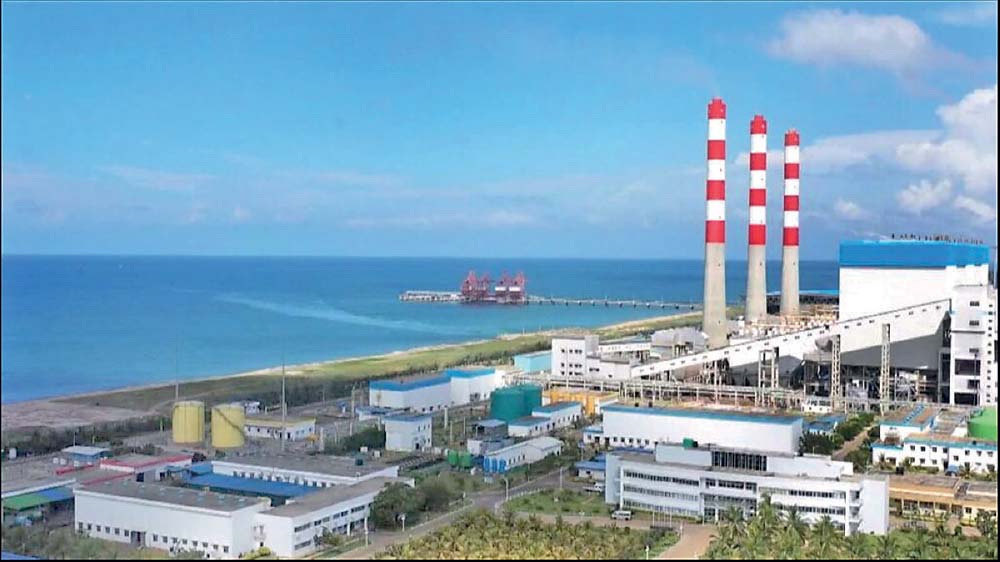
Norochcholai Power Plant
Every year, Sri Lanka’s only coal power plant releases tens of thousands of tons of sulphur dioxide over the North Western Province, spends over $100 million importing fertiliser that could be made from those same emissions, and files compliance reports that every independent observer agrees are worthless. The technology to fix all three problems costs less than one year of the damage it prevents — and it exists, proven, in plants from China to Germany. What is missing is not money. It is political will…and the ability to think out of the box
 Passionate about the country, Mawandia tracks energy policy, climate change, impact investing and sovereign risk across South and Southeast Asia. Views expressed are his own.
The smoke nobody is counting
On a clear morning in Norochcholai, the three concrete stacks of the Lakvijaya power station stand against the sky like fingers pointing at an accusation nobody wants to read. The plant generates about a third of Sri Lanka’s electricity. It is the country’s only coal-fired power station, and it has been, by almost any measure of regulatory compliance, operating outside the law for most of its existence.
The story of Norochcholai is not simply one of a badly run power plant. It is the story of a country that built industrial infrastructure, attached legal obligations to it, and then collectively decided not to enforce them — not once, not for a year, but for over a decade and a half. It is the story of the Flue Gas Desulphurisation units — the scrubbers that were supposed to remove sulphur dioxide from the plant’s emissions before they reached anyone’s lungs — being installed, repeatedly breaking down, being out of service for months at a time, and never once resulting in a prosecution, a fine, or a shutdown order.
And it is, buried inside all that failure, the story of an extraordinary missed opportunity. Because the sulphur dioxide that Norochcholai pumps into the atmosphere is not just a poison. In the right system, with the right technology, it is a raw material. It is nitrogen and sulphur. It is fertiliser. It is foreign exchange that Sri Lanka desperately needs and currently spends nearly $200 million a year importing.
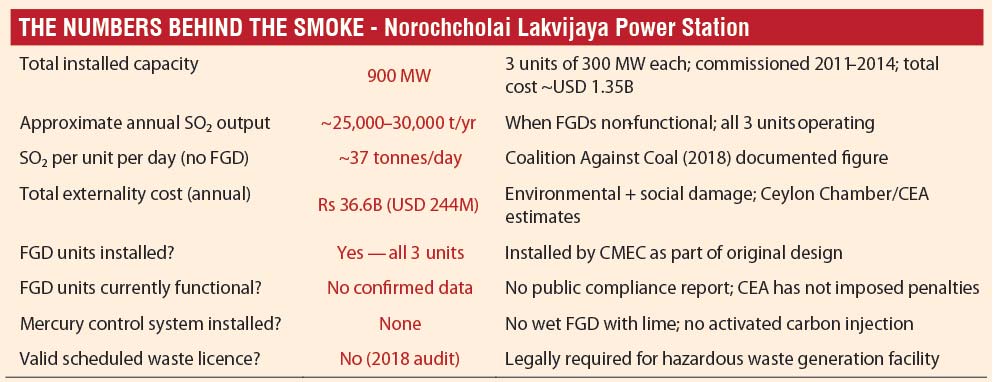
“Each day the FGD of a single unit is non-functional, 37,000 kg of sulphur oxides are released to the sky, creating acidification. The same audit documented approximately 1,000 tons of fly ash generated per day, with around 400 tons openly dumped rather than sold - Coalition Against Coal (CAC), Report on Lakvijaya Power Plant Environmental Compliance (2018).
The machine that should have worked
Flue Gas Desulphurisation (FGD) is not exotic technology. It is a proven, globally deployed system that removes sulphur dioxide from the exhaust gases of coal-burning boilers before they exit the stack. More than 90% of coal-fired plants in the United States, the European Union, China, and Japan operate with functional FGD systems. The technology comes in several variants — wet limestone, seawater, dry injection, and ammonia-based — and the most basic versions have been commercially operating since the 1970s.
Norochcholai was built with wet FGD units as part of its original design — not as an afterthought, but as a contractual requirement, because the plant burns imported bituminous coal — sourced from Indonesia (the primary supplier), South Africa, Australia, and Russia — which at the sulphur concentrations used requires scrubbing. Without the FGD, the plant’s emissions exceed Sri Lanka’s own permissible limits under the National Environmental Act. The Central Environment Authority (CEA), the regulatory body responsible for enforcement, has known this for years.
The FGD units have been described, in successive compliance reviews, as chronically non-functional. In a 2018 investigation by the Coalition Against Coal, the FGD on Unit 1 had not been operational for a continuous period spanning from October 2017 to January 2018, then again for 24 days in February–March 2018 alone. The plant’s electrostatic precipitators — the equipment that captures fine particulate matter — malfunctioned for months. In July 2018, the FGD unit on Unit 2 was destroyed when a welding fault set its insulation material on fire. The sensors that are legally required to monitor emissions continuously were found to be uncalibrated and, according to the Coalition’s engineers, producing data that was “neither reliable nor accurate.”
When the FGDs are non-functional — which, by available evidence, is frequently — each of the three 300 MW units releases approximately 37 tons of sulphur oxides per day directly into the atmosphere. With all three units operating at full load, the plant’s total annual SO₂ emissions reach an estimated 25,000–30,000 tons per year — dispersed by the monsoon winds across the North Western Province, the Puttalam lagoon, agricultural land stretching toward Anuradhapura, and ultimately across a country that has no functioning ambient air quality monitoring network with which to measure what it is receiving.
A price paid in lungs and harvests
Sulphur dioxide does not stay where it is emitted. It travels. Studies of Indian coal plants — whose geography and monsoon patterns are broadly comparable to Sri Lanka’s — have shown SO₂ dispersal of up to 200 kilometres from source, forming secondary fine particulate matter (PM2.5) as it reacts with moisture and ammonia in the atmosphere. According to the Centre for Research on Energy and Clean Air (CREA), 80% of PM2.5 from coal combustion is secondary particulate formed from SO₂. It is this secondary PM2.5, not the visible smoke from the stack, that penetrates deepest into the lungs and enters the bloodstream.
The Puttalam district, where Norochcholai is located, already has among the highest chronic respiratory disease burdens in Sri Lanka. The North Western Province produces significant quantities of the country’s rice, coconut, and tobacco — all crops sensitive to sulphur deposition and soil acidification. Sulphur oxide emissions at scale, falling as acid rain, lower soil pH, leach out calcium and magnesium, and reduce yields over time in ways that are diffuse, hard to attribute to a single source, and therefore politically invisible.
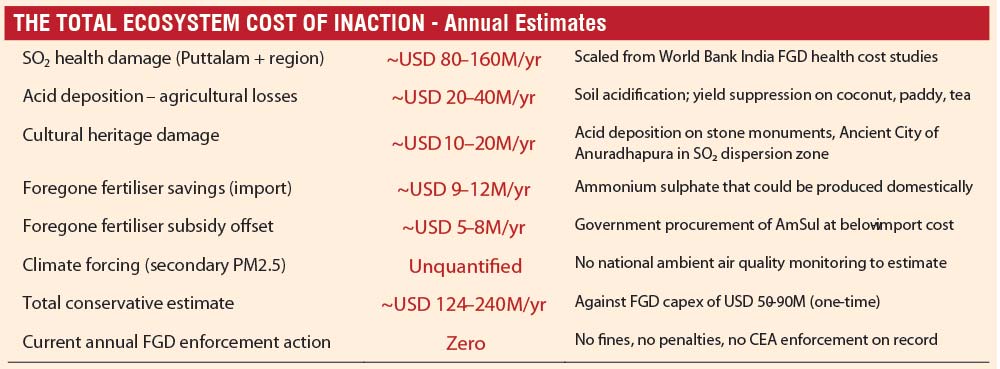
The total social and environmental damage from Lakvijaya’s emissions has been estimated at Rs 36.6 billion — approximately $244 million — per year, according to analysis by the Ceylon Chamber of Commerce and CEA. This figure encompasses air quality damage to human health, acid deposition damage to agriculture and ecosystems, and damage to Sri Lanka’s cultural heritage, which includes some of the world’s most significant ancient monuments in the direct downwind path of the plant. None of this cost appears on any electricity bill. None of it is paid by the Ceylon Electricity Board. It is paid — silently, invisibly, continuously — by Sri Lankan citizens.
“Sulphur oxide emissions can travel far (up to 200 km) and acidity poses a serious risk to Sri Lanka’s unique cultural and natural heritage. The plant also has no protections against mercury pollution.” — Coalition Against Coal, Environmental Audit of Lakvijaya Coal Power Station (2018)
The fertiliser factory hidden in the smoke
Here is the part of the story that receives almost no attention, despite being, in economic terms, perhaps its most important feature. The sulphur dioxide that Norochcholai is emitting in violation of its own operating licence is not simply waste. With a different FGD configuration — specifically, an ammonia-based scrubbing system rather than the limestone-based system currently installed — that sulphur dioxide becomes the feedstock for ammonium sulphate, one of the world’s most widely used agricultural fertilisers.
Ammonium sulphate — (NH₄)₂SO₄ — contains 21% nitrogen and 24% sulphur. It is particularly valued for acidic-loving crops, for tea (Sri Lanka’s most important agricultural export, grown on soils that require sulphur nutrition), for coconut, for tobacco, and for paddy rice in sulphur-deficient soils. Sri Lanka currently imports ammonium sulphate as part of a total fertiliser import bill that reached $197 million in 2024, and was as high as $270 million in 2022 during post-crisis restocking. The country spent approximately $253 million per year on fertiliser subsidies even before the 2021 organic fertiliser disaster — the government’s catastrophic attempt to go fully organic overnight, which cut agricultural output by 20–40% in its first growing season and contributed directly to the food security dimension of the 2022 crisis.
The ammonia-based FGD process works as follows. Instead of injecting limestone slurry to react with SO₂ and produce gypsum — a low-value, difficult-to-dispose-of byproduct — ammonia is injected into the scrubbing tower. The SO₂ reacts with ammonia and oxygen to produce ammonium sulphate in solution, which is then crystallised and dried into granular fertiliser. The process produces no liquid waste streams. The closed-loop system is cleaner than limestone FGD. And it generates a saleable product.
A Shenhua Ningxia CTL plant in China, operating on a comparable scale to Norochcholai, documented the economics with precision: limestone FGD was costing the plant $14.6 million per year in operating costs including gypsum disposal. Switching to the ammonia-based Efficient Ammonia Desulfurisation (EADS) process not only eliminated those costs — it turned the scrubbing operation into a net profit of over $500,000 per year from ammonium sulphate sales, at market prices of approximately $90 per ton. At today’s ammonium sulphate prices of $140–160 per ton for the Asia-Pacific market (China: $143/t; Southeast Asia: $155/t, mid-2025), the economics are considerably stronger.
“The ammonia-based FGD process can essentially eliminate operating costs while generating a profit from the sale of ammonium sulphate — netting total annual savings of approximately $15 million versus limestone FGD alone.” — Power Engineering International, Ammonia-Based Flue Gas Desulfurisation (Shenhua Ningxia CTL plant case study).
What the numbers say: The case for ammonia FGD at Norochcholai
The table below presents indicative figures for Norochcholai against comparable Indian and Western plants, drawing on published engineering data, Indian Central Electricity Regulatory Commission benchmarks, World Bank health cost studies, and publicly documented plant case studies. These are engineering estimates, not audited accounts — but they are derived from real-world comparable projects and are sufficiently precise to frame a capital allocation decision.
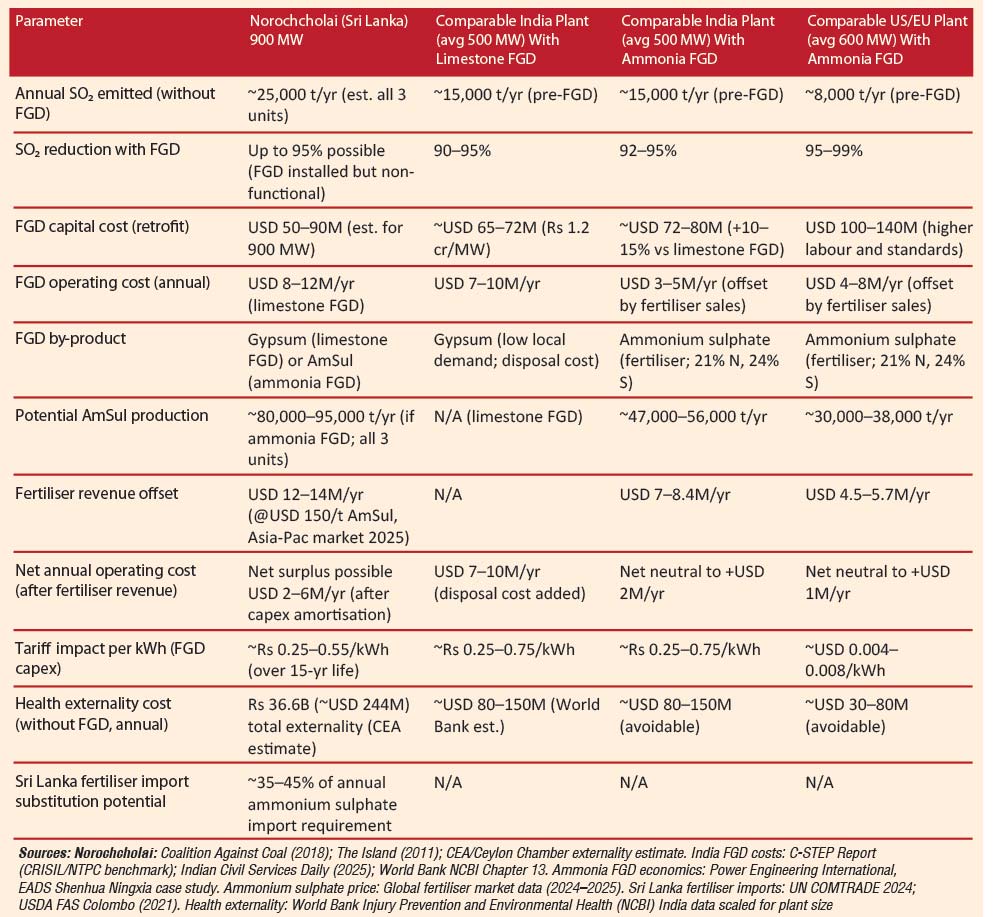
The key numbers crystallise the decision. With ammonia-based FGD operational on all three units, Norochcholai could produce approximately 80,000–95,000 tons of ammonium sulphate per year. At $120 per ton, that is $9.6–11.4 million per year in fertiliser that Sri Lanka would no longer need to import. Against annual FGD operating costs of approximately $3–5 million, the net operating cost of running the scrubbers effectively approaches zero — or turns slightly positive.
The capital investment required is the real question. Retrofitting Norochcholai’s three units with upgraded ammonia-based FGD is estimated at $50–90 million, depending on the scope of work required to rehabilitate or replace the existing limestone scrubbers. Spread over a 15-year asset life, this amounts to approximately Rs 0.25–0.55 per kilowatt-hour of generated electricity — a fraction of the Rs 7.55 per unit that PUCSL’s own External Cost Study attributed to the health damage from Kelanitissa’s uncontrolled HFO emissions, and an even smaller fraction of the $244 million in annual externality damage attributed to Norochcholai itself.
The payback period, accounting for fertiliser revenue offsets, avoided health costs (which the IMF, World Bank, and every serious environmental economist would price into any sound national investment appraisal), and avoided acid rain damage to agriculture, is well under five years. Framed as a straightforward infrastructure investment with a quantifiable return, the ammonia FGD retrofit at Norochcholai is one of the most attractive capital projects available to the Sri Lankan state.
Why tea needs this fertiliser and why that matters
Ammonium sulphate is not a generic fertiliser. It occupies a specific niche in the nutrient requirements of the crops that define Sri Lanka’s agricultural export economy. Tea requires both nitrogen for vegetative growth and sulphur for amino acid synthesis and enzymatic function. Sri Lankan tea research has consistently shown that sulphur deficiency — common in the high-rainfall, highly leached red laterite soils of the hill country — limits shoot growth and ultimately reduces the quality and quantity of made tea. The Tea Research Institute of Sri Lanka recommends ammonium sulphate as the nitrogen carrier of choice specifically because it simultaneously addresses both deficiencies.
Coconut, which covers more than 400,000 hectares of the North Western Province — the very province downwind of Norochcholai — responds strongly to sulphur nutrition. Paddy rice in sulphur-deficient soils shows yield increases of 10–25% from sulphur application. The irony could not be sharper: Norochcholai’s emissions are depositing sulphur compounds over Sri Lanka’s agricultural land in an uncontrolled, acidifying form that damages crops, while a controlled FGD system would capture that same sulphur and deliver it to those same soils as a precision-formulated fertiliser that farmers are currently importing from China, Malaysia, and the Middle East.
Five things the authorities must finally do
The regulatory failure at Norochcholai is not a mystery. The law exists. The licence conditions exist. The emission standards exist. The enforcement body — the Central Environment Authority — exists. PUCSL, as the sectoral environmental regulator for the electricity industry under the Sri Lanka Electricity Act, has the authority to impose conditions on generation licences and to sanction non-compliance. What has been absent is the decision to use these powers. What follows is not a wish list. It is a description of what these institutions are legally obligated to do.
1. Commission an independent technical audit of the FGD units
Not an audit by CEB’s own engineers. An independent technical audit, commissioned by PUCSL, conducted by a qualified environmental engineering firm with no CEB relationship, producing a public report on the current operational status of every piece of air pollution control equipment at Norochcholai. The last credible public assessment was conducted by an NGO in 2018. The state regulator has produced nothing equivalent in seven years. This is the foundational requirement from which everything else follows.
2. Impose time-bound emissions compliance conditions on the plant’s generation licence
PUCSL has the legal authority to impose conditions on the CEB’s generation licence under the Sri Lanka Electricity Act. Those conditions should specify: (a) maximum SO₂ emission concentrations, aligned with current standards; (b) a 24-month deadline for the FGD units on all three stacks to achieve certified operational status; (c) financial penalties for every month of non-compliance, enforceable without ministerial override; and (d) automatic generation restrictions if emissions exceed twice the permitted level. The 2025 Amendment Act has weakened PUCSL’s independence, but its licence-condition powers remain. They must be used.
3. Conduct a feasibility study for ammonia-based FGD with
fertiliser co-production
The technology is proven. The economics, as this article has summarised, are compelling. The Ministry of Energy should commission — within six months — a full engineering feasibility study for retrofitting Norochcholai’s FGD system with ammonia-based technology to produce ammonium sulphate for domestic agricultural use. The study should include: comparative capex and opex estimates for limestone vs ammonia FGD; market assessment of domestic ammonium sulphate demand (Tea Research Institute, coconut sector, paddy growers); procurement options and possible co-financing by the ADB, World Bank, or Japanese government, all of whom have active programmes in Sri Lanka’s power sector.
4. Integrate fertiliser co-production into the national agriculture and import substitution strategy
Sri Lanka spent $197 million importing fertiliser in 2024. It is rebuilding its agricultural sector following the 2021 organic fertiliser catastrophe. The Ministry of Agriculture and the Ministry of Energy have never, to any public knowledge, held a joint meeting on the potential of coal plant FGD by-products to supply domestic fertiliser needs. That meeting should happen. A formal inter-ministerial working group should be established to assess whether ammonia-based FGD at Norochcholai can be structured as both an environmental compliance measure and a food security investment. These are not competing objectives. They are the same investment.
5Establish a national ambient air quality monitoring network
Sri Lanka currently has no credible, publicly reported, continuously operating ambient air quality monitoring system covering the areas affected by Norochcholai. The Fort Station in Colombo, installed in 1996, is the primary reference point. This is not compliance monitoring. It is the absence of monitoring. Without it, Sri Lanka cannot quantify what its citizens are breathing, cannot hold polluters accountable, cannot meet its international environmental commitments, and cannot make evidence-based decisions about power generation technology. A network of CAAQMS stations covering at least Puttalam, Anuradhapura, Kurunegala, and Colombo should be deployed within 12 months, with data published in real time.
The country that keeps choosing the expensive option
Sri Lanka’s relationship with Norochcholai is a microcosm of its relationship with its own institutions: rules are written, agencies are established, licences are issued, and then the enforcement step is quietly omitted. In the electricity sector, this omission has already cost the country a sovereign default. In the environmental sector, it is costing approximately $124–240 million per year in avoidable damage — and it is wasting an opportunity to produce a critical agricultural input domestically rather than importing it.
The country that banned organic fertiliser imports in 2021 and watched its rice production collapse; that spent the 2022 crisis scrambling for foreign exchange it did not have; that has a fertiliser import bill of nearly $200 million a year while operating a facility that could produce a significant portion of that domestically from what is currently being pumped into the atmosphere as an unregulated pollutant — that country should not need to be persuaded that the ammonia FGD investment at Norochcholai makes sense. The arithmetic is not complicated. The technology is not novel. The legal obligation to act exists, has always existed, and has simply never been met.
Norochcholai will continue to operate, under the CEB LTGEP 2025–2044, until approximately the late 2030s when it is scheduled to retire at the end of its coal supply contracts and make way for LNG and renewables. That is fifteen years of continued operation. Fifteen years of SO₂ emissions that either poison the atmosphere over Sri Lanka’s most agriculturally productive provinces, or become ammonium sulphate fertiliser for Sri Lanka’s tea and coconut and rice farmers. The choice is not between coal and clean energy. That choice has already been made. The choice is between extracting value from an asset the country is stuck with, or simply continuing to pay the costs of operating it badly.
Fifteen years of smoke or fifteen years of fertiliser. The technology, the economics, and the law all point in the same direction. Only the regulator is looking away.
SOURCES and METHODOLOGY NOTES
Norochcholai FGD status and emissions: Coalition Against Coal (CAC), Environmental Audit of Lakvijaya Coal Power Station (June 2018); The Island, ‘Coal Power and Emissions in Sri Lanka’ (2011); Sunday Times Sri Lanka, ‘Explosive Report on Hazards of Norochcholai Coal Power Plant’ (June 2018); Ilankai Tamil Sangam, ‘Report on Norochcholai Power Plant’. SO₂ per unit per non-FGD day (37 tons): CAC audit (2018). Annual SO₂ estimate (25,000–30,000 t): The Island (2011) projection for all 3 units; CEA draft emission standards. Total externality cost (Rs 36.6B/$244M): Ceylon Chamber of Commerce EIU / CEA estimate, as cited in multiple secondary sources. FGD technology and ammonia FGD: Power Engineering International, ‘Ammonia-Based Flue Gas Desulfurisation — EADS technology at Shenhua Ningxia CTL Plant’ (2021); NCBI Bookshelf, ‘Costs and Benefits of Installing FGD Units at Coal-Fired Power Plants in India’ (World Bank, 2017). India FGD costs (Rs 1.2 crore/MW): Civil Services Daily (2025); C-STEP Report; Electrical India Magazine. FGD compliance status India: CREA, ‘Increased SO₂ Emissions from Coal-Fired Power Plants’ (November 2024); CREA, ‘Enforcing SO₂ Norms in India’s Coal Power Plants Is Non-Negotiable’ (May 2025). Sri Lanka fertiliser imports ($197M, 2024): UN COMTRADE database (2025). Fertiliser subsidy cost 2019 (LKR 46B): USDA FAS Colombo Report (2021). 2022 imports ($270M): OEC World. Ammonium sulphate price ($115–130/t, 2024–2025): Global fertiliser market data. Tea and sulphur nutrition: Tea Research Institute of Sri Lanka, fertiliser recommendations; agronomic literature on sulphur-deficient laterite soils. PUCSL environmental mandate: Sri Lanka Electricity Act No. 20 of 2009; PUCSL External Cost Study (2020). LTGEP 2025–2044: CEB/PUCSL (May 2025). Coal composition (South African coal): CAC audit; CEB procurement records. Fly ash and coal spillage: CAC (2018) — 17,000t spillage to ocean; 50,000t wind-blown losses estimated.
(The author is passionate about the country, and tracks energy policy, climate change, impact investing and sovereign risk across South and Southeast Asia. Views expressed are his own. He could be reached via email [email protected])



