Thursday Mar 12, 2026
Thursday Mar 12, 2026
Monday, 22 December 2025 00:00 - - {{hitsCtrl.values.hits}}
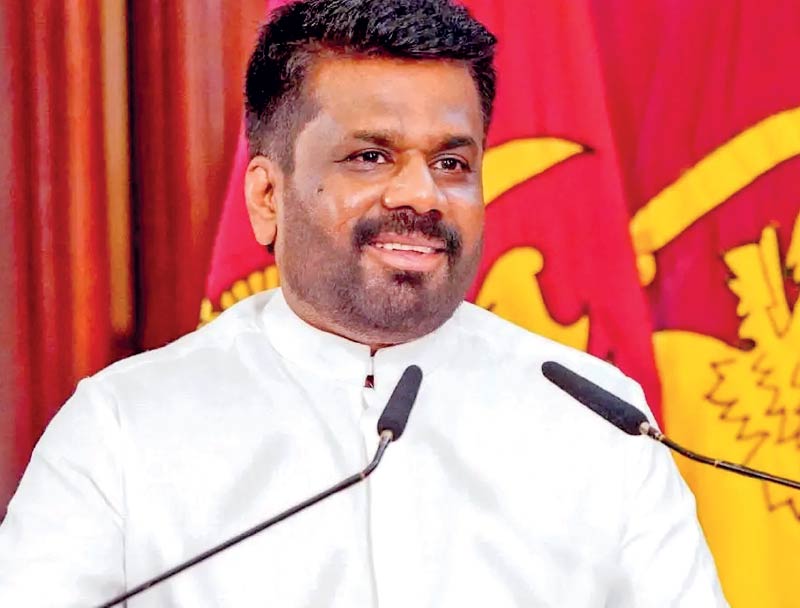
President and Finance Minister Anura Kumara Dissanayake
Your Excellency, Our nation faces a defining moment. A devastating cyclone has left more than 2 million of our population in crisis, demanding immediate and massive funding for relief and reconstruction. Simultaneously, the postponement of the proposed property tax reveals the profound difficulty of reforming a system that is fundamentally broken.
These are not separate crises. They are symptoms of the same disease: a tax system that punishes production, rewards evasion, and is incapable of generating the revenue needed for either disaster response or national development.
Raising existing taxes—VAT, income tax—will only deepen the misery, fuelling inflation and pushing more citizens into poverty. We therefore propose a complete paradigm shift: the Single National Asset Tax (SNAT). This is not a minor adjustment. It is a coherent plan to immediately double Government revenue to fund disaster recovery and permanently abolish all other major taxes to unleash an economic boom that lifts every Sri Lankan.
Part 1: The revenue revolution – Funding the recovery and beyond
The question is how to find hundreds of billions for reconstruction without crushing the people. The answer lies in a resource we have failed to tap: the immense wealth held in property and assets by the most affluent Sri Lankans.
1.1 The untapped potential
The current revenue from all local property taxes and national vehicle licenses is a pittance. Official data reveals its shocking underuse:
Current Annual Revenue Base
This Rs. 75 billion base is just 2.1% of total Government revenue. Our current system ignores the nation’s primary store of wealth.
1.2 The SNAT Solution: A 100x multiplier
The SNAT proposes a simple, urgent measure: apply a 100x multiplier to this existing base.
Revenue Impact of the SNAT
This single step, focused on asset wealth, generates over Rs. 7.5 trillion—enough to fully fund the disaster response and create a historic surplus to transform the economy over the next 10 years.
Part 2: The foundation – Where the nation’s wealth resides
The SNAT is not merely a revenue tool; it is a corrective for
profound inequality. Economic analysis reveals a stark concentration of national wealth:
Socio-Economic Classes and Wealth Distribution
The inescapable conclusion: the top 7% of Sri Lankans control approximately 70% of the nation’s wealth, primarily in real estate and business capital. The current system taxes their income and consumption, which can be hidden or avoided. The SNAT targets their visible, immovable assets—a fair and efficient approach.
Part 3: The great unwinding – Abolishing a broken system
This levy must be the gateway to permanent reform. We propose using this moment to abolish the taxes that strangle our economy:
Part 4: The design – Fairness, stability, and simplicity
4.1 Core Mechanism The SNAT is an annual levy on two visible asset classes which can never be hidden: 1. Immovable Property (land and buildings) 2. Luxury Vehicles (cars, SUVs) 4.2 Iron-Clad Safeguards
Part 5: The transformative impact – A six-month horizon
1.Plummeting Prices and Export Boom: The removal of embedded taxes would slash production costs and less Bank borrowings. Our exports would become instantly hyper-competitive, and a lower cost base would make Sri Lanka a premier destination for tourism, manufacturing and for Foreign Direct Investments.
2.Currency Appreciation: The flood of revenue and investment would strengthen the Rupee dramatically, reducing the cost of imports, including essential food and fuel, further combating inflation.
3.Investment Floodgate: With no corporate tax, Sri Lanka becomes the region’s premier investment destination.
4.Brain Drain Reversal: Professionals will have every reason to build their futures here.
5.Poverty Reduction: Soaring real incomes and job creation will lift millions out of poverty within a year.
6.Financial Liberation: Abolishing tax on interest will collapse lending rates to 3-5%, making capital accessible for all.
Part 6: A global precedent and a final appeal
This model is grounded in global success. Estonia—a “Baltic Tiger”—booms under a policy that taxes corporate profits only upon distribution, not reinvestment. The SNAT applies this growth-centric logic to our entire economy. Estonia’s tax system is widely considered the most efficient and competitive in the world (consistently ranked #1 by the Tax Foundation).
Its uniqueness stems from a “business-first” philosophy that prioritises reinvestment over immediate collection. Your Excellency, the traditional path leads to more inflation, more poverty, and deeper division. It is a path of despair. The SNAT offers a path of unity, recovery, and historic prosperity. It aligns the interests of the wealthy with the recovery of the nation. It provides the state with abundant revenue while liberating its citizens from a punitive and complex system. The cyclone has laid bare our vulnerabilities. Let our response reveal our strength and vision. We urge you to seize this moment not merely to rebuild, but to reinvent—to champion the Single National Asset Tax (SNAT) and lead Sri Lanka into a new era of justice and abundance.
Respectfully, a concerned citizen for economic renewal.




