Thursday Feb 26, 2026
Thursday Feb 26, 2026
Saturday, 10 January 2026 00:04 - - {{hitsCtrl.values.hits}}
 A seizure with systemic implications
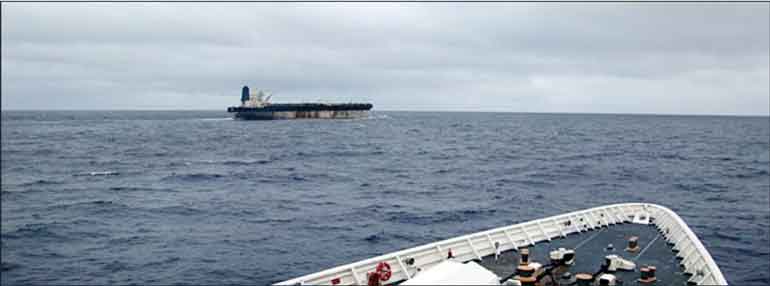
THE recent seizure by the United States of a Russian-flagged oil tanker on the high seas has drawn sharp diplomatic protest from Russia, but the real significance of the episode lies well beyond the immediate bilateral dispute. At its core, the incident raises a fundamental question confronting the contemporary international system: can a State unilaterally enforce its domestic sanctions regime on the high seas without multilateral authorisation?
On the surface, the episode may appear technical—one vessel, one interception, one diplomatic exchange. Yet history shows that seemingly isolated maritime incidents often signal deeper shifts in how power is exercised and justified. For maritime trading nations and smaller states, the stakes are particularly high, because the law of the sea has long functioned as one of the few domains where rules have meaningfully restrained power.
Flag-state jurisdiction: The bedrock of maritime order
Modern maritime governance rests on a clear and long-established rule: a vessel operating on the high seas is subject almost exclusively to the jurisdiction of the state whose flag it flies. This principle, codified in the United Nations Convention on the Law of the Sea (UNCLOS), emerged from centuries of conflict, competition, and negotiation over control of the oceans.
The purpose of flag-state jurisdiction is not to privilege any particular power, but to ensure predictability. Without it, the seas would revert to a condition where the strongest navy could impose its will on commercial shipping, undermining global trade and security alike. In legal terms, therefore, a Russian-flagged tanker operating beyond territorial waters remains under Russian jurisdiction, irrespective of political disputes over its cargo or destination.
This rule has been one of the quiet successes of post-war international law. It has allowed maritime commerce to expand on an unprecedented scale, insulated, though never entirely, from geopolitical rivalry.
Narrow exceptions, not open licence
UNCLOS recognises that no rule can be absolute, and it therefore provides narrowly defined exceptions to flag-state exclusivity. States may board or seize vessels in cases of piracy, where ships are stateless or fraudulently registered, where the flag state consents, or where the UN Security Council has explicitly authorised maritime interdiction.
These exceptions are deliberately limited. Their narrow scope reflects a shared understanding that enforcement on the high seas, if left unchecked, would quickly become destabilising. Importantly, unilateral sanctions enforcement does not fall within these recognised exceptions.
Sanctions, however justified in moral or policy terms, remain instruments of domestic or coalition law unless elevated through multilateral processes. This distinction is not academic. It is precisely what separates collective security from coercive unilateralism.
The US justification and its legal fragility
Washington has sought to justify the seizure by arguing that the tanker was part of a clandestine “shadow fleet” engaged in deliberate sanctions evasion. Allegations include opaque ownership structures, deceptive reflagging practices, and efforts to obscure the vessel’s true operational control.
International law does permit limited boarding where a vessel is stateless or fraudulently flagged, particularly to verify nationality. Yet this authority is tightly circumscribed. The legality of any seizure ultimately depends not on suspicion or intent, but on the vessel’s actual legal status at the moment of interception.
If the tanker was validly registered under Russian law and recognised as such internationally, the legal justification for unilateral seizure becomes fragile. This distinction is crucial. It marks the line between lawful verification and coercive enforcement, and between rule-based order and power-based practice.
Russia’s response: Law, rhetoric, and strategic signalling
Russia’s reaction has been framed in legal language—freedom of navigation, sovereign equality, and the sanctity of flag-state jurisdiction—combined with sharper political rhetoric. References to “piracy” are legally imprecise, but politically purposeful. They signal Moscow’s rejection of what it perceives as extraterritorial enforcement by a dominant power.
Beyond rhetoric, the episode has carried strategic signalling. Reports of Russian naval shadowing during the incident underscore the risk that economic enforcement actions may spill into the military domain. As maritime trade becomes increasingly securitised, the boundary between law enforcement and power projection grows thinner.
Selective sovereignty and the precedent problem
The tanker seizure fits a broader and troubling global pattern: selective sovereignty. States increasingly invoke sovereignty as inviolable when it shields their own actions yet treat it as conditional when it obstructs strategic objectives. This selectivity erodes the normative foundations of the international system.
Precedents matter deeply in international relations. If unilateral maritime enforcement becomes normalised under the banner of sanctions compliance, other powers will inevitably adopt similar practices under their own legal narratives. What is framed today as legitimate enforcement by one state may tomorrow be replicated by another, citing different laws, interests, or security concerns.
Why this matters for Sri Lanka and other maritime states
For maritime states such as Sri Lanka, the implications of this trend extend far beyond abstract legal debate. Sri Lanka sits astride one of the world’s busiest east–west shipping corridors, through which a substantial share of global energy supplies and commercial traffic passes.
As major powers expand sanctions enforcement, naval surveillance, and shadowing operations in the Indian Ocean, there is a growing risk that ostensibly neutral waters around Sri Lanka could become operational spaces for great-power contests—without Sri Lanka’s consent or participation. Such a development would not require open conflict. Even intensified naval presence, intelligence activity, or diplomatic pressure related to port access would narrow Sri Lanka’s strategic autonomy.
For non-aligned, trade-dependent states, the weakening of multilateral maritime norms carries immediate and tangible consequences. The defence of freedom of navigation and an UNCLOS-based order is therefore not merely principled; it is existential.
The Indian Ocean as a contest space
The broader context cannot be ignored. The Indian Ocean is no longer a peripheral theatre. It has become central to global energy flows, supply chains, and strategic competition involving the United States, China, and India.
As competition intensifies, enforcement actions, whether sanctions-related or security-driven, are increasingly likely to occur in or near neutral maritime zones. For smaller states, this creates the risk of being drawn into strategic narratives they did not author and confrontations they did not choose.
A system under increasing strain
The post-1945 international order has been under strain for years, weakened by unilateral interventions, selective treaty compliance, and the declining authority of multilateral institutions. What makes this episode particularly troubling is its extension into the maritime domain,one of the most rule-bound areas of global governance.
The law of the sea has endured precisely because states recognised that restraint served their long-term interests. When restraint yields to expediency, restoring trust becomes exceedingly difficult.
Conclusion: Law must restrain power at sea
The US seizure of a Russian oil tanker may yet be defended on narrow factual grounds, depending on the vessel’s registration and conduct. Even so, the broader implications remain unsettling. International law survives not because it is always enforced, but because states accept limits on how they pursue their interests.
When enforcement becomes unilateral rather than collective, power begins to reshape law rather than the reverse. For the international community, particularly small and medium-sized states, the lesson is clear. Preserving freedom of navigation and maritime legality is not about endorsing one power or condemning another. It is about defending a system in which law restrains power, and not power redefining law, on the world’s oceans.
(The author is a retired
ambassador.)
References
United Nations. United Nations Convention on the Law of the Sea. Montego Bay, 1982.
Lowe, Vaughan et al. The United Nations Convention on the Law of the Sea: A Commentary. Oxford: Oxford University Press.
Kraska, James. Maritime Power and the Law of the Sea. Oxford: Oxford University Press.
Byers, Michael. International Law and the Use of Force. Cambridge: Cambridge University Press.
Joyner, Daniel H. “Sanctions, International Law, and the Maritime Domain.” Journal of International Law and Politics.



