Friday Oct 16, 2026
Friday Oct 16, 2026
Saturday, 16 May 2026 00:02 - - {{hitsCtrl.values.hits}}

From left: Economist Talal Rafi, Standard Chartered Bank Sri Lanka Chief Executive Officer and Ceylon Chamber of Commerce Vice Chairman Bingumal Thewarathanthri, German Industry and Commerce in Sri Lanka Chief Delegate Martin Klose, Verité Research Director Subhashini Abeysinghe and Echelon Media Group Co-founder and Publisher Shamindra Kulamannage
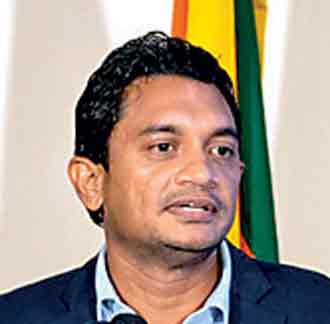
Industry and Entrepreneurship Development Deputy Minister Chathuranga Abeysinghe

European Union Delegation Ambassador Carmen Moreno

Verité Research Lead Economist Mathisha Arangala
 High-level dialogue co-hosted by Verité Research and the Delegation of the European Union to Sri Lanka and the Maldives examines how Sri Lanka can position itself as a credible, long-term destination for foreign direct investment
Verité Research and the Delegation of the European Union to Sri Lanka and the Maldives recently co-hosted a high-level policy dialogue on 7 May 2026 at the Lighthouse Auditorium, Lakshman Kadirgamar Institute of International Relations and Strategic Studies, Colombo.
The event, titled ‘From Recovery to Growth: Attracting Quality FDI in a Shifting Global Economy,’ which brought together Government, diplomatic, and private sector leaders to examine the conditions and reforms necessary for Sri Lanka to attract sustained, high-quality foreign direct investment (FDI) as its economy transitions from stabilisation to growth.
The keynote address was delivered by Industry and Entrepreneurship Development Deputy Minister Chathuranga Abeysinghe. He outlined the Government’s reform agenda, which includes the phasing out of para-tariffs, amendments to the Port City Act, the Strategic Investment Act, as well as the forthcoming Public-Private Partnership Act and Investment Protection Act. He called for Sri Lanka to move beyond low-value exports towards higher-complexity production integrated into global supply chains, and framed quality FDI as capital that raises productivity, promotes value addition, enables inclusive growth, and adheres to environmental and circular-economy standards.
“We now need to be very selective and attract specific types of FDIs...Our land is limited. Our resources are limited... Productivity will be a key indicator in attracting quality investments,” the Deputy Minister said.
In her opening remarks, the European Union Delegation Ambassador Carmen Moreno noted that the European Union, collectively the world’s largest source and recipient of FDI, with an outbound stock of € 9 trillion in 2024, is an important investment partner across Asia. She said that European companies invest preferentially in countries that offer predictable rules, strategic vision, skilled labour, and access to wider markets. She highlighted the EU’s Global Gateway strategy as a key instrument to support partner countries in building the conditions required for quality investment.
“Today, global environment investors demand not only a list of advantages, but they need to see direction, they need to understand where Sri Lanka wants to position itself in the coming years... No country can attract quality investment just by marketing itself,” Moreno noted.
Underscoring the urgency of building these conditions, Verité Research Lead Economist Mathisha Arangala delivered a context-setting presentation on the four structural forces reshaping global FDI: rising geopolitical tensions, rapid technological change, growing protectionism, and climate considerations. Citing macroeconomic data, he warned that Sri Lanka has historically lagged its regional peers and risks becoming an afterthought in a fast-reorganising investment landscape if it fails to adapt swiftly.
A subsequent panel discussion moderated by Echelon Media Group Co-founder and Publisher Shamindra Kulamannage focused on the structural constraints and policy issues affecting Sri Lanka’s ability to attract foreign direct investment. The panel featured Standard Chartered Bank Sri Lanka Chief Executive Officer and Ceylon Chamber of Commerce Vice Chairman Bingumal Thewarathanthri, Verité Research Director Subhashini Abeysinghe, economist Talal Rafi and German Industry and Commerce in Sri Lanka Chief Delegate Martin Klose.
 While Vietnam’s merchandise exports to India grew 90-fold, from $ 100 million in 2005 to $ 9 billion in 2024, Sri Lanka’s exports to India grew by only 50% over the same period, from $ 600 million to just $ 900 million. Bridging this gap and capturing future supply chain shifts will require aggressively expanding trade networks, as Sri Lanka currently holds preferential market access agreements with only 9 countries, compared to 16 or more for regional competitors like Vietnam, Thailand, Indonesia, and the Philippines
Panellists identified policy consistency and regulatory predictability as the most critical determinants of investor confidence, alongside structural challenges including limited market access through trade agreements, difficulties in sourcing encumbrance-free land, labour law constraints, high input costs, and the need to upgrade digital connectivity and logistics infrastructure. The panel broadly agreed that Sri Lanka’s ongoing reform momentum is real. However, they emphasised that India’s emergence as a major regional supply chain hub and the reorganisation of global value chains shape a narrow window of opportunity that requires urgent and sustained action. Panellists also called on policymakers to constitutionally entrench key economic policies and investment frameworks to provide durable certainty across political cycles.
To illustrate the cost of missing this regional window of opportunity, Arangala’s presentation underscored a stark comparative data point: while Vietnam’s merchandise exports to India grew 90-fold, from $ 100 million in 2005 to $ 9 billion in 2024, Sri Lanka’s exports to India grew by only 50% over the same period, from $ 600 million to just $ 900 million. Bridging this gap and capturing future supply chain shifts will require aggressively expanding trade networks, as Sri Lanka currently holds preferential market access agreements with only 9 countries, compared to 16 or more for regional competitors like Vietnam, Thailand, Indonesia, and the Philippines.




