Thursday Oct 15, 2026
Thursday Oct 15, 2026
Monday, 12 January 2026 00:31 - - {{hitsCtrl.values.hits}}
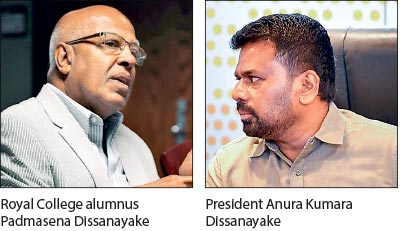
Royal College alumnus (1967-74) Padmasena Dissanayake has issued the following Open Letter to President Anura Kumara Dissanayake
 I write to you as an alumnus of Royal College (1967 to 1974) and as a citizen who resonates with your mandate to eliminate the culture of impunity and financial misappropriation within state institutions. While Royal College is a premier Government school funded by the taxpayer, it is currently operating as a shadow State where public assets are exploited for private gain by the Royal College Union (RCU) – The Association of its Past Pupils. This entity recently claimed before the Right to Information Commission (RTIC)—which functions as a quasi-judicial body with the powers of a court—to be an independent private entity and not a public authority.
This admission in the written submission for Appeal No: RTIC/APP/No.1095/2023 creates a massive legal paradox. If the RCU is a private club beyond the reach of public accountability, then by what authority does it manage and collect revenue from State-owned assets? Under Ministry of Education Circular No. 52/2023, all school resources including sports complexes, swimming pools, and grounds are the full property of the State. Section 1.2 of said circular mandates that all income from these resources must be managed by the School Development Society (SDS). Instead, we see a reality where even a simple billboard within Government premises or a car park on Government land generates income that goes directly to this so called private entity named RCU.
The credibility of the RCU in managing such funds is deeply compromised. During the 2017 and 2018 rugby seasons, the RCU remained silent for nearly seven years regarding what is arguably the largest fraud in the history of Sri Lankan schools. A member responsible for depositing the gate collections of rugby matches failed to remit the funds to the relevant bank account, resulting in the misappropriation of Rs. 17.6 million for personal use. The entire RCU leadership maintained a troubling silence on this misuse of public income by their private entity, raising serious questions about their fitness to oversee state-linked resources.
The RCU and its alumni are certainly welcome to support their Alma Mater with their capacity, talents, and expertise to manage and operate these facilities. Charging a fair management fee for doing so is totally acceptable and a standard practice of good faith. However, what is currently happening is the wholesale diversion of state revenue. The RCU’s audited accounts reveal a staggering Rs. 759,853,306.35 held in debentures alone. While this private entity sits on nearly a billion rupees harvested from school property, the school’s actual statutory body, the SDS, is in a state of administrative collapse. The 2024 audited accounts for the SDS carry a serious Disclaimer of Opinion from the auditors—indicating a total failure to provide sufficient evidence for financial transactions—yet this warning is ignored by the authorities to date.
This orchestrated negligence allows the RCU to appear as a benefactor while the State's own funds are written off or lost due to alleged software issues and missing bank statements. This diversion of funds falls squarely under the Anti-Corruption Act, No. 9 of 2023, which empowers the commission to investigate the management of public property and procedures conducive to corruption. The Principal of Royal College, as a public officer and the ex-officio President of both the RCU and the SDS, has a fiduciary duty to protect State revenue. Allowing a private entity to collect income even from billboards and car parks, while the school suffers from infrastructure deficits and parents are taxed for basic facilities, constitutes a misuse of public property as defined under the law.
The claim that the RCU is governed by a Trust gazetted by Parliament is a fabrication used to mislead. There are two distinct entities: a Government school and an old boys association governed by its own trust. No private trust has the legal mandate to supersede State ownership or the Offences against Public Property Act No. 12 of 1982. A Trust meant for the management of an alumni association cannot be used as a licence to plunder State revenue generated on Government soil.
Sir, if this model is allowed to continue, it will become a blueprint for corruption across every Government school in the country.
I urgently request you to enforce Circular 52/2023 by directing the Ministry of Education to reclaim all income-generating assets and place them under the SDS. Furthermore, I request a forensic audit of the RCU's wealth to determine how much has originated from State properties and a formal investigation into the 2024 SDS accounts. We seek the restoration of the rule of law where the wealth of Royal College belongs to the students and the State - not to a private investment portfolio.




