Thursday Jul 16, 2026
Thursday Jul 16, 2026
Wednesday, 15 July 2026 00:28 - - {{hitsCtrl.values.hits}}
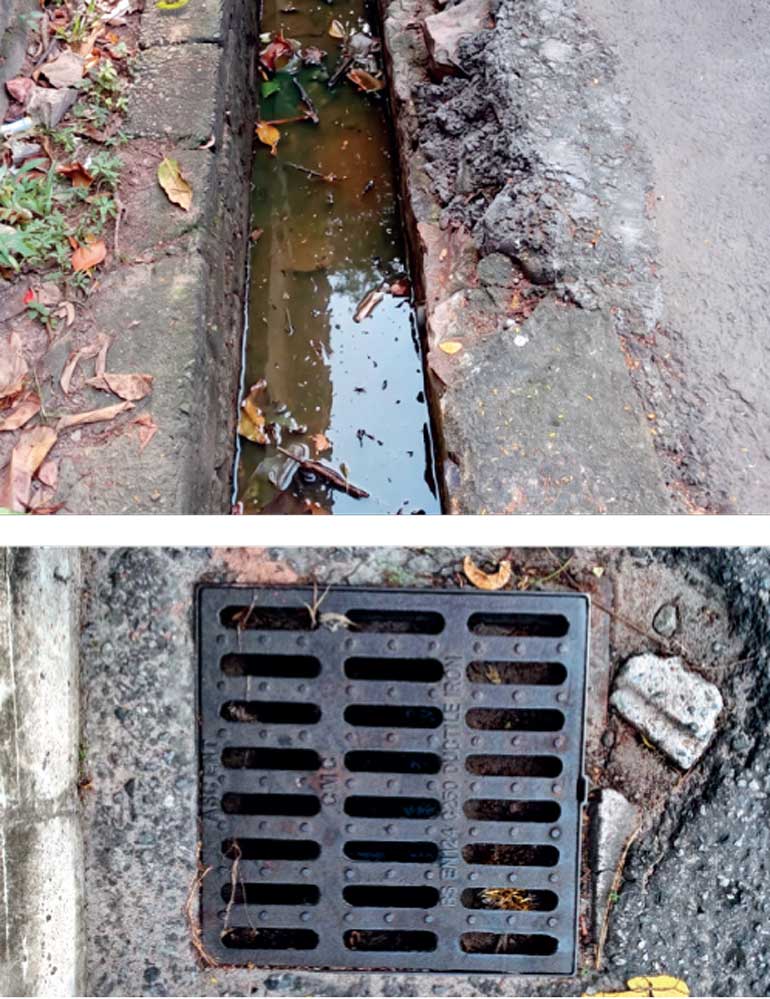
 A research study reveals that 70% of dengue prevention responsibility lies with national authorities, largely due to roadside drainage systems remaining open and exposed to the environment, while only about 30% is related to risks originating from households, schools, and workplaces. However, current practices indicate that national authorities mainly focus on inspecting households and identifying potential breeding sites within domestic and institutional environments.
The study further shows that roadside drainage systems remain largely open and exposed. These open roadside drains create highly favourable conditions for mosquito breeding and are a major contributor to the spread of dengue. This environmental exposure accounts for a significant portion, estimated at around 70%, of the overall dengue transmission risk.
Therefore, national authorities must urgently prioritise addressing issues related to roadside drainage systems. Greater attention should be given to maintaining, covering, and properly managing these drains, rather than placing disproportionate emphasis on households, workplaces, and schools alone.
The research has been conducted by Priyantha Wickramarathna along with Prof. S.P. Samarakoon, former Dean, Faculty of Science, University of Ruhuna.
Sri Lanka is currently facing a severe dengue outbreak in 2026, with more than 63,800 reported cases and 42 deaths, predominantly affecting the Western Province.
Significant public health concern
The rapid escalation of infections has triggered significant public health concern, particularly in densely populated urban and peri-urban areas where environmental conditions favour mosquito breeding.
The situation underscores the continuing vulnerability of the country to dengue outbreaks, despite years of control efforts.
As of early July 2026, the country has recorded 63,835 dengue cases and 42 deaths, with a case fatality rate of approximately 0.07%, according to the National Dengue Control Unit. The outbreak has intensified sharply in recent months, with 21,543 cases reported in June alone and a further 8,451 cases within the first few days of July. The Western Province remains the epicentre of the outbreak, with Colombo reporting 12,968 cases and Gampaha 12,929 cases, together accounting for more than 40% of the national total. Other districts such as Matara, Kalutara, Kandy, Ratnapura, and Galle have also reported rising case numbers, indicating a widespread national risk.
Dengue is transmitted by the Aedes aegypti mosquito, which breeds in stagnant water commonly found in containers, flower pots, drainage systems, discarded tyres, and other water-holding receptacles. The current outbreak has been exacerbated by several interrelated factors, including heavy monsoon rains that create abundant breeding sites, rapid and often unplanned urbanisation, and the possible emergence of a new dengue virus strain. This new strain may reduce the effectiveness of existing immunity in the population, thereby increasing susceptibility to infection. Secondary infections, in particular, pose a greater threat as they can lead to severe forms of the disease, including dengue haemorrhagic fever and dengue shock syndrome.
The symptoms of dengue typically include high fever, severe headache, pain behind the eyes, joint and muscle pain, nausea, vomiting, and skin rashes. In some cases, warning signs such as abdominal pain, persistent vomiting, bleeding, and lethargy may develop, indicating progression to severe dengue. Early recognition and timely medical attention are therefore critical, as the disease can rapidly become life-threatening if not properly managed.
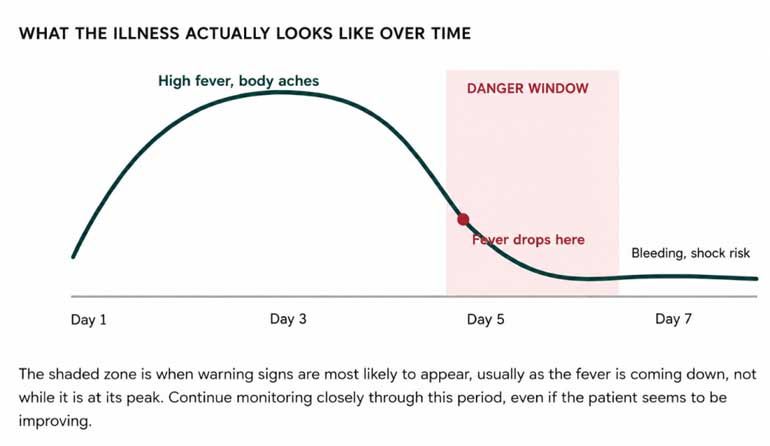
The diagram explains how dengue illness typically progresses over time and highlights the most dangerous period for patients. At the beginning (Day 1 to Day 3), the curve rises sharply, representing the onset of high fever and body aches. This is when patients feel the most obvious symptoms, such as fever, headache, and muscle pain. Many people assume this is the most critical stage, but the graphic shows that this is not necessarily the most dangerous phase. Around Day 4 to Day 6, the graph enters the shaded area labelled the “Danger Window.” This is the most important part of the chart. Here, the fever starts to drop, which can give a false sense of recovery. However, this is actually when serious complications are most likely to occur. The drop in fever is marked clearly on the curve, indicating a turning point in the illness.
During this danger period, patients are at risk of bleeding and shock, as shown on the right side of the graph. Even though the patient may appear to be improving, the body can suddenly deteriorate. This is why close monitoring is essential during this stage.
By Day 7 and beyond, the curve stabilises, indicating either recovery or progression depending on how the illness was managed during the critical phase.
The key message of the graphic is very important: The most dangerous phase of dengue is not when the fever is highest, but when it begins to come down.
In response to the escalating situation, Sri Lanka has strengthened its dengue control efforts through the National Dengue Control Unit. Key interventions include enhanced disease and vector surveillance, intensified mosquito control measures such as fogging and larviciding, widespread community awareness campaigns, and improved hospital preparedness with strengthened clinical management protocols. Authorities have identified 142 high-risk Medical Officer of Health (MOH) areas and are urging communities to actively participate in eliminating mosquito breeding sites, emphasising that fumigation alone is insufficient to control the spread.
Hospitals across the country remain on high alert, with increased capacity for dengue case management and emergency response. In addition, some universities and educational institutions have temporarily shifted to online learning modes to reduce crowding and minimise the risk of transmission. These combined efforts highlight the seriousness of the outbreak and the need for coordinated action between authorities and the public to effectively control and reduce the spread of dengue.
(The author is Director, ISO Quality Centre for Research and Development)




