Tuesday Sep 15, 2026
Tuesday Sep 15, 2026
Tuesday, 24 February 2026 00:29 - - {{hitsCtrl.values.hits}}
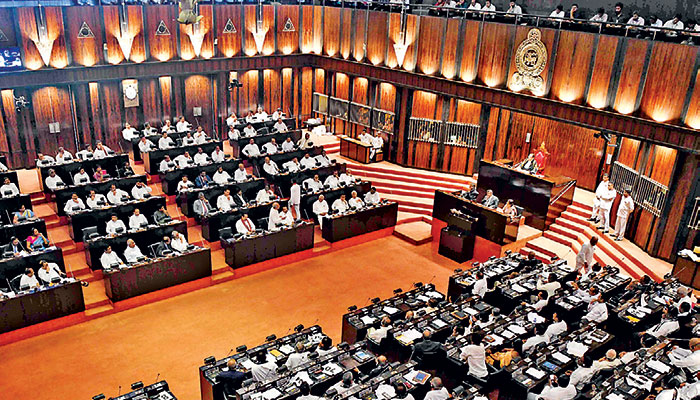
 The NPP Government, in keeping with its electoral promise as pledged in its Manifesto has repealed the Pension rights afforded to past members of Parliament. It is an undeniable fact, this proposal received the overwhelming positive response from the general public who have been consistent in expressing their opposition to the perks and privileges enjoyed by the members of Parliament.
A few leading personalities, voiced their objections to the removal of these facilities which they contend will result in severe financial constraints to the past members. However, the members of Parliament decades ago didn’t enjoy any such facilities, prior to the introduction of the pension rights for members of Parliament in 1977 under the Parliamentary Pension Act No:1 of 1977 which has now been repealed. Under the existing PR System of electing representatives to the Parliament millions are spent by the candidates to enter the Parliament. This bears testimony to their financial status. The protests made by the opposition that abolishing the Pension rights to the members will lead into corruption does not hold water.
The members of Parliament of the Sri Lankan Parliament enjoyed various luxuries, inclusive of free housing facilities, postal and telephone facilities, extra ordinary security, fuel, back-up vehicles etc., all of which were afforded at the expense of the tax payers. Apart from the aforesaid they were entitled for duty free vehicle permits with the option of selling their permits. Most of them sold their permits and derived substantial financial benefits. No one talks about the duty free vehicle permits enjoyed by the members of Parliament in the past. An ordinary citizen does not have such benefits and is compelled to seek the assistance of a financial institution at exorbitant interest to own a vehicle. The members of Parliament were entitled to receive their pension after a duration of only five years, without any contribution to the Government Pension Fund. A developing country like Sri Lanka cannot afford to give special privileges to its members at the expense of the tax payers.
Global trend
In some of the developed countries pension rights are granted to the members of Parliament under a contributory Scheme and globally there is a trend to integrate such schemes with the Public Sector Retirement Plans. It has been reported France and Italy have abolished Parliamentary Pension Scheme and MPs have been brought under a contributory scheme.
Members of the European Parliament are entitled for pension at the age of 63, with benefits based on percentage of salary for years in Office. United States offers a voluntary contributory pension scheme for their Senators and Members of the House of Representatives. Many countries are revising their existing systems due to public pressure, while some others maintain contributory plans. Many systems require mandatory contributions from MP’s salaries.(e.g., Japan 9.7%, Australia 11.5%).
Introduction of contributory pension scheme for all
In the interest of all, the time is now opportune, for the incumbent Government to consider introducing legislations to extend pension rights to all private sector employees, the self-employed sector under the MSME Sector, daily paid wage earners such as three-wheel operators, school van drivers, carpenters, masons, street vendors and all other unskilled workers and individuals engaged in various other cottage industries. The aforesaid are silent contributors to the economy of the country and are a neglected category without any social security. They should be accommodated under this scheme as their future is very bleak. The moment they become invalid or incapacitated they lose their income and join the poverty line. They face tremendous challenges to survive once they become invalid and are not in a position even to meet their living expenses for survival.
Pension rights at present are enjoyed only by the state sector employees, in addition to certain other large private sector institutions inclusive of State Banks and a few private sector banks. It has been revealed only a total of 2 million citizens currently enjoy pension rights.
The NPP Government’s move to scrap the pension rights of the Members of Parliament has received overwhelming support from the general public based on its approval ratings. The time is now opportune for the introduction of a Private sector Pension bill, to extend pension rights to the private sector employees under a contributory pension scheme. They should be entitled for pension rights after serving a reasonable period as applicable in the Government Sector. The introduction of Pension Scheme to all sectors of the country, inclusive of the MSME Sector is the need of the hour and aspiration of all towards leading a dignified retired life
Past attempts towards the introduction social security
The previous Government in 2011 made a proposal towards the introduction of Social Security for the retirees. Unfortunately, this proposal had to be abandoned due to vociferous protests made by certain sections of the society at that time.
Attempts made by successive Governments too didn’t have the desired effect.
Existing reality
In today’s context with the falling interest rates one cannot expect a substantial amount as interest income; given a choice most will no doubt prefer a pension. Under the existing scenario a retiree should have at least a sum of Rs. 5 million in a deposit account to derive a monthly income of Rs. 30,000. All their living expenses, utility payments, medical expenses etc., have to be met out of this income. In addition, the falling interest rates have deprived them of a dependable regular income. A pensioner from an established Fund could expect periodical increments. This additional incentive is not available if the money is invested in a term deposit due to the prevailing trend of falling interest rates. The pension fund ensures the dependents of the pensioner are taken care of in case of any unforeseen circumstance as they are additionally covered by the Widows and Orphans Pension Scheme in most cases which ensures the dependents are taken care of on the demise of the pensioner.
Many retirees who have exhausted their EPF funds are today marching towards the poverty line as in certain cases they have been neglected by their children on whom they reposed all their trust and confidence. According to the Sri Lankan culture, most children normally take the responsibility of caring for their aged parents, once they lose their earning capacity. In certain isolated cases they have been abandoned by their children.
In many Western countries, there are elders’ homes specially run with government aid to take care of aged parents and Senior Citizens; most of them lead a happy and contended life. The situation is different in our country as we have very limited institutions of the aforesaid nature; most of which are beyond the reach of the ordinary senior citizen and only the affluent category could avail such facilities. This justifies the compelling need to have a regular dependable income by way of a pension which is a security and guarantee for the aged senior citizens.
Retirement Plan under Insurance Scheme
There are a few leading insurers who provide pension scheme under a well-planned contributory insurance scheme. The reality is the monthly payment derived from such schemes on maturity will hardly be adequate to meet even the utility payments of the retirees.
In today’s context the youngsters are keen in opting for short-term benefits rather than long-term benefits as the short-term benefits appear to be attractive. Some of them lack an effective financial management or a plan to visualise their future when they reach the retirement age as they have no desire to contemplate of their retirement at present.
There are numerous instances of young employees moving away from their existing pensionable positions. This is the trend mainly in certain well-established banks and these young employees join certain young and emerging institutions mainly due to lucrative incentives offered without realising that they are foregoing a lifetime financial guarantee and security.
Many such employees who opted for the short-term benefits by foregoing their pension benefits are today faced with severe financial constraints due to the absence of any regular monthly income on reaching their retirement age. They have exhausted all their savings and are at the mercy of their children.
Opportunity to move forward
The NPP Government’s move to scrap the pension rights of the Members of Parliament has received overwhelming support from the general public based on its approval ratings.
The time is now opportune for the introduction of a Private sector Pension bill, to extend pension rights to the private sector employees under a contributory pension scheme. They should be entitled for pension rights after serving a reasonable period as applicable in the Government Sector. The many advantages which could be derived under such a scheme should be explained to all stakeholders to avoid any fear psychosis which will naturally be created by interested parties. They should be educated of the important benefits of a pension scheme. The introduction of Pension Scheme to all sectors of the country, inclusive of the MSME Sector is the need of the hour and aspiration of all towards leading a dignified retired life.
(The writer is a Past President of the HNB – Retired Employees Association )




