Sunday Sep 27, 2026
Sunday Sep 27, 2026
Monday, 9 March 2026 04:28 - - {{hitsCtrl.values.hits}}
By Kumar Ranaweera
Sri Lanka stands at a critical juncture with its economic stability and future prosperity tied inextricably to export led growth. The India-Sri Lanka Free Trade Agreement (ISFTA) that has been operational since 2000 has been instrumental in expanding bilateral commerce, but its challenges are apparent. The lack of information and guidance especially for entrepreneurs has prevented the full realisation of regional trade potential, especially for Sri Lankan businesses. A comprehensive, modern trade agreement and model is not merely desirable, it is essential for Sri Lankan firms to boost exports and achieve strategic integration into the world's fastest growing major economy – that is India.
Economists and policy experts, including those from the Advocata Institute, have consistently advocated for the urgent conclusion of pending trade agreements to protect Sri Lanka from marginalisation in the global trade arena, which would then unlock further Supply Chain Opportunity for Sri Lanka. A comprehensive window or portal that offers information and guidance on how to navigate India’s diverse social economic architecture would also help boost Indo-Lanka trade and investment, especially from the Sri Lankan side. The current trade reality is one marked by a significant imbalance. India is Sri Lanka's largest trading partner, yet its exports to Sri Lanka vastly outweigh the island nation’s. However, it is worth noting that over 60% of Sri Lanka's total exports to India have historically utilised the ISFTA’s benefits, underscoring the agreement's vital role.
The most transformative potential of a renewed trade pact lies in enabling Sri Lankan companies to integrate seamlessly into the burgeoning Indian supply chain. India with its 1.4 billion people offers one of the most diverse markets in a single location, and it becomes imperative for every venture to understand the different dynamics of each state. As India solidifies its position as a global manufacturing hub, the demand for intermediate goods, components, and raw materials is skyrocketing. For Sri Lankan firms, this represents a golden opportunity to shift away from merely being an assembler of finished goods and become a strategic supplier of inputs.
Integration into the Indian supply chain
Integration into the Indian supply chain is explicitly considered "essential for developing exports" for Sri Lanka. This move allows Sri Lankan manufacturers to move up the value chain, supplying finished components to Indian industrial producers. For instance, Sri Lanka already exports products like insulated wires and cables to India as well as certain rubber components, demonstrating an existing capacity for industrial input supply. A deeper, more liberalised agreement would eliminate the existing structural barriers, such as narrow product-specific concessions, tariff rate quotas, and extensive negative lists that currently limit Sri Lanka's major export potential.
The proximity of the two nations already offers a major advantage, including reduced costs and timely delivery. The existing ISFTA’s relatively flexible Rules of Origin, which allow for a minimum of 25 percent Domestic Value Addition (DVA) for a product to qualify for preferential tariffs, is a strong foundation to build upon for deeper integration for a broader Economic Advantages.
Renewed trade agreement
A renewed trade agreement, such as the proposed Economic and Technology Cooperation Agreement (ETCA), would provide more than just market access. In the first place it would Diversify Sri Lanka's Export Basket. While traditional exports like spices and certain food products remain important, a comprehensive agreement would open doors for non-traditional, higher-value manufactured goods and services. Thereon, it will boost foreign participation and investment, especially due to the guaranteed, preferential access to the immense Indian market. Sri Lanka becomes a significantly more attractive base for export-oriented FDI, boosting employment and technology transfer. The closer ties would naturally facilitate Indian investment in Sri Lanka, contributing to ‘productivity enhancement, public welfare, and industrial capacity-building’ within the island nation.
The current challenge is clear: regional trade in South Asia – especially Sri Lanka – is currently well below its estimated potential, a scenario contrasting sharply with other successful economic blocs globally. To reverse this trend, Sri Lanka must prioritise an ambitious new trade architecture. Removing outdated restrictions explicitly facilitates supply chain linkages and is an effective policy move to secure an export-led future.
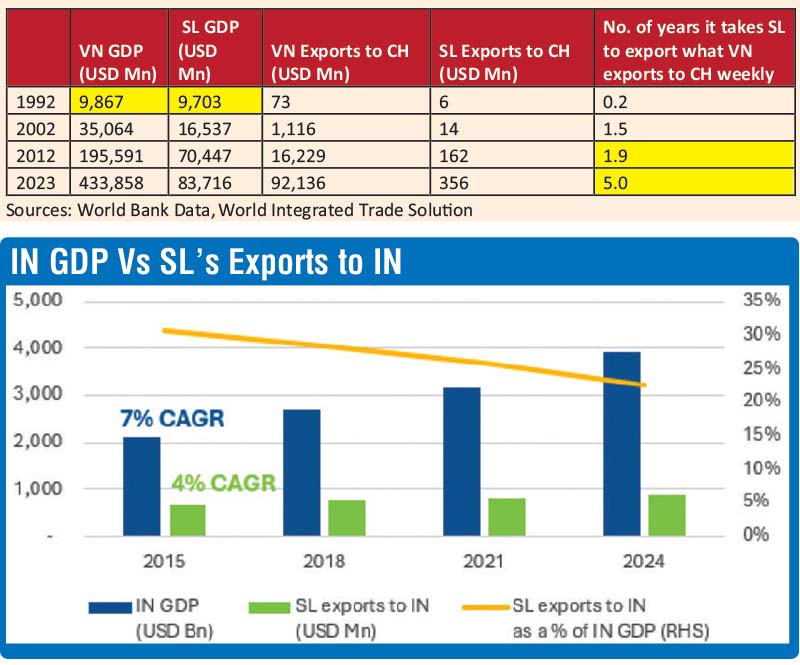
The story of Sri Lankan exports vis ASEAN is also one of a "composition problem." While ASEAN nations have spent the last two decades plugging themselves into the Chinese supply chain and each other (mobile phones and related parts, Integrated Circuits, Machine parts, fruits and staples at scale, rubber and plastics for the Chinese automotive and consumer goods industries), Sri Lanka has stayed largely with a 20th-century product mix that simply cannot match up to the new trend. The disparity is now so vast that a neighbour like Vietnam which had a similar GDP to Sri Lanka three decade ago now exports more to China in one week than Sri Lanka does in five years.




