Thursday Oct 22, 2026
Thursday Oct 22, 2026
Saturday, 16 May 2026 02:00 - - {{hitsCtrl.values.hits}}
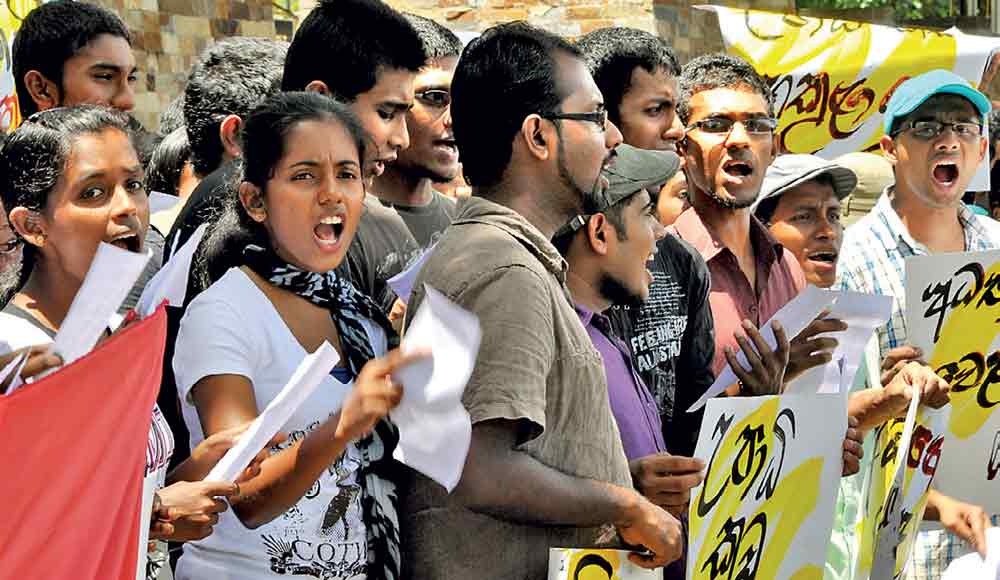
A group of university students engaged in a protest – File photo
 Having served as a Member of Parliament, Chairman of the COPE Committee of Parliament, Secretary to a Ministry, and as an academic for more than twenty years — including serving as a Professor before resigning to enter public service and policymaking — I feel a responsibility to express several observations regarding the present state of university administration and the treatment of academic and non-academic staff within Sri Lankan universities.
I was particularly motivated to write this after witnessing the recent legal conviction involving a Professor of the University of Peradeniya. While that incident may concern one individual, it also reflects deeper structural and administrative weaknesses that have gradually developed within the higher education system. These problems are not isolated incidents; rather, they indicate systemic shortcomings in governance, accountability, transparency, and institutional culture.
Weakness of Vice Chancellors in administrative leadership
The position of Vice Chancellor is one of the most important leadership roles within a university. A Vice Chancellor is expected to provide intellectual leadership, administrative discipline, institutional vision, and moral authority. Unfortunately, in many universities today, Vice Chancellors appear increasingly weak in handling administrative matters effectively and independently.
Several Vice Chancellors tend to avoid difficult decisions, particularly when powerful internal groups, political influences, trade unions, or senior administrative officers are involved. Instead of exercising firm and balanced leadership, some become passive observers of institutional conflicts. As a result, disciplinary issues remain unresolved, administrative inefficiencies continue unchecked, and unfair practices become normalised.
A university cannot function properly when its highest authority lacks the courage or independence to enforce rules equally. Fear of controversy, political pressure, or internal opposition has weakened the administrative confidence of many university leaders. Consequently, decision-making becomes delayed, inconsistent, or selective.
This situation creates uncertainty among academic staff and students alike. It also damages the credibility of the university administration and weakens respect for institutional governance.
Penalisation of academic and non-academic staff on personal grounds
One of the most disturbing developments within certain universities is the tendency to use administrative mechanisms to target individuals based on personal disagreements, professional jealousy, ideological differences, or internal rivalries.
Disciplinary inquiries, transfers, delays in promotions, denial of research opportunities, and exclusion from committees are sometimes used not for legitimate institutional purposes, but as tools of personal retaliation. In some cases, staff members who express independent opinions, expose irregularities, or challenge administrative decisions become victims of subtle or direct harassment.
This creates a culture of fear within the university system. Academics may begin to avoid expressing honest opinions or engaging in constructive criticism because they fear administrative consequences. Such an atmosphere is fundamentally incompatible with the principles of academic freedom and intellectual independence that universities are supposed to protect.
Universities should encourage debate, critical thinking, and diversity of opinion. However, when personal bias influences administrative action, professionalism declines and institutional trust collapses. Honest and capable individuals become discouraged, while those who cultivate personal loyalties often gain advantages.
This trend is deeply harmful to the moral and intellectual foundations of higher education.
Irregularities in appointments and promotions
Another serious issue concerns appointments, recruitments, and promotions within universities. These processes should be based strictly on merit, academic qualifications, research achievements, teaching ability, integrity, and professional competence. Unfortunately, there are increasing concerns that personal connections, favoritism, political influence, and internal alliances sometimes play a greater role than objective evaluation.
In certain cases, highly qualified candidates are overlooked while less deserving individuals receive appointments or promotions. Interview boards and selection committees may not always function with complete transparency. Criteria are sometimes applied inconsistently, and procedural fairness may be compromised.
This situation creates frustration among capable academics who dedicate years to research, teaching, and professional development. When merit is ignored, the overall quality of universities inevitably declines. Talented young academics lose motivation, and some may even seek opportunities abroad, contributing to the brain drain already affecting the country.
Moreover, irregular appointments weaken public confidence in state universities. Universities must remain institutions where excellence is recognised and rewarded fairly. If the academic community begins to believe that success depends more on influence than merit, the entire higher education system becomes morally weakened.
Excessive influence of bureaucratic structures
Universities are academic institutions, not merely bureaucratic organisations. However, in many instances, the administrative machinery — particularly certain Registrars, Senior Assistant Registrars (SARs), and other administrative officers — appears to exercise disproportionate influence over university affairs.
While administrative officers play an essential role in institutional management, problems arise when bureaucratic procedures dominate academic priorities. Some administrative officers become excessively powerful because they possess procedural knowledge and long-term institutional control, while academic leaders remain temporary or administratively weak.
As a result, important decisions are often delayed, unnecessarily complicated, or manipulated through procedural technicalities. Academics may find themselves trapped within rigid bureaucratic systems that discourage innovation, efficiency, and independent thinking.
In some universities, bureaucratic culture has become stronger than academic culture. Administrative convenience sometimes takes precedence over academic development, student welfare, or research advancement. This undermines the true purpose of a university.
Healthy universities require a balance between academic leadership and administrative support. Administrative officers should facilitate academic progress, not dominate institutional decision-making.
Financial misconduct, negligence, and weak accountability mechanisms
Another deeply concerning issue within certain universities and affiliated institutions is the existence of financial mismanagement, negligence, and weak accountability systems.
During my tenure as Chairman of the Committee on Public Enterprises (COPE) from 2020 to 2022, I personally witnessed several instances where negligence and administrative failures by senior authorities caused significant financial losses. These were not merely minor procedural mistakes, but serious lapses involving funds entrusted to higher educational institutions.
 Universities must remain places of fairness, intellectual freedom, professionalism, and national development. Strengthening governance, ensuring transparency, protecting academic independence, and restoring merit-based systems are essential if higher education is to regain public trust and continue serving future generations effectively
One well-known example involved financial misconduct and administrative irregularities at a Postgraduate Institute affiliated with the University of Peradeniya. The incident demonstrated how weaknesses in oversight, internal controls, procurement procedures, and administrative accountability could result in substantial financial losses and reputational damage to the institution.
It must be clearly understood that, in this particular case, the money involved was not taxpayer money allocated by the Government. These funds had been paid by students who enrolled in postgraduate degree programmes. Therefore, the negligence or misuse of such funds becomes even more serious because students and their families made personal financial sacrifices in pursuit of higher education and professional advancement.
Unfortunately, in some institutions, financial discipline appears weak, while audit observations and accountability mechanisms are not treated with the seriousness they deserve.
In several cases, there appears to be:
 Negligence in financial decision-making,
Failure to follow procurement procedures,
Weak internal audit mechanisms,
Delays in taking disciplinary action,
Lack of accountability among senior administrators, and
Attempts to conceal institutional failures rather than correct them.
What is even more troubling is that lower-level officers are sometimes blamed while those holding higher authority escape responsibility. A healthy governance system requires accountability at every level, especially among senior decision-makers. Universities should be examples of integrity, professionalism, and public responsibility. If financial misconduct and negligence are tolerated within higher educational institutions, the moral authority and credibility of the entire university system become weakened.
Therefore, stronger financial oversight mechanisms, independent audits, transparent procurement systems, and regular accountability reviews are urgently needed within the university sector.
Need for an Independent Commission to investigate irregularities
Given the seriousness of these concerns, there is an urgent need to establish an independent commission or oversight mechanism to examine irregularities within the university system.
Such a body should investigate issues relating to appointments, promotions, disciplinary procedures, abuse of administrative power, misuse of institutional resources, and violations of institutional fairness. The purpose should not be political revenge or interference, but rather the restoration of transparency, accountability, and public confidence.
At present, many affected individuals feel that there is no impartial mechanism through which they can seek justice. Internal inquiries often lack independence, while existing oversight structures may not be sufficiently effective. Therefore, an external and credible review mechanism is necessary.
This commission should consist of respected academics, retired judges, administrators of integrity, and independent professionals who understand both the academic environment and principles of natural justice.
Sri Lanka’s university system has historically produced distinguished scholars, professionals, and public servants. However, institutional decline cannot be ignored. Without meaningful reforms, universities risk losing their credibility, academic standards, and moral authority.
Universities must remain places of fairness, intellectual freedom, professionalism, and national development. Strengthening governance, ensuring transparency, protecting academic independence, and restoring merit-based systems are essential if higher education is to regain public trust and continue serving future generations effectively.
(The author served as a university lecturer from 1996 and was the Chair Professor of Philosophy at the University of Peradeniya when he resigned from academia in order to accept a policymaking role as a Member of Parliament in 2020. He also served as the Head of the Department of Philosophy at the University of Peradeniya. In public service, Dr. Herath has held several high-level positions, including Permanent Secretary to the Media and Information Ministry and Chairman of the Central Environmental Authority. He also served as the Chairman of the Committee on Public Enterprises (COPE) of the Parliament of Sri Lanka from 2020 to 2022. He graduated from the University of Peradeniya and holds postgraduate degrees from the University of Kelaniya and Ohio University, USA. Dr. Herath currently leads the policy think tank Nexus Research Group.He can be reached at [email protected] and on X (formerly Twitter) at @charith9)




