Sunday Sep 13, 2026
Sunday Sep 13, 2026
Monday, 31 August 2026 00:00 - - {{hitsCtrl.values.hits}}
 By A. M. Peiris
It is with much despair that I opt to express my opinion regarding an article that was published in the Daily FT on 6 August 2026, which was boldly titled as mentioned above.
Before proceeding further, I must acknowledge that I am an ordinary octogenarian whose contemporaries have mostly departed from this world, and whose personal details would not interest anyone.
Prior to expanding on the “five false doctrines misleading Sri Lanka”, the writer makes the authoritative assertion that “Sri Lanka is headed for another calamitous cycle towards the end of this decade because of the simple failure, unwillingness or inability of our society – especially its intelligentsia – to think through these currently dominant false doctrines.”
I pity the intelligentsia, let alone the gullible ordinary citizens like you and me, for their mediocre abilities. Is it fair to demean the abilities of the responsible citizens of this country in this manner? There are and have been exceptionally brilliant and resourceful intellectuals who serve the country and its children, as opposed to endorsing the political elite who are amusingly said to be blessed with economic prowess due to their assembly line of a bloodline. We cannot broadly judge the ability, credibility, and sincerity of our intelligentsia in this belligerent manner.
Out of the ‘five false doctrines’ currently misleading Sri Lanka, as professed by the writer, at the moment the first one is as follows: “Corruption is the main problem and root cause of the economic crisis. Combating corruption is and should be the main priority.” The writer disagrees and declares “Corruption and its elimination have never been the top priority in the history of political or economic thought.”
Corruption-free environment
What is ‘corruption’? The question fits the context of the said article. Corruption is, at its core, dishonesty. It is immoral to the hilt. It is ignominious and shameful. This is because corruption promotes a culture of impunity where many individuals are tempted to do unlawful activities such as the acceptance of bribes, which can range from monetary trimmings to politically-motivated appointments to diplomatic positions and so on. If corruption is backed by the Government, it is conducive to activities such as drug trafficking, the exploitation of natural resources and the amassment of wealth by hook or by crook. So, doesn’t corruption affect the economic development of a country? Doesn’t it drive away true talent and surface mediocre forces to the top? If this happens even a modicum of corruption would thwart even the most efficient development of human resources. Therefore, a corruption-free environment can be considered a significant catalyst of accelerating the development of a country’s socio-economic strata. True, it is a difficult thing to achieve, given the greedy and selfish nature of human beings. However, as everyone knows these days, it is not face-value development but sustainable development that is crucial for Sri Lanka to reach its full potential as a country. The former may be impressively quantifiable, especially for the election purposes of political dynasties, but it is the latter that would ultimately enrich, protect, and preserve the country’s resources and release a growth spiral that is driven ever upwards by public trust.
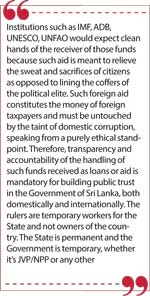
I further wonder whether loan-granting international institutions would ever endorse corruption and misuse of their funds. As far as I understand, institutions such as IMF, ADB, UNESCO, UNFAO would expect clean hands of the receiver of those funds because such aid is meant to relieve the sweat and sacrifices of citizens as opposed to lining the coffers of the political elite. Such foreign aid constitutes the money of foreign taxpayers and must be untouched by the taint of domestic corruption, speaking from a purely ethical standpoint. Therefore, transparency and accountability of the handling of such funds received as loans or aid is mandatory for building public trust in the Government of Sri Lanka, both domestically and internationally. The rulers are temporary workers for the State and not owners of the country. The State is permanent and the Government is temporary, whether it’s JVP/NPP or any other. They must fulfil promises, failing which they must loosen the reins and retreat with dignity. 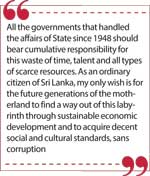
The writer raises another point regarding the acceleration of brain drain and I quote: “The evidence of the worsening of material conditions and prospects under the JVP/NPP’s new political economy is the accelerating migration of the educated, especially from the State universities and most employable professions (medicine, agriculture etc.).” This assertion is surprisingly uncorroborated, and potentially misleading. When making such assertions, relevant statistics need to be cited for it to be a meaningful addition to public discourse, else we run the risk of devolving into an exercise in gossiping.
As part of the citizenship training we received long ago as secondary school children, we learned a lesson for life. Never to be dogmatic but to be realistic and to always be guided by cause-and-effect thinking. With these thoughts in mind, I would like to add some final words on another assertion by the writer: “Prof Howard Nicholas has pointed to President Premadasa’s rapid province-based industrialisation drive as the only time we had a strategy which could have avoided a debt trap. Under President Mahinda Rajapaksa this country earned enough to pay back any international private debt it incurred.”
My question is: if any of those politicians were true visionaries, why did the country repeatedly fall to bankruptcy and face the problem of insolvency a few years back? All the governments that handled the affairs of State since 1948 should bear cumulative responsibility for this waste of time, talent and all types of scarce resources. As an ordinary citizen of Sri Lanka, my only wish is for the future generations of the motherland to find a way out of this labyrinth through sustainable economic development and to acquire decent social and cultural standards, sans corruption.




