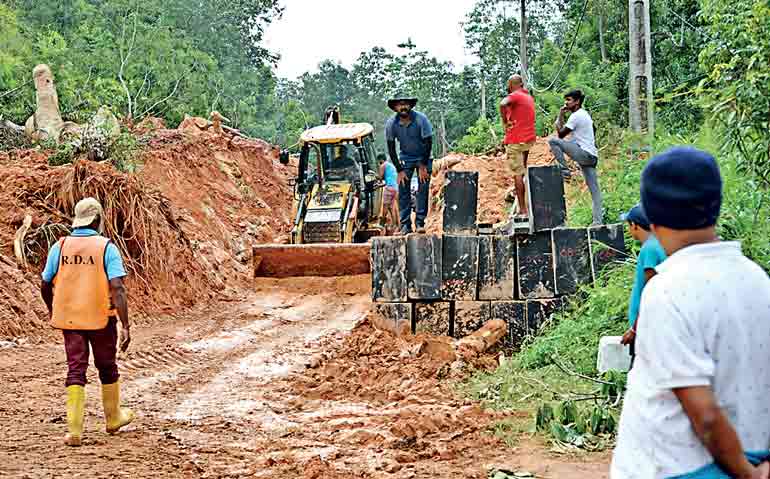
Cyclone Ditwah has left Sri Lanka facing one of its most complex reconstruction challenges in recent history. According to the World Bank’s Global Rapid Post-Disaster Damage Estimation, direct physical damage to housing, infrastructure, agriculture and public facilities is estimated at approximately $ 4.1 billion. Out of this, $ 3.282 billion is for Infrastructure and Residential/Non-Residential Buildings and contents. The remainder of the $ 4.1 billion (approximately $ 814 million) is attributed to agriculture-related damage.
The scale of rebuilding required is unprecedented, particularly in the context of current fiscal and capacity constraints. At such a moment, speed of delivery is not a luxury; it is a necessity. Delays in reconstruction do not merely inconvenience communities. They prolong displacement, escalate construction costs, disrupt livelihoods, and erode public confidence. The single most decisive factor in avoiding these delays is how procurement is structured and implemented.
Emergency procurement exists
Sri Lanka’s Procurement Guidelines 2024, issued by the National Procurement Commission, already provide for emergency and expedited procurement in circumstances where normal tender timelines would result in unacceptable delay or risk to life, safety or essential services.
Emergency procurement does not mean abandoning transparency or accountability. It lawfully allows:
- Shortened bidding and evaluation timelines
- Restricted or limited bidding where justified
- Direct contracting in clearly defined urgent situations
- Framework agreements for recurring works and supplies
- Delegated financial authority to accelerate approvals
- Post-award audits in place of pre-execution delays
The National Construction Association of Sri Lanka (NCASL) has also proposed a methodology for emergency reconstruction activities to the President, which shall be of great value. It proposes emergency contracts to be pre-framed with a maximum value of
Rs. 600 million per contract (or as applicable to RDA or other agencies).Contracts to be awarded based on unit rates, using a pricing formula such as HSR + 25% + 2.5% SSCL (or similar).
Why procurement delays construction
From an industry perspective, reconstruction delays rarely occur because contractors lack capacity. They occur because:
- Approval delays
- Designs are finalised without aligned procurement plans
- Tenders are repeated unnecessarily
- Approvals move sequentially instead of in parallel
- Materials and specialist services are procured haphazardly
- Sub-contractors are engaged late or informally
A practical way forward: Design-and-build
For large-scale reconstruction design-and-build procurement offers a practical and time-efficient solution. However, it should:
- Require early submission of concept designs and performance specifications
- Mandate clear identification of key sub-contractors at bid stage
- Specify minimum and maximum numbers of sub-contractors for major disciplines such as civil works, MEP, geotechnical and specialist systems
- Include named specialist sub-contractors for high-risk or technically complex components
Creating the conditions for speed
First, financial constraints on contractors must be acknowledged. Excessive bonding and rigid collateral requirements immobilise capital at the very moment rapid mobilisation is required. Proportionate risk management — supported by staged payments and appropriate guarantees — allows more firms, including capable SMEs, to participate meaningfully.
Second, labour and equipment must move freely. Reconstruction is a national priority and should be treated as such. Skilled and semi-skilled workers must be able to mobilise across districts without unnecessary administrative friction, and temporary measures should be available where workforce shortages arise. It is neither unprecedented nor unreasonable to consider temporary, regulated access to foreign construction labour for clearly defined roles and durations.
Third, material supply chains must be stabilised. Delays caused by aggregate shortages, quarry approvals or equipment constraints quickly cascade into stalled sites. Time-bound, well-regulated facilitation measures can prevent these disruptions without compromising environmental or safety standards.
These are not concessions; they are practical responses to post-disaster market realities.
Institutions must act together
Fast-tracked procurement cannot be driven by one ministry or agency acting in isolation. It requires coordinated leadership across institutions that already exist and are fully capable.
Key institutions include:
- National Procurement Commission – regulatory oversight and guidance
- Ministry of Finance/Treasury – delegated financial authority and funding flow
- Line Ministries and Provincial Councils – project ownership and execution
- Professional Bodies, including NCASL, MCSL, CIOB, etc– technical standards, peer review and industry mobilisation
- Professional bodies, in particular, have a critical responsibility. This is not about replacing government authority. It is about strengthening delivery capacity at a moment of national urgency.
Conclusion: Build faster, build better
Sri Lanka does not need to reinvent procurement to rebuild after Ditwah. The legal tools already exist. The construction industry has the technical capacity. Professional institutions are ready to support. What is required now is decisive leadership and disciplined execution so that Sri Lanka can be rebuilt faster.
(The author is the President of Ceylon Institute of Builders)