Thursday Oct 22, 2026
Thursday Oct 22, 2026
Tuesday, 9 December 2025 00:26 - - {{hitsCtrl.values.hits}}
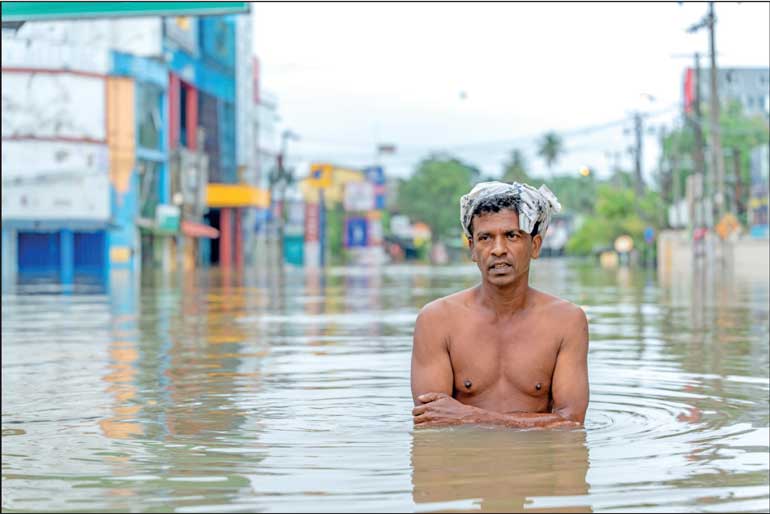
How much more can a country take ? – Pic courtesy: UNICEF/InceptChange

The floods that washed over Sri Lanka were not the fury of nature only even if it is easier to think so. They were the clash of global climate disruption with local infrastructure incapable of bearing the brunt, governance delayed and systems never designed for the world we now inhabit. It was a joint failure, global, national, institutional.
Cyclone Ditwah converted homes to islands and wiped out familiar landscapes. Over 1.4 million people in all the 25 districts of Sri Lanka lost their homes with hundreds of thousands thrown into makeshift shelters. The storm passed, but its effects will reverberate in our economy, food security and collective psyche even after the water drains away.
A friend recently asked me, “How much more can a country take?”
But the deeper question is: How long will we deny what is already evident?
For decades we built prosperity through the destruction of the systems that sustain life. We buried the wetlands in concrete. We mined riverbanks for quick capital. We created permanent real estate on flood plains. That was how we celebrated GDP, while undermining the ecological infrastructure that protected us.
What failed was not the rain. What failed was a world view built on extraction and denial, one that severed us from the ecological intelligence that has always existed in South Asia. We adopted systems that were never designed for our realities, importing solutions that became problems, and drifting further from the wisdom that once kept us safe.
Every sector played its part. The government made the rules of planning negotiable. Businesses took the optics of the moment and short-term profits over long-term intelligence. Instead of system redesign, non-profits stayed on responding to constant trends and crises without reframing systems. Survival was outsourced to charity, and we stepped in to act. Climate, we behaved as though it was optional.
And still, rebuilding conversations revolve around the same old playbook of donor money, capital projects, private sector governance committees to administer disaster funds and buildings that are full of equipment yet without the knowledge and collaboration necessary for getting them to run properly. Too often the development and private sectors incentivise visibility, not results. And we get instead a few disparate efforts scrambling for credit as opposed to coming together on the actual enemy which are outdated, fragile systems that fail under climate pressure.
 Our competition is not against each other but with one another. We must abandon that reasoning.
But while all of this is unravelling a new story has been emerging from all across Sri Lanka and it is a story of regeneration and redesign. Since 2018, I have had the honour to witness this first hand through collaborations with farmers bringing back soil and water systems, entrepreneurs creating circular value chains, and communities rebuilding the ecosystems that restore them in return. These works illustrate that resilience is not environmental charity, but the motor of long-term prosperity.
But these are not experiments or fairy tales. They are models for a future that can endure.
The rebuilding that has to happen, in Sri Lanka and well beyond is going to require billions of dollars’ worth of investments in the coming years. Whatever currency is spent from now on is one of two things:
A risk multiplier or a resilience multiplier.
We are at a global fork in the road:
 We are not regaining what was lost. We are designing what must endure.
This country has never lacked resilience. But resilience cannot keep compensating for bad decisions. The water revealed the truth, and we are only as safe as the systems we build. It is now up to every institution, government, business, civil society, to decide whether we continue defending old mistakes, or begin investing in new intelligence.
(The author is a regenerative strategist and innovation leader working across South Asia and globally. She is the Founder and Chair of Good Life X, advancing systemic transformation built on ecological intelligence, community leadership, and future-ready economies.)




