Friday Mar 13, 2026
Friday Mar 13, 2026
Tuesday, 10 March 2026 00:24 - - {{hitsCtrl.values.hits}}
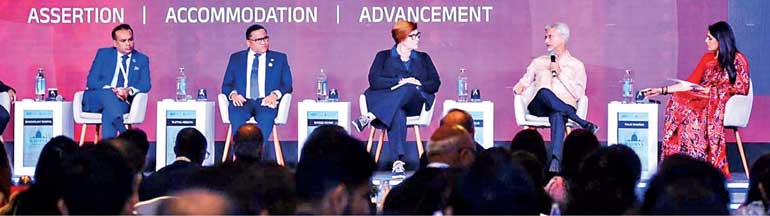

Foreign Affairs Minister Vijitha Herath speaks at the “Raisina Dialogue” in New Delhi last week
 In an international forum what matters is not superlative oratory. What matters is effective communication and not linguistic gymnastics.
At the Raisina Dialogue Foreign Minister Vijith Herath did not take cover under ‘Strategic Ambiguity’. Pukka Sahibs are furious that our Minister responded with careful phrases though somewhat haltingly. That he did not unleash a cascading torrent has disappointed elite circles.
He may have sounded diffident, self-effacing and unassuming in responding to Palki Sharma’s trap question. But he offered a clear explanation. He explained the rescue of survivors, recovery of the dead and the internment of the second vessel with its crew as strict interpretation, and compliance of the applicable law of UNCLOS.
Someone forwarded to me an FB post by the very personable, vibrantly opinionated BASL President Rajeeve Amarasuriya who is obviously disappointed with our Foreign Ministers response. I reproduce it below:
“I was present in the hall at the Raisina Dialogue when Foreign Minister Vijitha Herath made his remarks during the panel discussion on ‘The Future of the Indian Ocean.’ Very often, Ministers are not necessarily experts in foreign relations or foreign policy. One cannot fault them for that. However, it is the responsibility of the Foreign Ministry and our diplomatic missions to properly brief and prepare the country’s representatives for all possible questions and scenarios. In this instance, I believe it was entirely foreseeable that the question regarding the two Iranian vessels would be raised — particularly with Palki Sharma moderating the discussion.
A carefully calibrated response could easily have been given. For example, the Minister could simply have said that Sri Lanka maintains friendly relations with all these nations, and that our decisions will always be guided by law, principle, and what is in the best interests of the country. Such a response would have resonated well with the audience — a hall of over 600 influential leaders, policymakers, diplomats, and analysts from across the world. I sincerely hope that lessons are drawn from this moment, and that in the future our representatives are better prepared and supported, particularly when speaking on global platforms of significance.”
A carefully calibrated response such as “Sri Lanka maintains friendly relations with all these nations” may have induced the acerbically combative Palki Sharma into other contentious areas of which there is enough inventory on India Sri Lanka relations from the time of Arahat Mahinda to J N Dixit.
That said I perfectly understand the BASL President’s yearning for the incisive sharp witted elan of a Kadirgamar or the cerebral extravagance of a Shirley Amarasinghe who chaired the UN committee on UNCLOS. The NPP consists of outsiders.
But we live in the age of Pete Hegseth and not Bob McNamara. When I heard the buffoonery of making Iran toast, I pulled out my copy of “Wise Men’ by Walter Isaacson and Evan Thomas. It describes the American intellectual Brahmins who shaped the 20th Century which is rightly called the American Century. It is a different time and a different world.
 The elite dilemma is understandable. Our Elite are trapped in a historic conundrum that Frantz Fanon tried to define in his tract ‘Black Skin White Masks.” Mastery of the Colonizers language is power. In Fanon’s case it was French. It is a way to be as good as the Colonizer or even better. Yet it also creates a further sense of alienation from one’s own heritage.
But today the instrument of universal communication is ‘globish.’ That is English adopted to serve a purpose, that of communication.
I will soon turn 84. That is if my terribly calcified aortic valve functions reasonably till mid-August. I share the same birthday 13 August with Fidel Castro. It is a vantage point that allows me to look back not with anger but to look at the future with genuine bewilderment. After all, I leave behind some promising grandchildren.
I belong to a vanishing generation that witnessed the transformation of the global order from the promising years of hope in the era of decolonisation, (In Pukka Sahib parlance - twilight years of colonialism), chimeric interlude of non-alignment in a bipolar world and now in to the maddening complexities of a multipolar world that is yet to find its contours.
Era of ‘principled non-alignment
So, my lifetime covers the era of “principled non-alignment”, to the horribly wicked and bewilderingly maze like contemporary reality of “multi-alignment,” where small nations must navigate competing interests taking care to avoid offending global titans and to use a phrase of Nirupama Rao – to describe India “A Titan in Chrysalis.”
I was a young adult in a Utopian era of conviction when Sri Lanka handled the twin crises of Suez and Budapest. With Oxonian oratory S.W.R.D. Bandaranaike emerged as the moral voice in the World Stage competing with Cambridge educated Jawaharlal Nehru. Then ‘Ceylon’ adopted a bold stand supporting Egypt’s right to nationalise the canal while simultaneously condemning the Soviet suppression of the Hungarian revolt with mute indignation. After all, SWRD was the expedient utopian.
If I recall correctly V.K. Krishna Menon of India was decidedly lukewarm in his condemnation of the Soviet Union. He earned a black mark in an otherwise brilliant career.
In 1961, I witnessed the formation of the Non-Aligned Movement. Then in the 1967 six-day” war we lived through the tectonic shift in the Middle Eastern geopolitics that redefined Arab nationalism as inherently subject to Israeli security as perceived by the West.
The idealism of the mid-20th century that gained global recognition in the post-Vietnam years had a brief resurgence with the Arab Spring. That didn’t last. With Nixon unilaterally undermining Bretton Woods, dollar hegemony remained entrenched.
The BASAL President demands calibrated answers to questions in the age of transactional and nationalist politics of Donald Trump and Benjamin Netanyahu.
This missive may not appeal to the generation of the current President of the BASL.
Yet I must speak out because my generation spans the time when our foreign policy advocates defined sovereignty, justice, and equality —whether in 1956 Budapest, Six Day War in 1967, the Sino Indian clash in the Himalayas in 1962. I will not revisit the ‘Parippu Drop’ in the 1980s because it is water under the bridge. We are silent on Gaza today because we have maids, cooks, nurses and whatnots in Israel. The collective moral conscience of the Third World is no more. Today is the era of “each for itself”.
Scoring debating points with Palky Sharma was not the principal concern of our genuinely self-effacing Foreign Minister.
Palki Sharma could have asked many trap questions from the Suave Master Class Diplomat who is the Indian Minister of External Affairs at the same event. She could have grilled him on Iranian Frigates, and the Indian PMs visit to Israel barely 48 hours before Iran was bombed. She did not.
I still listen to Peter Paul and Mary singing Bob Dylan’s great lyrics “Blowing in the Wind.”
“How many roads must a man walk down
Before you call him a man?
How many seas must a white dove sail
Before she sleeps in the sand?
Yes, and how many times must the cannonballs fly Before they’re forever banned?
The answer, my friend, is blowin’ in the wind
The answer is blowin’ in the wind… “




