Thursday Oct 15, 2026
Thursday Oct 15, 2026
Monday, 29 December 2025 05:24 - - {{hitsCtrl.values.hits}}
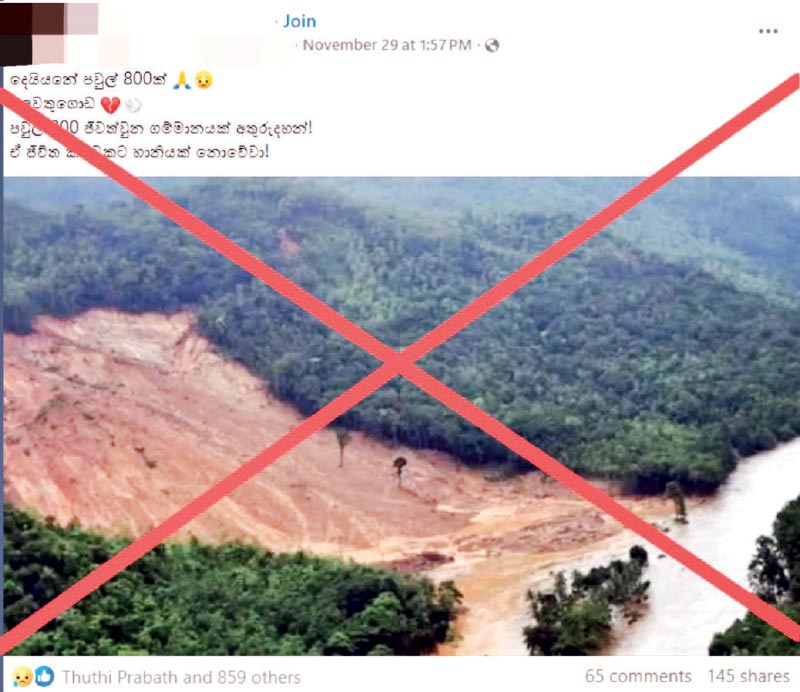
Screenshot of a post claiming 800 families had died in the Alawathugoda landslide, analysed and debunked by Fact Crescendo
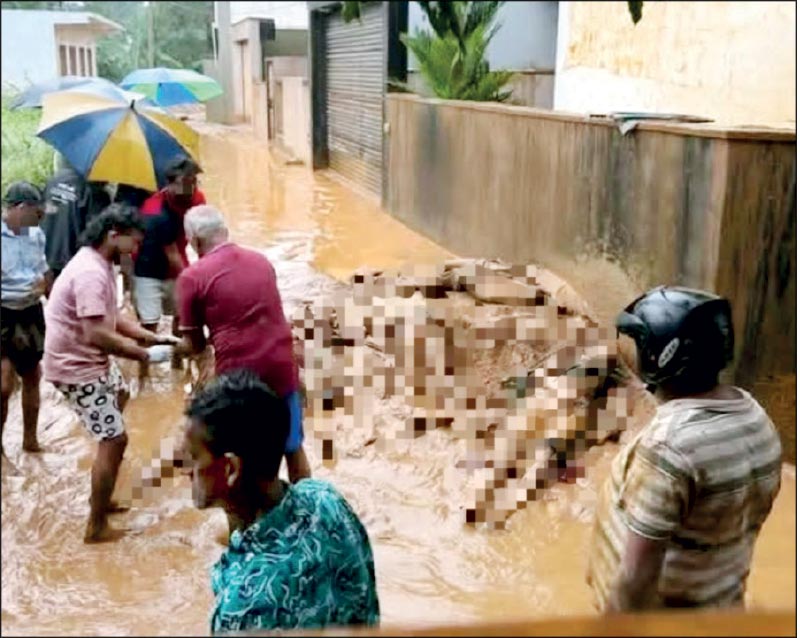
An image of deceased victims in Gampola that users mistook for AI-generated content. Faces and bodies blurred
By Divya Thotawatte
 My grandfather came shouting that the dam was cracking. We got up and ran straight out onto the road. Everyone in our lane was already outside
– Usitha Thisum Ilangakoon, a young man (21) from Pupuressa in Gampola
|
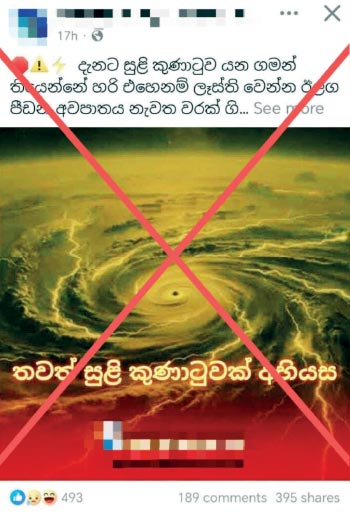
Screenshot of a misleading social media post analysed and debunked by Fact Crescendo shortly after landfall of CycloneDitwah
|
When Cyclone Ditwah hit Sri Lanka, people were caught unawares. Warnings were woefully inadequate or entirely missing, depending on where and in which language one received information. The resulting uncertainty triggered panic, fuelling a quick surge of alarmist misinformation.
While 22 districts in the island were gazetted as disaster zones – indicative of Ditwah’s scale, with deaths, missing persons and mass displacement – rumours beat relief operations in speed.
According to the Police Department, at least 57 false social media posts linked to Cyclone Ditwah have been identified and a special unit at the Criminal Investigation Division (CID) has commenced reviewing them under emergency regulations.
Police Spokesperson F. U. Wootler told the Daily FT that the Cybercrimes Investigation Division (CCID), which operates under the CID, was inquiring into these posts. The unit was still gathering “digital, video, forensic, and cyber evidence”, and a comprehensive report would be submitted to court once investigations were completed.
Several posts circulated exaggerating the local impact of Cyclone Ditwah, like claims that entire villages had been buried by landslides, or that key infrastructure such as bridges and dams had cracked. Official agencies were also targeted, including claims that the Disaster Management Centre (DMC) had been deactivated. Other posts falsely alleged that international relief shipments, such as food aid from Pakistan, were expired, fuelling public criticism and diplomatic embarrassment. Fact Crescendo noted that such content heightened public anxiety and weakened trust in authorities and institutions at a time when clear and credible information was critical.
On 29 November, a state of emergency was declared by President Anura Kumara Dissanayake under the provisions of the Public Security Ordinance No. 8 of 1959 to better respond to the national emergency. The extraordinary gazette limited its scope to: Protect public safety and national stability during the prevailing crisis and enable rapid disaster response and coordination across all sectors. President Dissanayake, who also declared 22 districts as disaster zones, assured the nation that the regulations would be used only to deal with the national disaster.
The institutional inability to communicate coherently led to and directly created the space for disinformation to flourish
– Disinformation expert and Groundviews Founder Dr. Sanjana Hattotuwa
However, the same regulations are now being used by the Police Department to probe “inciting” social media posts that misinformed the public during a disaster.
Police response aside, the DMC too was overwhelmed by the rumour mill. The DMC was inundated with anxious callers seeking information or to verify rumours. DMC was compelled to spend valuable time and resources to counter a surge of false information spreading online, diverting attention from lifesaving response efforts.
“Time is precious for disaster response,” said DMC Media Assistant Director Janake Hadunpathiraja, who recalled having to field hundreds of calls unnecessarily engaging the DMC hotline following false claims on social media related to the cyclone. A particularly damaging viral claim was the purported breach of the Kotmale dam. Each call required operators to calm panic and verify falsehoods, taking up time that could have been utilised to guide people at risk.
Cyclone Ditwah first hit Sri Lanka’s Eastern coast on 28 November, bringing heavy rainfall, flooding, and landslides across several districts, displacing over 233,000 during the peak of the emergency, according to the United Nations (UN) Sri Lanka.
Fact-checkers and disinformation researchers monitoring online content during the cyclone noted the majority of false claims centered around floods and landslides. They noted that old videos, including floods in Indonesia, Nicaragua and India, were reshared and falsely presented as footage from Cyclone Ditwah-affected areas in Sri Lanka.
“Initially, there were many content claims on the potential damage, especially about the bridges and some dams being breached,” Fact Crescendo’s Research Consultant Prabuddha Athukorala said. “Most of this content was shared in panic and often in good faith. None of the dams were breached, and many of the claims were effectively debunked.”
Among the most visibly damaging was the false news that the Kotmale dam had breached on 30 November. Posts went viral on November 30, luring hundreds of residents out of their homes in fear.
Usitha Thisum Ilangakoon (21) from Pupuressa in Gampola recalled being jolted awake around midnight. “My grandfather came shouting that the dam was cracking,” he said. “We got up and ran straight out onto the road. Everyone in our lane was already outside.”
Because their home sits near the Pupuressa mountain, a quick exit was not possible. They waited outside for about 15 minutes, trying to reach people and verify what was happening. During that time, around 40 vehicles had sped past, and a motorcyclist had also ridden through, warning people that they were fleeing Gampola fearing their homes would be destroyed. Ilangakoon felt the warning was suspicious, prompting him to call the police. Officers confirmed it was a falsehood and that the public panicking was being used by thieves as a cover for robberies.
Sandaru Bandara Wasalthilaka (21) from Jayamalapura in Gampola said his family chose not to flee when the rumour spread, on the basis that if the dam had actually burst, there would have been no time to escape. But most others from his village and the neighbouring village fled fearing for their lives. The panic even caused several people to be hospitalised, he said. However, Gampola police confirmed that no deaths were caused as a direct result of the panic.
The DMC later clarified that the dam had not breached, with official corrections issued by the early hours of 1 December and subsequently reported in the media. The incident even drew a response from the President on 8 December.
We didn’t run. We knew that if the dam actually burst, there would be no time to run – Sandaru Bandara Wasalthilaka, a young man (21) from Jayamalapura in Gampola
Factchecker Athukorala identified Facebook, WhatsApp, and YouTube as the primary platforms through which much of the misinformation spread. He observed that the rise of AI-generated images was eroding trust so significantly that authentic photos were also occasionally mistaken for fakes, complicating verification during emergencies.
He further warned that disaster misinformation carried a risk that information that is false at the time of sharing could quickly become plausible as conditions evolved. He noted that fact- checking during the cyclone was especially difficult because conditions were changing rapidly, official confirmations were delayed, and even authorities were sometimes unsure of the ground situation.
During fast-moving crises, this uncertainty makes it harder for people to distinguish between legitimate warnings and harmful false alarms, increasing the likelihood of panic-driven decisions, he added.
Crises amplifying misinformation
Media Analyst and Science Communication Expert Nalaka Gunawardene noted that rumours have emerged around disasters long before social media. What has changed is the scale and the speed at which they spread. He explained that with Sri Lanka having 130 mobile subscriptions per 100 people and over half the population now online, rumours spread more easily.
Distinguishing between disinformation and misinformation, he noted that only a relative few would deliberately originate false content (disinformation). “When these spread, many people are fooled,” he said, adding that when these misled persons shared such content uncritically, it would become misinformation, a more widespread phenomenon.
Gunawardene also pointed to the psychological conditions created by a major emergency as a key factor in the spread of misinformation. Any disaster generated uncertainty and heightened emotions such as fear, suspicions, panic, and even hysteria. “At such times, even rational people can become more gullible to believe falsehoods,” he explained, highlighting that the real culprits were the relative few who originated falsehoods out of sheer mischief, or due to their anti-social attitudes or political interests.
DMC’s Hadunpathiraja lamented that misinformation during the cyclone had directly disrupted disaster-response operations.
Hadunpathiraja said, following the dam breach rumours, especially the false posts around Kotmale dam breach, hundreds of calls tied up the DMC hotline. Had each call taken just a minute, that meant hundreds of minutes correcting false information, time that could have been used to save lives, he explained.
“Imagine someone calling us with the last seconds of their phone battery. If they get stuck in a queue, they might not get the lifesaving information they need before their phone dies.”
He also said that posts were circulating with the contact details of DMC district officers, making matters worse. Staff had kept getting calls from other districts, diverting them from assigned responsibilities as part of DMC’s cyclone response. “Even after the DMC issued a statement recently offering correct information, the damaging posts continued to circulate,” he added.
However, National Building Research Organisation (NBRO) Director General Dr. Asiri Karunawardena said the NBRO’s experience was different. The organisation had kept its official channels updated during the cyclone and had not encountered any mis- or disinformation related to their area of responsibility.
During field operations, Sri Lanka Red Cross Society (SLRCS) Disaster Management Manager Damitha Chanaka noted that while misinformation had not directly hindered Red Cross response efforts, false information like that of the Kotmale dam breach, had caused unnecessary panic among communities. These rumours had led some residents to evacuate prematurely or move to unsafe areas, while others had disregarded official warnings due to confusion and mistrust, he added.
Chanaka added that misinformation had reduced the effectiveness of early warning dissemination and slowed relief operations, highlighting the need for stronger risk communication, verified messaging, and closer coordination with media and community leaders.
Even rational people can become more gullible to believe falsehoods – Media Analyst and Science Communication Expert Nalaka Gunawardene
Information vacuum, criminal culpability
Meanwhile, researchers noted that even when official clarifications were issued, they often arrived after rumours had already spread widely, limiting their corrective impact.
Disinformation expert and Groundviews Founder Dr. Sanjana Hattotuwa explained that slow, uneven, and often inaccessible official communication created uncertainty on the ground. “If there is coherent, regular, official, clear, and evidence-based communication, then people will not be as misled. The institutional inability to communicate coherently led to and directly created the space for disinformation to flourish.”
Much of the official communication that was published during Cyclone Ditwah was inaccessible to large segments of the population, creating fertile ground for disinformation, Hattotuwa noted, explaining that messages were predominantly in Sinhala, leaving Tamil-speaking communities uninformed, as well as the disabled, blind, and deaf, who were also not accommodated by the communications.
He explained that Sri Lanka had been grappling with the same crisis communication failures since the 2004 Asian tsunami, with little structural reform despite repeated disasters. He argued that the spread of disinformation during Ditwah was less a failure of platforms, and more the result of deep-rooted institutional weaknesses in crisis communication.
“It is their (the DMC and Meteorological Department’s) inability and unwillingness to take disaster communications seriously that created the space for public panic and mass displacement caused by the disinformation that people who were scared, anxious, traumatised, and stressed were consuming,” Hattotuwa said, noting that repeated failings of official communications amounted to “criminal culpability”.
Gunawardene added that overly technical warnings and updates from the relevant state institutions also added to the public confusion. Despite having the technical expertise and legal mandates to issue alerts, agencies such as the Meteorological Department, DMC, and the Irrigation Department had repeatedly failed, across successive crises, to communicate risks in ways that were easily understood by the public.
Drawing on his long-standing monitoring of disaster communications, he noted that inconsistent messaging, confusing visual tools such as weather maps, and imprecise wording on official updates created information gaps that allowed mis- and disinformation to thrive.
Even after the DMC issued a statement on December 29 offering correct information, the damaging posts continued to circulate – DMC Media Assistant Director Janake Hadunpathiraja
Preventing public harm
As institutional disaster communications continue to lag, emerging technologies will only accelerate the speed and reach of disinformation during crises.
Hattotuwa emphasised that AI-generated content, though it was not primarily used maliciously in this instance, could become far more convincing and dangerous in the future. “Over the longer term, you could have AI that… suggests that a particular area or community has been impacted. It can create a fraudulent relief or aid campaign that only serves to enrich whoever is behind that campaign.”
With extreme weather expected to become more frequent due to climate change, Hattotuwa stressed that chasing after false content after it goes viral would never be enough, and that strengthening the fundamentals of official, timely, and coherent crisis communication was far more effective in reducing the impact of misinformation.
Despite the scale of Cyclone Ditwah, the misinformation that accompanied it did not reveal a new failure. It exposed a long-standing pattern in how disasters have been communicated. False dam breach news, overwhelmed emergency hotlines, and diverted emergency resources highlighted how quickly an information vacuum could turn into public harm. Unless these structural weaknesses are addressed, future crises are likely to trigger the same problems and failures as this one.