Monday Sep 28, 2026
Monday Sep 28, 2026
Wednesday, 1 April 2026 00:26 - - {{hitsCtrl.values.hits}}
 “People are either your brothers in faith or your equals in humanity” (Imam Ali – Nahj al Balagha)
To say, “the Arab countries should unite with the Islamic Republic of Iran” is not a complex proposition, it is clear and straightforward.
However, it requires certain essential qualities - at a minimum – such as the courage, unmatched bravery and military genius exemplified by Khalid bin Walid, along with inspiration drawn from the visionary leadership and wisdom of Ali ibn Abu Talib, often called the “Gate of the City of Knowledge” by Prophet Muhammad (peace be upon him). Finally, Ikhlas - a sincere and solemn commitment to be ummatan wasatan - a middle nation, neither the extreme of hedonism nor monasticism. A question that may arise is whether the Arab rulers have any of these qualities. Never mind that perception, given the real threat to their security and existence, new policies and feasible alternatives would be welcome. The issue should be considered objectively, with logic and reasoning rather than emotion.
The proposal to unite with Iran may be assessed further against a range of multiple strategic and other considerations. Some of which are, from the perspective of: 1. Quranic teachings - what are its guidance and directions; 2. Eschatology - lessons to derive from the three Abrahamic faiths – Judaism, Christianity and Islam; 3. Geopolitics – the evolving shape and form; 4. Geo-economy - emerging dynamics in international trade; 5. Greater Israel project - role of Zionism and Christian evangelicals; 6. Imperialism - US hegemony and its vassal European countries; 7. The growing interest of China and Russia in the region; 8. Peace, security and prosperity for all.
This column does not examine each point in detail; rather, it focuses on the broader realisation of item 8 - Peace, security and prosperity for all – which by default may interconnectedly reflect on the other areas as relevant. For a detailed study, interested analysts and researchers may pursue on the other points and expand the discussion with the objective of achieving point number 8. Thereby, positively contributing to a world where hegemony, arrogance, deception, oppression, corruption, injustice, stereotyping and war are replaced with overall peaceful living - utopian it may sound but none can deny that a minimal level is certainly achievable. After all, the establishment of court systems, democratic institutions, humanitarian and international laws are all in order to maintain the semblance of humanity and peaceful existence.
Lessons from the GCC
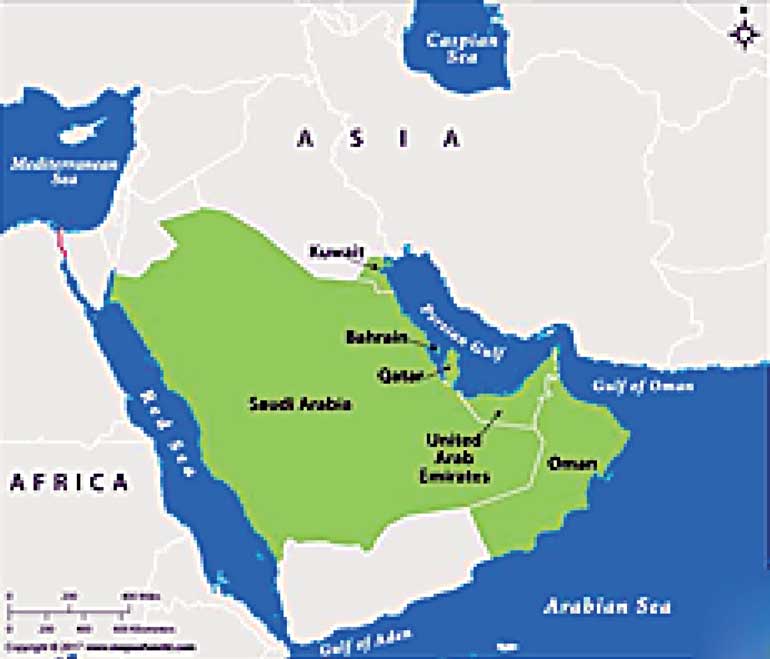
 The Gulf Cooperation Council (GCC) is a miserable and shameful failure. Shameless because all these are Muslim countries and supposed to be bounded by fraternity. Sadly, by their own conduct they opted to go in different directions. The GCC was established in 1981 as an alliance of six Middle Eastern countries viz. Saudi Arabia, Bahrain, Oman, Qatar, Kuwait and the United Arab Emirates (UAE). The objective was to create unity in defence, economy, politics and culture among its members.
These countries are basically family autocracies where the ruling families monopolise political power. The wealth of these nations is concentrated within the family. Wealth refers to the abundance of oil and natural gas supplies. On matters of national, regional or global interest overall priority is given to the stability, continuation and protection of the family status quo. Thus, justice, fairness and reasonableness in the objective sense is not found in their play book except when it is favourable for them. Political dissent in these countries is unheard of as opposition is suppressed to maintain the family dominance.
Some of the many reasons for the failure of the GCC as an alliance arises from the internal strife between these ruling families, political rivalry, the ego of being richer than the other, lacking sincere commitment for deep integration and collective strength, no strong institutional depth to handle crises situations between members of the alliance (the 2017 Qatar blockade serves as an example: where deep fractures within some of the countries – Saudi Arabia, UAE and Bahrain - became evident when they ignored GCC mechanisms designed to act as a single unified body). The credibility of GCC as a collective was questioned and its weakness and impotency as an alliance was disgracefully exposed when billions of Muslims worldwide witnessed their silence on the face of the Gaza genocide.
Embracing hegemony
 This disunity offered a great opportunity for the imperialists and the deceptive Zionists to play the role of good cop. These external powers were quick to exploit the division and manipulate to widen the cracks within, encouraged the rulers to look for solutions for their internal disputes bilaterally rather than through the collective mechanism of the GCC or urging the rulers to use external powers (the colonialists and Zionists) to influence a solution. These hegemonic schemes were to effectively undermine the strategic autonomy of the GCC as an alliance and to limit its influence globally.
The Americans backed by the Zionists succeeded in this project – ‘congratulation’. In order to protect their rulership, they willingly embraced this hegemony. The GCC today is not taken seriously by anyone. What a sad and unfortunate predicament compared to other vibrant and functioning alliances as the European Union, ASEAN. These are alliances between countries and peoples belonging to different religions, cultures, ethnicities, races and languages while the GCC consists of one Arab people, one Arabic language, one religion, one culture. A reasonable person may ask, “who is to be blamed for this state of affairs?”
Scaremongering
Scaremongering, is the act of exploiting feelings of fear by using exaggerated rumours of impending danger (Wikipedia).
These little sheikhdoms are strategically sitting atop the vast oil and natural gas wealth of the world. Some of them are demographically fragile with a negligible local population surpassed by a large expatriate workforce, some are geographically tiny and all are militarily weak. They also became easy pawns to colonialist and imperialist advances due to lack of exposure to manipulations, scheming and geo-politics.
For the US, this was an opportunity with several windows wide open to control the oil wealth and through that global dominance. The best weapon they used to get around these Arab rulers was by scare mongering. They used the tools of fear, uncertainty and doubt as manipulative tactics to strategically influence perception by spreading disinformation, suspicion and negative impressions, fabricated or taken out of context. Thereby, surreptitiously and diplomatically harming the trust, confidence and reliability that existed between the rulers and their people and, the general Muslim nations both inside and outside the Middle East region.
The Americans earlier used Saddam Hussein as the monster. The Council on Foreign Relations reported, “The Bush administration said it believed Saddam could pass weapons of mass destruction to Osama bin Laden’s network or other terrorists.” (February 2005).
After Saddam, the US used the Ayatollahs as the bogeymen. Vali Nasr Professor at Johns Hopkins University wrote, “the most important issue in the region has been Iran” it irks Israel, Saudi Arabia and UAE. “The entirety of our relationship with Persian Gulf monarchies is built around the idea of containing Iran. So, there is no such thing as leaving the Middle East without dealing with Iran.” (January 2022 – ‘The future of US-Middle-east relations’ Council on Foreign Relations).
Trump and Netanyahu adventurism
For the purpose of their political survival - Trump from the ‘Epstein Class’ and the Genocider Netanyahu - both have placed the entire world at risk militarily, economically and environmentally. If this does not penetrate into the brains of these Arab rulers, they run the risk of facing an irreversible situation in which their masters will not be present to protect them. Already, it is clear that the master’s priority is to protect Israel and not the so-called Arab allies. Paradoxically, the masters have not been able to protect their own military bases in the GCC soil.
The Arab rulers must recognise that many Gulf citizens are grateful to Iran for punishing the Zionist regime of Israel for the Gaza genocide and admire Iran for bravely standing against the Super power of the world, the USA. The Gulf citizens while they sympathised with the Palestinians were not happy with the stance of the rulers took during the Gaza genocide. They are also not happy with the rulers for normalising relationship with Israel. The regime which in its delusion of Greater Israel has been the cause of wars in Libya, Sudan, Somalia, Lebanon, Syria, Yemen, Iraq and now Iran. It is out of fear of the Rulers that the Gulf citizens are remaining silent.
Exit US or regime change
The GCC cannot collectively take a decision asking the Americans to exit from their territories because of internal divisions on the level of dependence on the US. Saudi Arabia is fully reliant on the US to protect its Monarchy from internal revolt and to secure its oil infrastructure. Qatar on the other hand did not fully buy into the US demonisation of neighbouring countries and has a soft approach towards the US. Therefore, it will be wise for these Gulf nations to individually choose to walk away from US dominance since reliance on the US has only brought them trouble and not the highly anticipated protection.
If the war continues and the GCC states get hit continuously, oil production will stop, tourism disrupted, industries will be shut down, no water and electricity if desalination and power plants are bombed, scarcity for food and the economy will be at a standstill. There is the threat of internal revolt by the Gulf citizens. The lid of repression, dissatisfaction with the stance on the Gaza genocide, servile obedience to the US and embracing Zionist Israel would all explode into the streets. Ironically, regime change will then take place not in Iran but in the GCC countries.
Jeffrey Sachs Professor at Columbia University in one of his many podcasts said, “I warned them (GCC countries) and I will tell them again having the US military on your soil will not give you protection. It’s a magnet for other people’s bombs.”
The time is up for the Arab rulers to think wisely and act quickly.
(The author, LLB (Hons) UK,
is an Attorney-at-Law, Ex-Corporate
and Legal Adviser.)




