Monday Sep 28, 2026
Monday Sep 28, 2026
Monday, 10 August 2026 00:25 - - {{hitsCtrl.values.hits}}
 Judicial reform: Why consensus matters
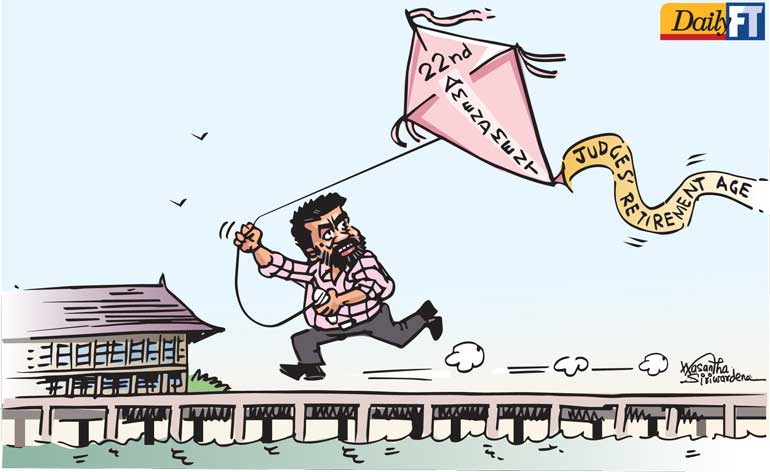
Sri Lanka stands at an important constitutional juncture. The Cabinet’s decision to approve a Constitutional Amendment Bill extending the retirement age of judges—spanning the Supreme Court, the Court of Appeal, and the lower courts—has sparked an intense discussion. While framed by the administration as an intervention to address severe case backlogs, the proposed amendment has drawn widespread attention and criticism from the legal fraternity, civil society, and religious leaders. Legal experts suggest that modifying the architecture of judicial tenure across all tiers of the court system warrants a careful evaluation of its long-term impact on the independence of the judiciary. The bill, which is the 22nd Amendment to the Constitution, has since been Gazetted and will be submitted to Parliament in the coming days for legislative scrutiny and a debate on its constitutionality.
Status quo: Local and international stakeholders
This concern is deeply shared beyond our borders, where regional and international bodies—including LAWASIA, the Commonwealth Lawyers Association (CLA), and the International Association of Judges (IAJ)—have noted that ad hoc changes to judicial terms can undermine the perception of judicial autonomy. The CLA, specifically, has urged Sri Lankan authorities to abandon these proposed amendments regarding the extension of judges' retirement ages, citing direct threats to the rule of law. When amendments immediately impact sitting judges, both international observers and local bodies, like the Bar Association of Sri Lanka (BASL) and the Judicial Service Association of Sri Lanka (JSASL),emphasise that the process must remain fully transparent to maintain public confidence in institutional good faith. To truly safeguard an impartial judiciary and avoid scrutiny regarding political motivation, these organisations insist that any adjustments to judicial tenures must strictly align with established international benchmarks, such as the Latimer House Principles.
Reviewing the proposed legislation
The proposed 22nd Amendment seeks to alter Article 107(5) of the Constitution, shifting the mandatory retirement age from 65 to 67 for Supreme Court judges, and from 63 to 65 for the Court of Appeal, alongside parallel statutory adjustments for the lower courts. In many jurisdictions, adjusting retirement parameters to reflect changing demographics and life expectancies is standard practice. However, legal scholars note that structural changes affecting the judiciary are most effective when handled with broad institutional consensus.
The legal fraternity: Internal divisions and stakeholder consensus
The proposed legislation has exposed deep divisions within the polity, legal fraternity, and civil society alike. A cross-section of legal professionals has come forward in support of the bill, arguing that extending the judicial retirement age does not impinge on institutional independence or compromise sitting judges. From their perspective, the amendment is a pragmatic solution to an inherent systemic crisis, offering a direct mechanism to clear a massive backlog of court cases that currently stands at over 1.1 million. Concurrently, proponents have criticised opponents of the extension, citing the mounting resistance as obstructive and politically motivated rather than legally sound.
Be that as it may, counter-arguments indicating a different consensus have emerged from the broader legal profession itself. The Bar Association of Sri Lanka (BASL) convened a special general meeting where thousands of legal practitioners voted to oppose the draft legislation. This high level of alignment within the nation’s largest legal fraternity suggests that the bill is viewed with deep caution by those who interact directly with the legal framework. A key point of the BASL's reservations is the lack of meaningful consultation and evidence-based justification during the drafting of the bill. 
Furthermore, the legal fraternity opined that the administration bypassed formal consultative processes with critical institutional stakeholders, such as the Bar Association of Sri Lanka (BASL) and preeminent legal authorities, prior to the draft's publication in the Government Gazette. They contend that in a democratic paradigm, pre-legislative engagement with the legal fraternity is essential to guarantee that policy initiatives remain constitutional, pragmatic, and grounded in broad consensus. Consequently, critics posit that the immediate application of this tenure extension to incumbent apex court justices may precipitate significant procedural complications. The experts argue that, should this bill encounter constitutional scrutiny, the justices of the Supreme Court would face a precarious conflict of interest, tasked with adjudicating legislation that directly modifies their own terms of service—a structural overlap that must be avoided to uphold the perceived impartiality and integrity of the judiciary.
A house divided: Partisan friction in Parliament
Meanwhile, this friction is mirrored inside Parliament, where lawmakers remain sharply divided along partisan lines. The NPP, including the Minister of Constitutional Affairs and Prison Reforms, defends the bill as a good-faith measure. Lawyers affiliated with the NPP have justified the bill on the premise that extending the retirement age of experienced judges bodes well for clearing inherent court backlogs. They maintain that retaining experienced senior judges is crucial for the continuous, effective delivery of judgments, and forms a core pillar of the NPP Government’s broader judicial reform agenda.
Conversely, Opposition parliamentarians reject this rationale, viewing the backlog argument as a mere facade. They argue that the bill is an attempt by the executive branch to exert undue influence over the judiciary for narrow political ends, at the expense of judicial autonomy and public trust. Joining the fray, constitutional experts argue that institutional efficiency requires a multifaceted approach and systemic structural reforms, rather than relying solely on extending the terms of sitting judges.
Public and civil society feedback
Beyond the legal sphere, the proposed amendment has drawn sharp responses from diverse sectors of Sri Lankan society. The BASL leadership has noted that the Mahanayakes (Chief Prelates) of the Buddhist chapters, namely, the Malwatte, Asgiriya, Ramanna, and Amarapura Nikayas - have expressed reservations regarding the bill in a joint communication to the executive. In contrast, Government spokespersons maintain that the chief Buddhist prelates have not formally opposed the constitutional amendment but rather accepted clarifications regarding its intent. Similarly, civil society organisations and other religious establishments, including the Church of Ceylon, have urged the Government to prioritise standard, consultative reform processes to safeguard democratic checks and balances. When broad civic and professional groups share a common viewpoint, it highlights the need to treat judicial tenure as a matter of fundamental governance ethics.
Structural and operational realities: Options for addressing backlogs
Critics challenge the administration's rationale by highlighting that out of the 1.1 million pending cases, more than 90% are bogged down specifically in the lower courts. They argue that this overwhelming bottleneck warrants urgent structural reforms aimed at reinforcing and widening the functional capacity of the broader judicial system. According to this perspective, a practical resolution requires addressing critical administrative bottlenecks, including the expansion of physical courthouses, judicial staff, and operational resources. Furthermore, legal experts emphasise that institutional backlogs cannot be solved without reinforcing crucial supporting bodies, such as the Attorney General’s Department and the Government Analyst’s Department, rather than merely extending the retirement age of judges at the apex and appellate tiers.
Meanwhile, senior legal practitioners have observed that a significant number of existing vacancies within the apex courts remain entirely unfilled. If the primary objective is truly the reduction of caseloads and judicial delays, filling those empty seats and expanding overall court capacity represents a direct, immediate, and far more logical course of action than altering the retirement rules mid-game for sitting apex judges.
Strategic imperatives and international benchmarks
BASL members argue that extending the retirement age of judges was not highlighted as an immediate governance priority in any major political party manifesto. It is also noted that no comprehensive impact assessment or clear structural rationale has yet been publicised to explain the specific urgency behind this legislative path. Given this informational gap, this sudden legislative focus has led to widespread calls for greater clarity regarding the administration's long-term strategic intent.
Questions have also been raised regarding the selective application of this policy. While the judiciary is being considered for an extended retirement age, other critical branches of the public sector facing similar labor shortages and administrative backlogs remain subject to standard retirement rules. To ensure a cohesive governance strategy, legal analysts suggest that judicial reform should ideally be integrated into a holistic policy encompassing the public sector in its entirety.
On a global scale, international history demonstrates that changes to judicial retirement parameters are most successful when handled through a meticulous and highly collaborative process. For example, when the United Kingdom raised its judicial mandatory retirement age from 70 to 75, the Government engaged in nearly two years of transparent public consultations before passing the Public Service Pensions and Judicial Offices Act 2022. This deliberate approach ensured broad institutional consensus and protected public trust. Adhering to these established global benchmarks safeguards domestic judicial independence from the shifting political vicissitudes of successive administrations.
A path forward: Key takeaways
In light of the extensive reservations voiced by key stakeholders—including professional legal bodies, civil society groups, and religious leaders—halting the current proposal to permit exhaustive national discourse represents the most constructive path forward. Meaningful reform must look beyond temporary measures, prioritising systemic transparency and urgent structural modernisation instead. Addressing the root causes of judicial delay requires expanding physical infrastructure, filling open vacancies across the bench, and empowering lower-tier courts alongside their affiliated institutions. Ultimately, maintaining the clear independence of the judiciary remains vital for the long-term stability of Sri Lanka's democracy and the progression of the people's aspirations, directly honoring the governance standards and democratic trust established during the historic September and November 2024 elections.
"The complete independence of the courts of justice is peculiarly essential in a limited Constitution." - Alexander Hamilton (American Statesman, Legal Scholar, and Founding Father of the United States, writing in Federalist No. 78)
(The writer is a retired Ambassador and Foreign Ministry Spokesman. He can be reached at [email protected])




