Monday Oct 12, 2026
Monday Oct 12, 2026
Monday, 4 May 2026 00:18 - - {{hitsCtrl.values.hits}}
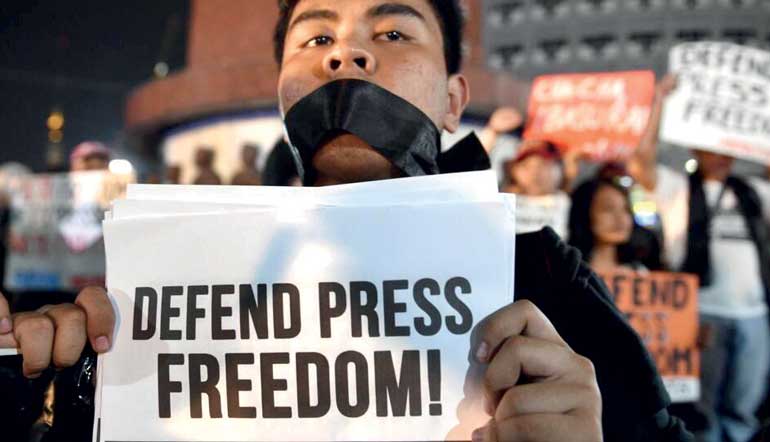
Freedom of the press around the world has fallen to its lowest level in a quarter of a century, according to the leading Paris-based press freedom NGO, Reporters Sans Frontieres (RSF), or Reporters Without Borders.
Every year, RSF publishes a World Press Freedom Index used to compare the level of freedom enjoyed by journalists and media outlets in 180 countries. Its ranking uses a five-point scale to assess a country’s level of press freedom, ranging from “very serious” to “good”.
For the first time since RSF started producing the index in 2002, more than half of the world’s countries fall into the “difficult” or “very serious” categories for press freedom – “a clear sign that journalism is increasingly criminalised worldwide”.
Only seven mostly Nordic countries are ranked with “good” press freedom, with Norway, the Netherlands and Estonia in the top three. France ranks 25th with a “satisfactory” score, while the United States ranks 64th with a “problematic” score, falling seven places since President Donald Trump took office.
RSF reports that Trump “has turned his repeated attacks on the press and journalists into a systematic policy”, citing the detention of Salvadoran journalist Mario Guevara, who was later deported, while he was documenting a protest against immigration raids, as well as the suspension of several notable public media institutions.
In Latin America, RSF highlighted the dramatic fall of Javier Milei’s Argentina (98th, -11) and of El Salvador (143rd), which has dropped 105 places since 2014 following the launch of a war against the Maras criminal gangs.
The press freedom NGO said that “Eastern Europe and the Middle East are the two most dangerous regions for journalists in the world, as they have been for 25 years”, notably putting Russia (172nd) and Iran (177th) in the bottom 10.
It added that wars and restrictions on access to information are some of the driving factors for the decline in press freedom. It cited Israel’s attacks on journalists in Gaza, the occupied West Bank and Lebanon as an example of this, ranking Israel 116th.
“Since October 2023, more than 220 journalists have been killed in Gaza by the Israeli army, including at least 70 who were slain while carrying out their work,” it said.
Broadly speaking, RSF reported that “the criminalisation of journalism, which is rooted in circumventing press law and misusing emergency legislation and common law, is proving to be a global phenomenon”.
It reported that more than 60% of countries – 110 out of 180 – have criminalised media workers in various ways, notably citing India (157th), Egypt (169th), Georgia (135th), Turkiye (163rd) and Hong Kong (140th) as prime examples of state-imposed crackdowns.
“Although attacks on the right to information are more diverse and sophisticated, their perpetrators are now operating in plain sight,”RSF Editorial Director Anne Bocande said. She cited “authoritarian states, complicit or incompetent political powers, predatory economic actors and under-regulated online platforms” as the main causes “for the global decline in press freedom”.
Bocande called on democratic governments and citizens to do more to end this global criminalisation of journalists, particularly through “firm guarantees and meaningful sanctions”.
“Current protection mechanisms are not strong enough; international law is being undermined and impunity is rife,” she said. “Inaction is a form of endorsement,” while concluding that “the spread of authoritarianism isn’t inevitable”.
Sri Lanka improves
Sri Lanka has moved up five places in the 2026 World Press Freedom Index, ranking 134th out of 180 countries with a global score of 40.77, according to the latest report by Reporters Without Borders (RSF).
The improvement marks a modest gain from 2025, when the country was ranked 139th, although concerns over structural and legal constraints on media freedom persist.
“Sri Lankan law does not restrict freedom of expression, but nothing guarantees the protection of journalists. The 1973 law creating a Press Council to ‘regulate’ the media poses a major problem because the President names most of its members. The Sri Lankan International Covenant on Civil and Political Rights (ICCPR) Act has been used to silence dissenting voices,” RSF said.
The report flags continued use of national security legislation and regulatory mechanisms as tools that could limit journalistic activity and dissent.
“The authorities often use the prevention of terrorism law to silence journalists, especially those who try to investigate the living conditions of the Tamil minority in the north and east of the island. Parliament passed an internet regulation law in January 2024 creating the Online Safety Commission, whose members are appointed by the president. Under the guise of defending ‘national security, it can censor the content and accounts of dissident voices on social media, and suspend the confidentiality of their sources”.




