Tuesday Oct 06, 2026
Tuesday Oct 06, 2026
Wednesday, 1 April 2026 00:02 - - {{hitsCtrl.values.hits}}
 |
|
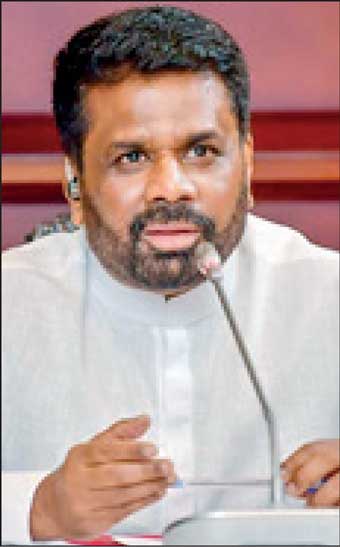
President Anura Kumara Dissanayake |
Many months after the catastrophe, the affected Hill Country Tamil families are still languishing in a desperate state, continuing to endure immense hardship. While relief, rehabilitation, and reconstruction efforts toward normalcy are progressing in other parts of the country, these activities remain extremely sluggish in the affected plantation areas.
Hundreds of families continue to languish without a permanent solution, living in schools, temporary camps, tents, and dilapidated plantation buildings. Many have been sent back to houses that they say remain unsafe for habitation. There is still a lack of clarity regarding the release of land for resettlement. The Malaiyaha people, who lack formal land ownership, face immense difficulties in accessing the relief and compensation announced by the Government. As a result, many have received nothing. A stalemate persists over whether the responsibility for repairing the damages in the Estate areas lies with the private companies or the Government. The key reasons for the current suffering of families are this Government’s lack of policy clarity and its sluggish execution.
Therefore, considering the massive impact of Cyclone Ditwah on the Hill Country Tamil community, and against the backdrop of affected plantation families being shunted from place to place causing deep distress, we present the following demands to the Government led by President Anura Kumara Dissanayake:
1. Malaiyaha families whose homes were fully destroyed or require resettlement, Rs 5 million must be provided. For partially damaged houses, up to Rs 2.5 million should be paid. Additionally, if there is a need to buy land, up to 5 million should be allocated (in accordance with Circular NDRSC/02/04/10).
2. Relief and compensation for housing and other losses must be provided to eligible Hill Country people on par with other citizens of the country, without any discrimination. No distinction should be made between workers and non-workers in the plantations when providing disaster relief and undertaking reconstruction efforts.
3. To ensure the Malaiyaha people’s connection to the land of this country, individual houses with formal land deeds must be provided within the plantation areas. Apartment-style (multi-story) housing projects in the plantation areas should be rejected.
4. The Indian Housing Project must not be diverted or used as relief for the Ditwah disaster. It must remain a separate, distinct project and be implemented in an expedited manner as originally planned.
5. The Ditwah housing projects must rebuild estate human settlements as integrated villages equipped with proper roads, formal addresses, electricity, drinking water, social infrastructure, and other essential amenities. This process must facilitate the abolition of the “Plantation System” and transform them into ‘new villages’.
6. To ensure land ownership and the creation of ‘new villages’, the lease agreements with Plantation Companies must be amended immediately.
7. People currently suffering in temporary camps, tents, and other locations must be treated with dignity and respect, rather than being shuttled around. Crucially, decisions regarding the identification of land for their new homes must be made in consultation with the affected families.
8. The right to land ownership must be granted equally to women.
9. Until a permanent housing solution with land ownership is achieved, Transitional Shelters must be provided immediately in suitable locations. These shelters must be equipped with basic facilities and adhere to international humanitarian standards (SPHERE Standards).
10. When providing Government relief and compensation for Malaiyaha Tamil families—covering agriculture, livestock, enterprise, and livelihood related damages—the state must adopt an equitable approach that goes beyond mere formal equality to address their specific vulnerabilities.
11. Similar to all other citizens of Sri Lanka, relief and services for the plantation community must be channeled through Divisional Secretariats, Provincial Councils, and Pradeshiya Sabhas. These should not be delegated to private companies or the Plantation Human Development Trust (PHDT).
12. The language rights of Hill Country Tamils must be respected. All application forms, official notices, and communications must be provided in Tamil. It must be ensured that Government offices communicate with these families in their language.
13. If there are difficulties or grievances in receiving relief and compensation, formal Grievance Redressal Mechanisms must be established at the Divisional, District, and National levels to provide timely solutions.
14. Any short-term disaster relief measures should not contradict or compromise the long-term demands or struggle of the Hill Country Tamil people for land and housing rights.
15. The Government must take full responsibility for repairing and reconstructing community infrastructure in Estates damaged by Cyclone Ditwah, including bridges, roads, stairways, retaining walls, and community buildings. The Government must provide clear instructions to Pradeshiya Sabhas regarding the legal provisions that allow these local Government bodies to allocate funds and undertake infrastructure repair and development within Estates. Any ambiguity preventing local authorities from intervening in these areas must be clarified.
We believe that the direct intervention of the President and the Prime Minister is essential to clear the policy gaps and to issue the necessary administrative orders, and expedite the relief and reconstruction efforts in the Malaiyaha regions. We urgently request the President and the Prime Minister to grant us an immediate opportunity for a discussion to address these critical issues and move towards solutions.
On behalf of the Malaiyaha people suffering from the impact of Cyclone Ditwah, we seek the support of all political parties, civil society activists, and academics to rectify the current lack of progress. In particular, we trust that the parliamentary representatives of Malaiyaha people—including members of the National People’s Power (NPP), the Tamil Progressive Alliance (TPA), and the Ceylon Workers’ Congress (CWC)—will endorse these demands and exert pressure on the decision-makers within the Government. We extend an open invitation to all of them to work together in unity to achieve a dignified and speedy recovery of suffering families.



