Monday Oct 12, 2026
Monday Oct 12, 2026
Monday, 12 October 2026 03:18 - - {{hitsCtrl.values.hits}}
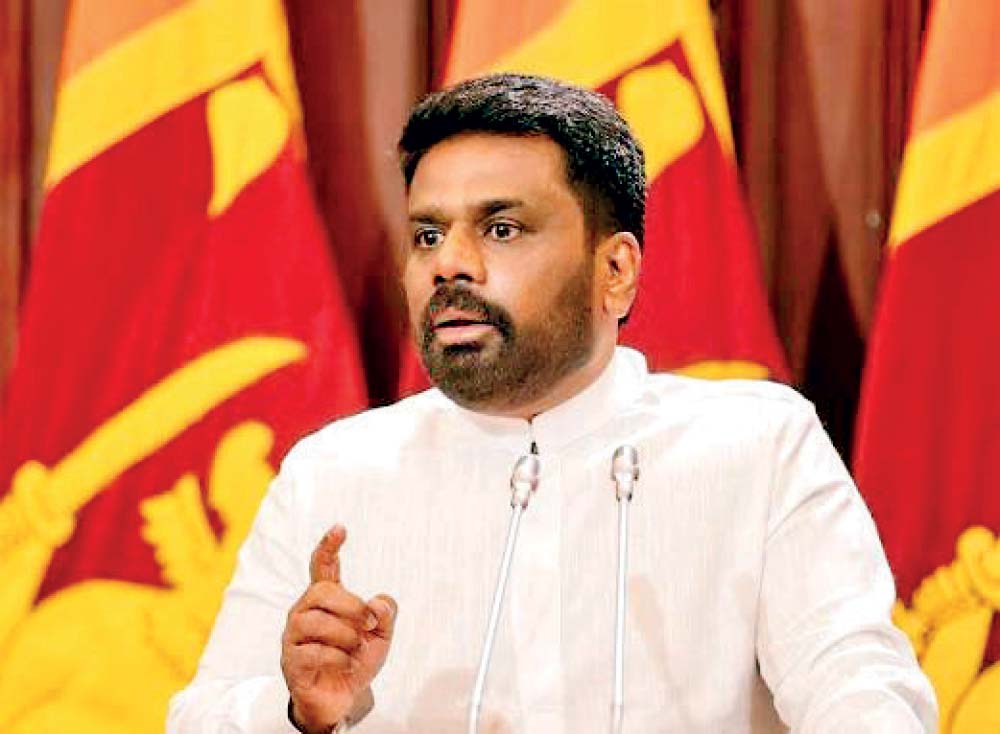
President Anura Kumara Dissanayake
 The NSC has urged the President that the Iranian vessels stranded South of Galle within Sri Lanka’s Exclusive Economic Zone are said to be facing acute shortages of water, food and medicine according to credible sources and require official Government search and rescue operations and possible medical attention
In an urgent letter sent on Friday to President Anura Kumara Dissanayake, the National Shoora Council (NSC) has urged the President to uphold the humanitarian principle that the territorial sea is a boundary for ‘exercising sovereignty’ and not a boundary limiting ‘humanitarian help’. NSC has urged the President that the Iranian vessels stranded South of Galle within Sri Lanka’s Exclusive Economic Zone (EEZ) are said to be facing acute shortages of water, food and medicine according to credible sources and require official Government search and rescue operations and possible medical attention.
On board are civilian seafarers and workers who are nationals of Iran, India, Bangladesh and several other neighbouring countries. The Iranian civilian vessels are unable to return to the home destination owing to the continued naval blockade and the unilateral sanctions announced by US President Donald Trump, measures that carry no endorsement or authority of the United Nations or of the UN Security Council.
The NSC letter signed by NSC President M.M. Zuhair, PC, and General Secretary Rashid M. Imthiyaz. Attorney at Law, have been copied to the Foreign Affairs Minister, Human Rights Commission of Sri Lanka, Defence Secretary and Sri Lanka Navy Commander.
NSC’s request to the President states: “We note with grave humanitarian concern the stated position that no supplies will be provided while these vessels remain beyond the 12-nautical-mile territorial sea. The Government has made no effort to facilitate or encourage Sri Lankan shipping agents, ship chandlers or private companies to officially deliver basic provisions. With the greatest respect, we submit that this position is not consistent with Sri Lanka’s obligations under international law, nor with the humanitarian traditions of our nation”.
NSC has sought immediate official assistance to the seafarers and workers. It is in the national interest to save human lives even at the cost of sanctions, the NSC has said.
On board are civilian seafarers and workers who are nationals of Iran, India, Bangladesh and several other neighbouring countries. The Iranian civilian vessels are unable to return to the home destination owing to the continued naval blockade and the unilateral sanctions announced by US President Donald Trump, measures that carry no endorsement or authority of the United Nations or of the UN Security Council
We note with grave humanitarian concern the stated position that no supplies will be provided while these vessels remain beyond the 12-nautical-mile territorial sea. The Government has made no effort to facilitate or encourage Sri Lankan shipping agents, ship chandlers or private companies to officially deliver basic provisions. With the greatest respect, we submit that this position is not consistent with Sri Lanka’s obligations under international law, nor with the humanitarian traditions of our nation
(b) Direct MRCC Colombo, the Sri Lanka Navy and Coast Guard, with the Sri Lanka Red Cross Society and the ICRC, to assess needs and deliver drinking water, food and essential medicine as an urgent humanitarian priority, and to evacuate for immediate treatment the sick and the injured.
(c) Issue clear guidance and assurance to Sri Lankan shipping agents, ship chandlers and private companies that the supply of purely humanitarian provisions is lawful and encouraged, distinct from bunkering, repairs, cargo or other commercial services.
(d) Engage the Governments of Iran, India, Bangladesh and other States of nationality, and the flag States, to secure provisioning, crew welfare and repatriation.
(e) Adopt a transparent standing policy, notified through diplomatic channels, so that the Nationals of India, Bangladesh, Iran and other countries stranded with acute shortage of essentials in Iranian vessels are provided urgent humanitarian assistance.




