Monday Sep 28, 2026
Monday Sep 28, 2026
Thursday, 7 May 2026 04:46 - - {{hitsCtrl.values.hits}}
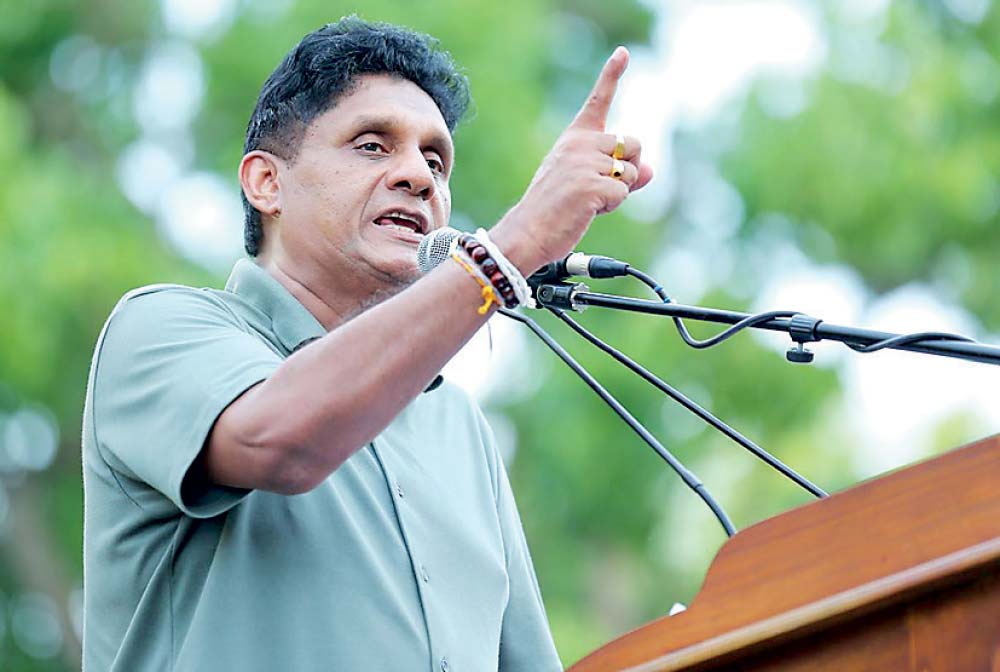
Sajith’s landmark speech for social democracy and a progressive middle path
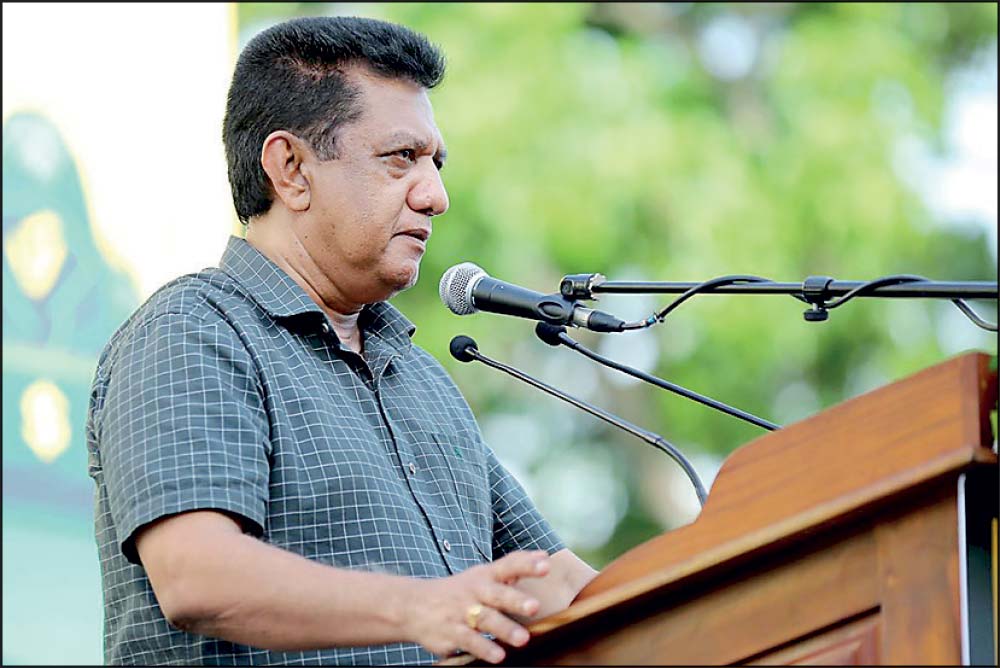
Thought-provoking speech by Prof. Charitha Herath
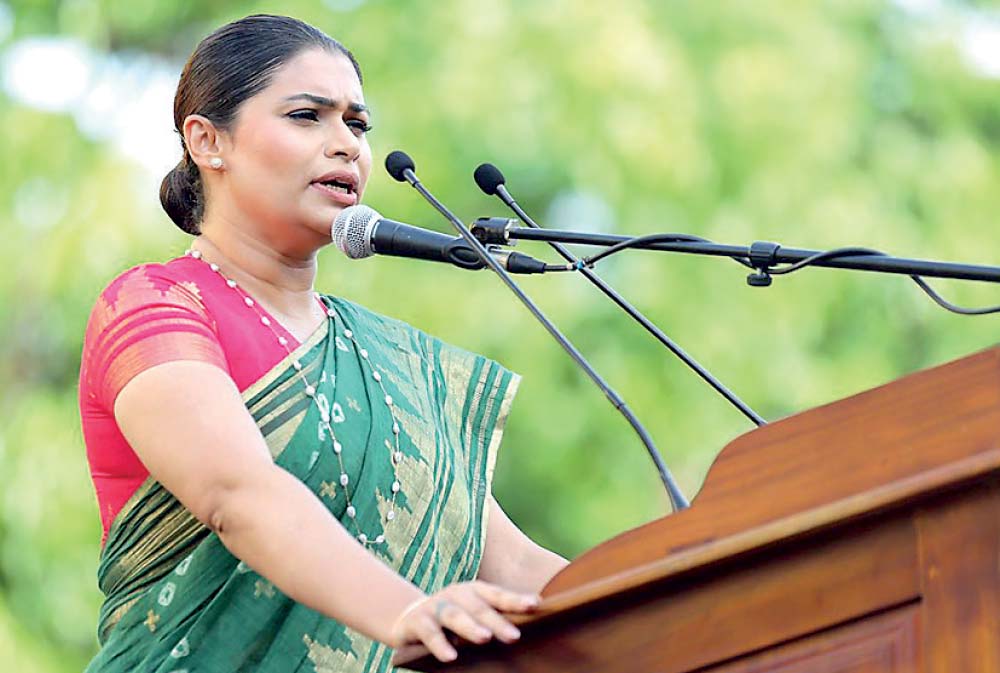
Hirunika Premachandra rocks the house
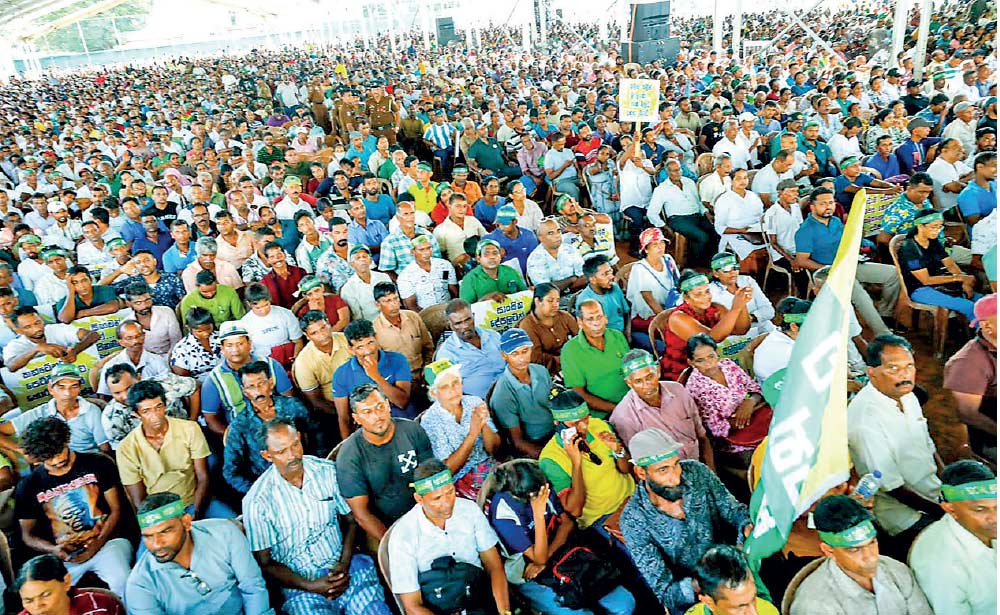
Segment of an impressively large crowd with many more in the open-air
 The JVP-NPP and its fellow-travelling intelligentsia really must study with diligence, the greatest political theorist and political philosopher (not political strategist) of the 20th century, Antonio Gramsci, who explained, doubtless in implicit relation to ex-Socialist Mussolini’s ascendancy, that winners are not always the most intelligent, evolved and correct, but can sometimes be the exact opposite—and those negative qualities can be the very reason for their success
 The most significant sentence uttered on May Day 2026 was by JVP General Secretary Tilvin Silva, who addressed the NPP rally in Kalutara and declared emphatically that “henceforth there will be no other governments in this country” (“meeta passey mey ratey vena aandu naha”). [https://www.youtube.com/watch?v=gJ0xBf4XtC8].
This isn’t the first time Big Brother Tilvin has said this, and it won’t be the last. I have no doubt that as a man of his word, and veteran apparatchik of a party comprised of men and women of their word, the JVP-NPP will attempt to implement this declaration.
The fact that Tilvin has to assert and reiterate this means that in the well-known words of Lenin which AKD, Tilvin et al are familiar with, the ruling elite is ‘unable to rule in the old way’. This is already observable in the fact that the JVP-NPP dares not hold the Provincial Council elections. The ruling party is caught in the throes of a crisis pregnant with transformational potential.
The crisis of the JVP-NPP Government was evidenced in the configuration and discourse of its May Day celebrations. I’ve never taken the May Day mobilisation of a ruling party to mean much, after witnessing the massive May Day of the ruling SLFP in 1977. It was organised chiefly by veteran trade union leader Alavi Moulana who waxed lyrical about it to my father (in my presence) late that evening at one of their usual watering holes. Several weeks later the SLFP was banished by the voters for 17 years.
Rapid rise, rapid decline
Anura Kumara Dissanayake who was so choosy of the company he kept politically that he spurned the Communist Party and dissident progressives Dullas Alahapperuma and Charitha Herath as allies in 2024, leaned heavily on Jeevan Thondaman’s CWC for his crowd in Nuwara Eliya in 2026. A proxy prop from the great neighbour perhaps?
AKD’s demeanour was different from what we have seen before—as shrewdly spotted by the SJB’s Hirunika Premachandra in her sizzling speech in Maligawatte. While gaining in bellicosity, pomposity and unpleasantness, he had lost his mojo. The content of the speech contained no sympathy, empathy or regret about the material suffering of the citizens. He rattled off statistics of supposed economic successes, none of which arrest the decline of the citizens’ living standards, still less provide tangible improvement.
The substantive core of Anura’s speech was the pledge of punitive justice to be visited on the old bipartisan governing elite. As his old friend and sympathiser Uvindu Kurakulasuriya, founder-editor of Colombo Telegraph remonstrated on FB, “Doesn’t it amount to contempt of Court for Anura to imply that the judgment will go one way rather than the other?”
Anura’s speech was all about the expeditious action of a judicial ‘guillotine’ as it were. Had he known that Marx and Engels viewed the French Revolution’s phase of the Great Terror dimly, with superior scorn, as manifesting “the petty-bourgeoisie’s fear” and that Robespierre too came to a swift, surgical end, he wouldn’t have been quite so enthusiastic to assume the role. AKD should also remember that Felix Dias Bandaranaike’s boast of the “foreign exchange racketeers” grilled on the CID’s 4th Floor and incarcerated at Paget Road, ended with FDB’s civic rights removed when the karmic wheel of politics turned.
May Day 2026 revealed that the Anura administration has peaked in its credibility, moral-ethical standing and popularity. The journey downhill has begun.
JVP-NPP fellow travellers (from emeritus professors through expatriate ex-1971 veterans to opinionated bloggers) are unable to accept the vertical decline of the Anura administration because they start from the erroneous assumption that 2024 was a high point which manifested the JVP-NPP’s intellectual and strategic superiority and would have been unachievable without such superiority. Therefore, they cannot bring themselves to believe that the beginning of the downswing could come so fast. They forget that at his zenith, Anura scored only 42%, not the 50+% that all his elected predecessors did.
The JVP-NPP and its fellow-travelling intelligentsia really must study with diligence, the greatest political theorist and political philosopher (not political strategist) of the 20th century, Antonio Gramsci, who explained, doubtless in implicit relation to ex-Socialist Mussolini’s ascendancy, that winners are not always the most intelligent, evolved and correct, but can sometimes be the exact opposite—and those negative qualities can be the very reason for their success. As it was in the case of the JVP-NPP in 2024.
“…Nor does it have to possess the qualities of coherence and intellectual profundity: it is not always the most coherent and intellectually rich movements which triumph. Indeed, a movement often triumphs precisely because of its mediocrity and logical elasticity: anything goes, the most blatant compromises are possible, and may well themselves be the cause of the triumph…”
(Antonio Gramsci, Selections from Cultural Writings, Lawrence & Wishart, Part X ‘Journalism’, item 8, p. 406)
Gramsci’s profoundly dialectical explanation helps us understand why the JVP which would not have made the grade in most parts of the world, succeeded in far outstripping its leftwing competitors twice—in the late 1960s/early 1970s and the late 1980s. It also explains how the JVP was so swiftly defeated on both occasions in two civil wars. Most relevant is that Gramsci’s original insight explains both the JVP-NPP’s victory in 2024 and its early degeneration, downswing and fear of provincial elections by 2026.
What the JVP-NPP leaders and their fellow-travellers fail to understand is that far from occupying the moral high ground of a non-elite indicting a bipartisan ruling elite of the entire post-Independence period, the JVP-NPP has lost the high ground not only by being unable to deliver the material goods and even approach the developmental and social protection contribution of that bipartisan post-colonial ruling elite, but also because their every expression of aggression and determination to remain entrenched in power, only triggers subsurface memories of the JVP’s brutality, totalitarianism and barbarism of the 1980s. Those memories accelerate the decline of popularity and revival of democratic political resistance.
May Day 2026 revealed that the Anura administration has peaked in its credibility, moral-ethical standing and popularity. The journey downhill has begun
SJB’s surprisingly big splash
AKD’s and the JVP-NPP’s adversaries, rivals and competitors have not yet achieved equilibrium with the new power-elite, but the main Opposition, Sajith Premadasa and the SJB, are certainly in contention; growing, evolving and moving in the direction of approximating and achieving equilibrium with the Government.
The SJB’s May Day gathering in Maligawatte was most impressive and obviously so to anyone who watched the mainstream TV coverage (especially 24-hourr news), the live FB feeds etc. Not only was the pluri-pavilion structure full, many large TV screens had to be erected on the perimeter fences for the thick penumbra of people girdling the venue, watching attentively while standing in the road.
The party leadership had decided against a May Day parade out of deference to Poya day but couldn’t prevent the spontaneous formation of spirited detachments marching through the streets, thronging the main gates and streaming through. Sajith Premadasa was mobbed on arrival and it took him a good long time to inch his way, only his face visible to the cameras, to the front row. (https://www.facebook.com/share/v/16sjjkVUXi/?mibextid=wwXIfr)
The speakers list had been limited to five seniors by the organisers but had to be flexibly expanded and rapidly revised to accommodate expectations of the enthusiastic, unexpectedly large crowd. The more frontally and ferociously the speakers assaulted the Anura administration and promised this was the beginning of a ceaseless struggle against the Government including if necessary in the streets, right through to 2029, the louder and longer the applause.
The SJB is clearly in good shape. Between the crowd, and the speakers as diverse as the thought-provoking Prof. Charitha Herath and the sparkling Hirunika Premachandra, it was apparent that the SJB was the main force of the Opposition, ready to compete with AKD and his Government and contend with it for state power. This would be obvious if a Provincial Council election was held—which is why it won’t. May Day 2026 indicated that the SJB is the Government-in-waiting and clearly the likeliest successor administration to AKD’s in 2029.
The timing of Eran Wickremaratne’s new appointment was probably intended to or could have rattled the SJB’s May Day, but evidently hadn’t even the effect of a pinprick on the party’s base and morale. All gossip about discontent over Sajith Premadasa’s leadership proved arrant nonsense because every SJB speaker, especially the fiery young ones, went stridently public with their endorsement of Sajith’s leadership of party, Opposition and country—some insisting that 2029 provides the chance to compensate for the wrong choices of Gotabaya and Anura over Sajith in 2019 and 2024. (https://mawratanews.lk/news/sajith-is-the-only-leader-who-can-save-the-country-unanimous-decision-video-i-sri-lanka-latest-news/#google_vignette)
AKD’s and the JVP-NPP’s adversaries, rivals and competitors have not yet achieved equilibrium with the new power-elite, but the main Opposition, Sajith Premadasa and the SJB, are certainly in contention; growing, evolving and moving in the direction of approximating and achieving equilibrium with the Government
Landmark speech: SP doctrine
The high point of the SJB May Day was Sajith Premadasa’s speech. In it, he attacked the previous administration for raiding the EPF-ETF while abjectly following IMF instructions; savaged the Anura administration for failing to rectify that injustice as it had pledged during the 2024 election; promised to do so under an SJB Government; and indicted the JVP-NPP for being “slaves” of both the IMF and the local big bourgeoisie.
Most importantly Sajith outlined his doctrine:
 Social democracy.
A social market economy
Rejection of both extremes—neoliberal right and socialist left.
A progressive middle path/third way.
(https://youtu.be/ALteNX-XOB8?si=dFriYgzeOiyD2jDI)
Though the latter definition was a reiteration of what he had said in Parliament since November 2022, this time it was an address by the SJB leader to the largest ever in-gathering of SJB members, in which he demarcated and defined the space for the party and positioned it within a paradigmatic, ideological and political space.
No other Sri Lankan party leader today has summarised his doctrine more lucidly and in universally comprehensible terms.
In doing so, Sajith tangentially answered Charitha Herath’s call in his own earlier speech for an ‘opening’ to left-leaning and patriotic voters. (https://youtu.be/hJ_PdcfVALE?si=_fBJFVlyhZBfeaA8)
Judged by speech content and audience reception, no one else in the party (that includes the SJB’s best-known economist) approximated the same stature as Sajith.
Namal Rajapaksa is a superb speaker and appealing personality, but has been unable to come out from under the Gotabaya Government’s wreckage and liberate himself from its majoritarian new right ideological discourse. In terms of ideas and ideology, depth of content and programmatic vision for solving the Sri Lankan crisis, Sajith (who enjoys a 20-year advantage making for experience and maturity) registers qualitatively higher as orator and evolved political leader.
Viewed comparatively on the same May 1st, Sajith Premadasa’s speech and deportment completely outclassed Anura Dissanayake, not to mention Tilvin Silva, Bimal Ratnayake, Harini Amarasuriya and KD Lal Kantha.
Sajith ended his speech with two smart moves:
Throwing down the gauntlet to President Anura Dissanayake, naming it “not a request but a challenge”: hold the Provincial Council election this year! If that were done, he said, by next May Day the SJB would have a number of provincial Chief Ministers among its speakers.
Deftly putting Ranil Wickremesinghe in his place. In a message to the SJB May Day event, UNP leader Wickremesinghe suggested that the committees appointed to establish unity between the SJB and UNP should reconvene expeditiously. Sajith said that the process of SJB-UNP unity was already underway and almost done—by which he seemed to mean organic reunification from below—but that the committees were superfluous because some elements in them were trying to sabotage the process. Translated, the message was that the preponderance of Sajith and the SJB was such that it was having a magnetic or suction effect on the UNP voters, generating spontaneous convergence at the grassroots.
My sense is that Wickremesinghe would serve his own interests best at this stage of the game (and life) by the graceful swift transfer of the UNP to Sajith Premadasa. As in 1988 when Ranjan Wijeratne unambiguously informed President Jayewardene that the only chance of UNP survival was to concede the Presidential nomination to Deputy Leader and Prime Minister Ranasinghe Premadasa, the only chance today of the residual UNP’s survival rather than politico-electoral and historical extinction, is fusion or alliance under the leadership and candidacy of Opposition Leader and former UNP Deputy Leader Sajith Premadasa.
When the SJB’s May Day event was over and having watched as much of the coverage of all parties as possible, what was clear to me is that more than any other political leader or politician and political party, Sajith Premadasa and the SJB under his leadership are ready, willing and able to take on President Anura Dissanayake and the JVP-NPP, defeat them, and significantly improve the economic conditions of the Sri Lankan citizenry and the prospects of the country as a whole.
When the SJB’s May Day event was over and having watched as much of the coverage of all parties as possible, what was clear to me is that more than any other political leader or politician and political party, Sajith Premadasa and the SJB under his leadership are ready, willing and able to take on President Anura Dissanayake and the JVP-NPP, defeat them, and significantly improve the economic conditions of the Sri Lankan citizenry and the prospects of the country as a whole
Premadasa’s voice
My conclusion doesn’t rest on Sajith’s May Day speech alone. To grasp his discourse, that watershed address must be heard and ‘read’ alongside his public remarks the day before, 30 April. Sajith’s speech at the launch of Dr. Chandima Wijeygunawardena’s book “Emi Achchi” at the Mahaweli auditorium on May Day eve, was a blistering attack on “neoliberalism and imperialist concepts” and the attempt by “neoliberal rightist extremists” to “implant them, thereby eroding…our national greatness”. (https://youtu.be/NJSqp1dSjCY)
The SJB and Opposition Leader made a strong case for national self-reliance in many key sectors ranging from food security to energy sources. He disclosed that at a discussion the SJB held with energy experts to ascertain whether or not Sri Lanka does have resources of natural gas and other sources of fuel, the experts confirmed that this was indeed true, but went on to shockingly reveal that forces inimical to such national endeavours strove to block research into these subjects. Those forces strove to keep us dependent on external sources instead of self-sufficiency in many fields including food, said Premadasa.
Expressing support for the underlying philosophy of Dr. Chandima Wijeygunawardena’s book, Sajith proceeded to make a strong pitch for making materially real, the national independence and sovereignty enshrined in our Constitution, and condemned their erosion to the point that we have been rendered extremely vulnerable to external shock. He advocated a drive for protecting our natural resources and building national self-reliance in as many crucial, critical fields as possible.
Watching the video of Sajith’s remarks at the book launch, I recalled that at age 18, his father R. Premadasa launched a monthly magazine titled ‘Swadeshaya’.
It is only Sajith Premadasa who has kept and is keeping the SJB a moderate centrist formation as distinct from an extreme rightist one, and preventing a pendulum-swing further to the polarising neoliberal right (as in Argentina and Chile) in 2029.
A swing away from the JVP-NPP, be it under Anura Dissanayake, Bimal or Harini, is a near-certainty and probably irreversible mainly for reasons of economic privation and downward social mobility. Of all those in Parliament and politics in general, Sajith Premadasa has the strongest grasp (bar none) of Development Economics and the need for policy rebalance which incorporates pro-people progressive reforms.
When I looked away from the screen while listening to Sajith’s May Day speech and remarks at the launch of ‘Emi Achchi’, there were minutes I thought I heard Ranasinghe Premadasa speaking.
https://dayanjayatilleka.webflow.io/




