Tuesday Sep 22, 2026
Tuesday Sep 22, 2026
Wednesday, 20 May 2026 04:24 - - {{hitsCtrl.values.hits}}
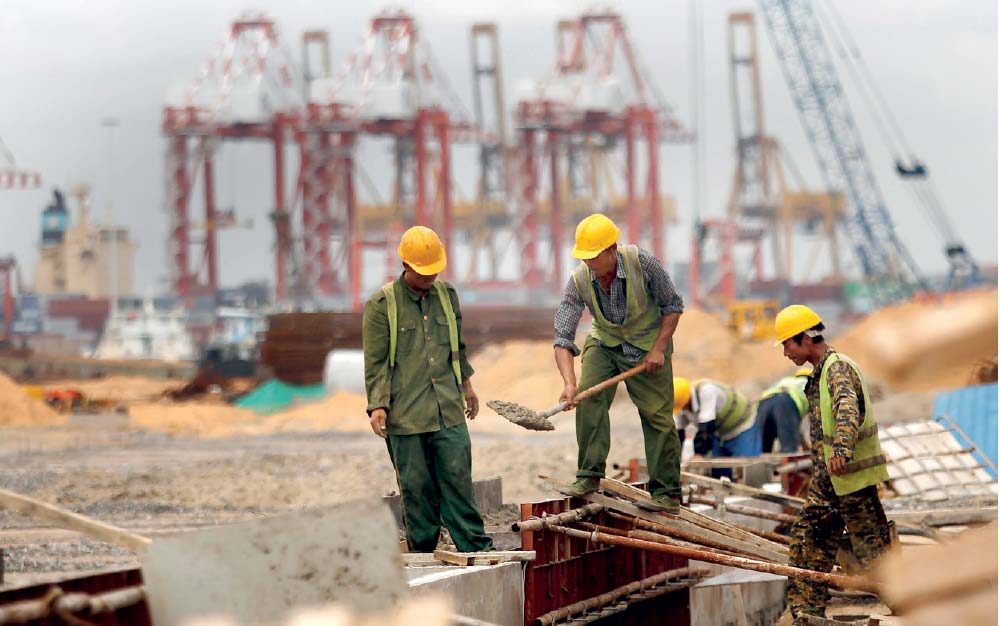
 It is high time for the Government to seriously examine its policies regarding the construction industry. Reducing or eliminating unwarranted levels and coverage of border protection is imperative for the healthy, long-term growth of the construction industry. Further, such a step will improve the industry’s ability to adopt modern, innovative, and resourceful technologies, enabling it to increase productivity and international competitiveness
 A dynamic economic driver and a vital pillar of Sri Lanka’s economy, the construction industry encompasses several key sectors: residential (homes and apartments), commercial (development of office spaces and hotels), industrial (construction of factories and power plants), and infrastructure (roads, bridges, and public facilities). Further, the construction industry extends beyond physical construction to encompass a broader spectrum of activities, including project management, planning, and engineering. This multifaceted sector supports both residential and commercial expansion and also forms the backbone of urban development. The industry’s ripple effect extends to related sectors like manufacturing and services, amplifying its impact. This industry generates millions of jobs, stimulates economic growth, and fosters innovation to enhance the quality of life.
Decades of Industry Growth
Sri Lanka's construction sector has witnessed a boom in recent decades, with private-sector property development and Government-led infrastructure projects. Government has been a principal promoter of the construction industry for several decades, largely based on funds borrowed from abroad, primarily focusing on the development of the country’s infrastructure: ports, airports, highways, rural infrastructure, including rural roads, water supply, irrigation systems, etc. Economic development, rapid urbanisation, and increased consumer spending have fueled demand for construction in the form of housing, high-rise buildings and condominiums, hospitals, schools and universities, and hotels, among others.
The recently initiated relief programs associated with Ditwah natural disaster (late 2025) are likely to provide a meaningful near-term increase in construction demand. The Government’s medium-term public investment program allocates over two-thirds of capital expenditure to priority construction activities, including highways, irrigation, and housing. Cyclone Ditwah caused damage equivalent to roughly 4% of GDP, providing the construction sector with a window of opportunity in the near term, thus enhancing construction demand.
Multiple challenges?
Amidst its positive elements in general, Sri Lanka’s construction industry is confronted with a number of persistent challenges and issues, some of which are insurmountable for the private-sector construction industry actors themselves and have remained unaddressed over the years. These constraints cannot be resolved without serious and sustained Government intervention. First, the COVID-19 pandemic and the economic contraction in 2022-23, along with their associated negative ripple effects, have been the most recent factors seriously impeding the industry's progress. Since then, the slow economic recovery has restrained the industry’s upward movement and prevented it from rebounding to its previous growth levels. Second, the opportunities that emerged in the aftermath of the Ditwah disaster are now thwarted by the external economic shock associated with the ongoing Middle Eastern war, which continues to adversely affect both the livelihood of the people and the economy of Sri Lanka. By 2019, the industry’s contribution to GDP was significant, at around 7-9 per cent, and it employed about 600,000 workers. After the Covid-19 economic contraction and the first-ever economic downturn of 2022-23, the industry’s contribution has shrunk to about 2 per cent, and its workforce has nearly halved by now. Third, the industry’s performance is being constrained by several policy-related issues, which are long-standing concerns whose early resolution is critically important to support the industry’s growth and the country’s overall development. Contractors, particularly large and medium-scale, are facing significant financial pressures due to, among others, rising material costs, outdated pricing structures, obsolete and outmoded rules and, regulations, and lengthy recommendation and approval processes, leaving public sector employees entrenched within inefficient bureaucratic structures, leading to a slowdown in new construction project opportunities.
Labour shortages and regulatory reforms
During the recent economic crisis, many workers in the industry left for foreign employment, while some migrated permanently. This has resulted in a shortage of both skilled and unskilled labour, a major problem that requires attention. Further, the exodus of trained workers is a huge blow to the industry because they cannot easily be replaced. Furthermore, principal stakeholders in the industry have regularly called for regulatory reforms without delay to stabilise and revitalise the construction industry.
Excessive protectionist tax regime at the border
While the industry faces a range of issues, one of the principal concerns is the Government’s policy stance on imported construction materials versus the construction-related domestic industry. The country’s construction industry, including contractors and the supply of imported material, is largely in the hands of the private sector. Over a long period of time, domestic construction material manufacturers have received additional support through protective border measures, primarily in the form of progressively increasing border taxes and levies. No doubt that the Government has collected a huge amount of revenue at the border level by taxing imported building materials. Nevertheless, this protection has led to many undesirable outcomes in the industry and the economy. This has made (a) the construction output price to rise (b) an inefficient and uncompetitive local input supply industry, and (c) the creation and continuation of a large number of rent seekers, in some cases, politically influential rent seekers. As a result, for a small-scale average house, builders face mounting difficulties due to cost escalation, making the unit cost of local construction higher than that of competitors in the region.
Undue and continuous protection accorded to a set of construction-related local industrialists, in order to shield them from competition from low-priced, high-quality imported construction materials, has been an unaddressed policy-related issue for a long time. Many of the imported construction materiel are subjected to a plethora of charges and levies at the border. In the first place, this duty structure has many layers, making it complex to understand the total tax burden. In addition to 20% customs duty, several other levies are imposed, such as 18% Value Added Tax (VAT), 10% Port and Airport Levy (PAL), 5-10% cess, and 2.5% Social Security Contribution Levy (SSCL). The Government has implemented a medium-term phasing out of para-tariffs, which is a welcome policy development. Even if the cascading-based border levy calculation is ignored, most imported construction materials carry a total levy exceeding 50% of the imported CIF value. Even for the smallest unit of house of the size, say, 500-600 square feet, the cost of levies at the border forms a substantial proportion of the total cost of the house unit. The local contractors cannot do anything about this, and the building owners have to shoulder the burden of rising construction costs due to border levies. This is purely to do with the Government policy maintained over several decades. The walls of protection accorded to selected local manufacturers in the construction industry have, over the years, enabled the collection of massive rents under Government policy. However, this rent has largely been paid by the small dwellers in the country. Even Government-related infrastructure and private-sector construction activities (e.g., hotels) have to bear high costs due primarily to the protectionist policy maintained over the years. This has certainly been a major constraint on the growth of the construction industry and works against its competitiveness vis-à-vis comparators in the region.
Oligopoly in construction material industry
Principal materials required for the construction industry are also primarily imported: cements and binders, metals and steel, wood and panels, roofing and flooring, electrical items, etc. Besides, there is a local oligopolistic cement manufacturing industry that also relies on imported materials, principally clinker. The production and supply of flooring products in the country are also characterised by an oligopolistic market structure, with a few key firms dominating the industry. Besides, a few industrial units are manufacturing iron and steel products locally, again based on imported materials. Wood imports have been allowed partly to protect and conserve the country’s forests. In general all imported construction materials have been accorded significant protection for many decades.
Therefore, it is high time for the Government to seriously examine its policies regarding the construction industry, particularly border protection policies. Reducing or eliminating unwarranted levels and coverage of border protection is imperative for the healthy, long-term growth of the construction industry. Further, such a step will improve the industry’s ability to adopt modern, innovative, and resourceful technologies, enabling it to increase productivity and international competitiveness.
This is the Pathfinder ViewPoint articles published by the Pathfinder Foundation. Readers’ comments are welcome at
[email protected]




