Friday Oct 02, 2026
Friday Oct 02, 2026
Tuesday, 17 March 2026 01:49 - - {{hitsCtrl.values.hits}}
 The availability and price of fuel is what the war brings to mind. The Government appears to be addressing availability issues by asking for supplies from Russia and India. It has yet to decide on the affordability problem. India is reported to have obtained Iranian approval for two LNG tankers to cross the strait, possibly in return for repatriating sailors. Sri Lanka has not so far shown it can change or even shape what is happening in the Gulf, though it also has Iranian sailors.
But constricting the Strait of Hormuz affects many other aspects of modern economies. The options explored below are within the powers of the Sri Lankan Government.
Food security
When President Gotabaya Rajapaksa banned chemical fertiliser overnight in 2021, rice harvests dropped by 32%, tea production fell by 18%, and the resulting agricultural collapse triggered widespread food insecurity and economic losses, including an estimated $425 million in lost tea exports alone. Five years later, the declines in nutrition have not been fully reversed.
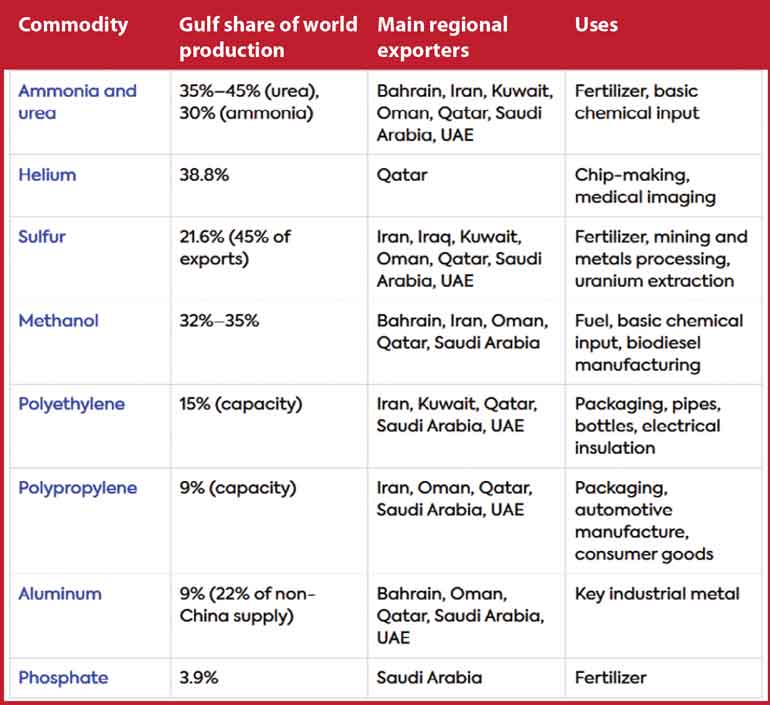
Sri Lanka imports all the fertiliser that supplies NPK (Nitrogen, Phosphorus, Potassium) in quickly absorbable form. The 2021 organic agriculture experiment showed what happens when access to NPK is lost. Sri Lanka is significantly dependent on fertiliser shipped through the Strait of Hormuz (36%, according to UNCTAD) but obtains more from China (According to 2025 Customs data, more than 50%). The peak demand for NPK fertiliser occurs in September for Sri Lanka. By that time the international markets should have achieved some kind of equilibrium, even if at elevated price levels.
So, the issue here is not availability (like in 2021-22), but affordability, both for the farmers and for the Government. The Government has budgeted Rs. 36.9 billion for fertiliser subsidies for 2026. If this is increased to at least partially shield the farmers, making it difficult to keep Government expenditures at 13% of GDP.
Overuse of fertiliser, especially urea, has been documented. The current crisis creates an opportunity to use price signals along with active engagement by extension officials to shift our agriculture to a more sustainable and cost-effective mode. The NPP did not promise free NPK fertiliser (a primary cause of overuse and soil damage) as did Gotabaya Rajapaksa and the SLPP. What is mentioned in the manifesto is research on efficient use of inputs including inorganic fertiliser. Thousands of extension officials are already in place. All that is needed is judicious management of the limited subsidy funds.
Remittances
After the Americans hit a desalination plant located in an island in the Persian Gulf, the Iranian authorities denounced that attack (which is a violation of international humanitarian law) and said a precedent has been set. The next day, an Iranian attack on the desalination plant in Bahrain was reported.
Unlike Iran, which is minimally dependent on desalination plants, most states in the Gulf rely on them for drinking water. If the war spreads to water supplies people will have to move out in large numbers and the economic impact will be massive. Not only will this result in the return of significant numbers of expatriate workers but also in diminishing their earning ability. Remittances may be expected to dip.
Despite there being little appreciation of the export of workers, both in terms of benefits to their families and to the economy, there is no realistic alternative for countries like Sri Lanka and Nepal. Beyond restructuring the Sri Lanka Bureau of Foreign Employment and making a concerted effort to diversify the countries that Sri Lankans can work in, not much can be done to alleviate the negative effects of risks associated with markets for labor in the Gulf.
Tourism
Modern mass tourism was enabled by cheap air travel, made possible by jet aircrafts. Elevated airfares caused by increases in jet fuel prices will harm the industry. It’s likely that the European markets which will suffer the biggest effects of fuel shortages and inflation will be affected the most. Tourism, being a discretionary expense, may be hit if costs go up. Demand in Asian markets may be less affected because their economic prospects may not be affected as badly and the travel component of a Sri Lankan vacation is smaller.
The three Gulf-based super-connector airlines that together brought in slightly more passengers than SriLankan Airlines have suffered some reputational damage which may take some time to remedy. Ideally, Turkish Airlines which already functions as a super connector may pick up the slack. Alternatively, a South Asia based super connector may emerge.
If Sri Lankan is quickly sold to an investor with deep pockets and the Government focuses on expanding the Katunayake airport including the building of the second runway, Colombo may stand a chance of filling the gap.
Energy
The largest category among Sri Lanka’s imports is fossil fuel, over 20% of value in 2024 but higher in some previous years. Even if some fuels such as LPG are now sourced from the US, the overall effects of the Hormuz constriction will be felt. In most years, the UAE was the largest source of oil imports. Even refined products imported from India and Singapore will be affected because the supply of crude oil is affected. Unlike many countries, Sri Lanka does not use LNG and is thus insulated from the effects of Qatar shutting down its liquification facilities.
Long-term contracts may dampen the effects of shortages, but even they may be affected by refineries declaring force majeure. Price increases are certain. Shortages are possible.
Because of the 2022 experience, there is no need to speculate. What will happen when there are shortages is known. What will happen when prices increase is known.
Under the Public Financial Management Act, No. 44 of 2024, and the agreement with the IMF, it is not possible to sell fuel or supply electricity other than at cost-reflective prices. Unless the Government wishes to exit the IMF agreement (where the fifth review has not been completed, purportedly because of Ditwah related budget changes) and amend or repeal the PFMA, prices will increase until the world markets return to previous levels.
If the increase is substantial, there will be a temporary contraction of demand. In December of 2021, Lanka Auto Diesel was Rs. 121 per litre. That was when the queues started building up and the roads were blocked. By November 2022, it was up to Rs. 430, a more than threefold increase, and rationed. Now it is Rs. 303, unrationed. And the roads are jammed with traffic. Price increases do not result in permanent demand contraction. The economy adjusts.
The only question is what to do if there are shortages. Unless there is rationing, queues and black markets will appear. With rationing, black markets will still appear but at least the roads will be usable. So, if the Government contemplating the reintroduction of the QR code based rationing scheme, it should be for a short time. But rationing once started may be difficult to stop for those whose thinking was formed by Soviet literature.
Sri Lanka needs economic growth. It is important to not lose sight of that as the various options for dealing with the war are considered. Demand destruction and rationing are not building blocks of economic growth. We can still get economic growth with less consumption of fossil fuels, but that is a long-term project. Still within our powers, unlike peace in West Asia.
(Editor’s Note: This column was written prior to the introduction of QR Code system on Monday)



