Thursday Oct 22, 2026
Thursday Oct 22, 2026
Thursday, 7 May 2026 04:29 - - {{hitsCtrl.values.hits}}
 Palm oil today is one of the most widely used vegetable oils in the world. Its dominance is not accidental. It is the most land-efficient oilseed crop, producing significantly higher yields per hectare than alternatives such as soybean or sunflower. It is versatile, affordable, and deeply embedded in global food and industrial supply chains. This makes palm oil not just a commodity, but a functional necessity. Policies that attempt to remove such a commodity from the system without addressing underlying demand often create unintended consequences

In 2021, Sri Lanka took a bold and widely noticed decision: to ban palm oil imports and phase out domestic oil palm cultivation. The move was driven by environmental concerns and public pressure, and at the time, it appeared to signal a decisive shift toward ecological responsibility.
Several years later, however, the conversation is evolving. As reflected in recent discourse, including reporting by the media, there is a growing call to reassess the decision not because the environmental intent was misplaced, but because the economic and systemic consequences have proven more complex than anticipated.
Sri Lanka’s experience is not an isolated case. It reflects a broader global dilemma: how to reconcile environmental priorities with the realities of food systems, livelihoods, and economic resilience.
The inconvenient truth: Demand does not disappear
Palm oil today is one of the most widely used vegetable oils in the world. Its dominance is not accidental. It is the most land-efficient oilseed crop, producing significantly higher yields per hectare than alternatives such as soybean or sunflower. It is versatile, affordable, and deeply embedded in global food and industrial supply chains.
This makes palm oil not just a commodity, but a functional necessity.
Policies that attempt to remove such a commodity from the system without addressing underlying demand often create unintended consequences. Demand does not disappear; it shifts..sometimes toward less efficient alternatives, sometimes toward increased imports, and often at a higher economic and environmental cost.
Sri Lanka’s experience appears to reflect precisely this dynamic. The intended environmental gains have been accompanied by increased dependence on other edible oil imports, pressure on foreign exchange, and disruptions across food processing and manufacturing sectors.
Beyond perception: The need for evidence-based dialogue
One of the core challenges in the palm oil debate is the gap between perception and context. While global concerns around deforestation and biodiversity loss are valid, they are not universally applicable in the same way across all geographies.
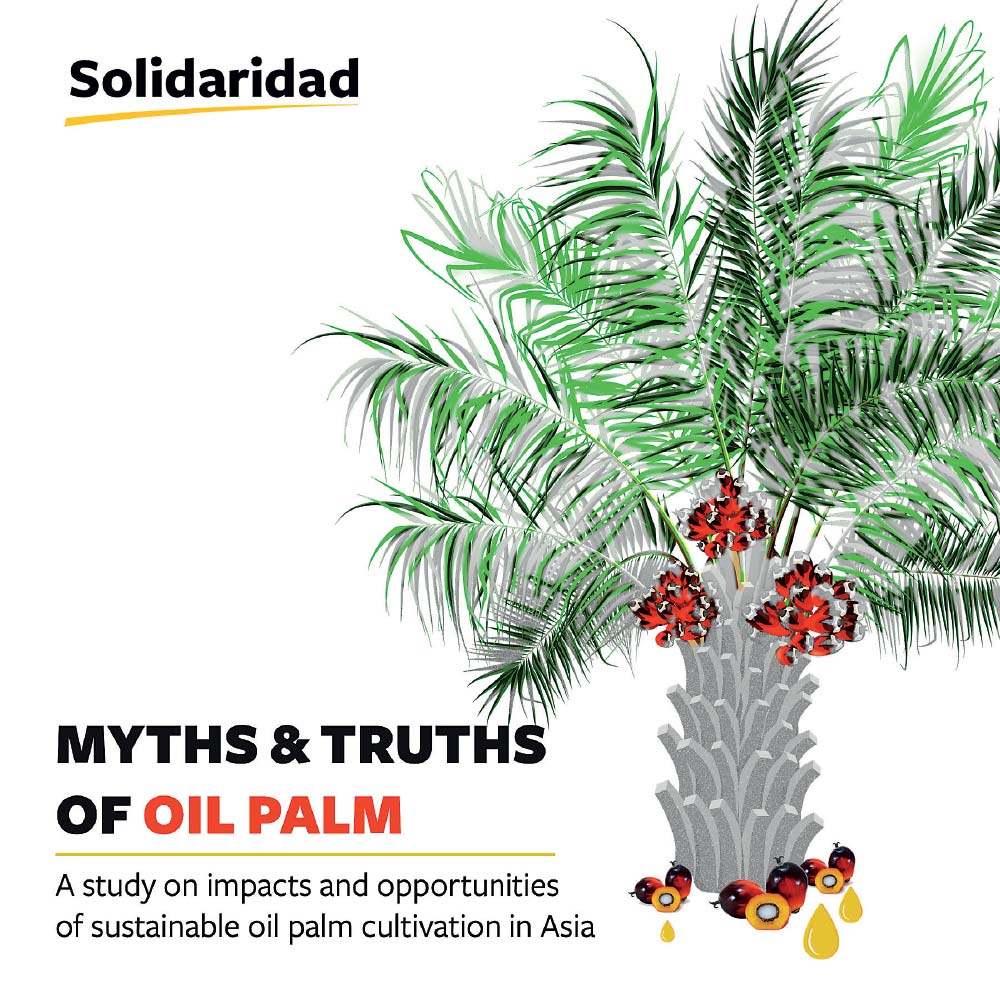
Recognising this, Solidaridad Network contributed to the discourse at the time of Sri Lanka’s policy shift through its publication Myths and Truths of Oil Palm. The objective was not to advocate for unchecked expansion, but to encourage a more nuanced, evidence-based understanding of palm oil. one that distinguishes between unsustainable practices and the crop itself.
This distinction is critical. When policy responds to perception rather than evidence, it risks addressing the symptoms rather than the system.
Sri Lanka now stands at a critical juncture. The question is no longer whether the original intent was justified, but how policy can evolve in light of emerging evidence and outcomes. A constructive way forward may lie not in reversing the decision outright, but in reframing it
India’s emerging approach: Reform over rejection
While Sri Lanka chose restriction, India has adopted a different, though still evolving, pathway.
India remains one of the world’s largest importers of edible oil, with palm oil forming a significant share. Instead of moving away from it, India is attempting to build domestic capacity while integrating sustainability into the production system. Initiatives such as the emerging IPOS (Indian Palm Oil Sustainability) framework reflect an effort to create standards that balance productivity, environmental responsibility, and farmer inclusion.
This approach is not without its challenges. However, it represents an important policy philosophy: transformation rather than withdrawal.
It acknowledges that in a country with growing population and nutritional needs, ensuring edible oil availability is not optional. The task, therefore, is to make supply systems more sustainable, not to disengage from them.
A regional perspective: Asia must shape its own narrative
Palm oil is often debated in global forums through lenses that may not fully reflect the realities of Asian economies, which are both major consumers and, in some cases, producers.
This is where platforms like the Asian Palm Oil Alliance (APOA) play a significant role. By bringing together stakeholders across the region, APOA is helping to foster a more balanced, science-based dialogue, one that aligns sustainability goals with economic and food security priorities.
The underlying principle is straightforward: solutions must be rooted in regional realities. Imported narratives, when applied without adaptation, risk oversimplifying complex systems.
From ban to framework: A way forward for Sri Lanka
Sri Lanka now stands at a critical juncture. The question is no longer whether the original intent was justified, but how policy can evolve in light of emerging evidence and outcomes.
A constructive way forward may lie not in reversing the decision outright, but in reframing it.
Rather than a binary approach, ban or allow. Sri Lanka could consider developing a structured sustainability framework for palm oil. A concept such as SriPOS (Sri Lanka Palm Oil Sustainability Framework) could provide a pathway to integrate environmental safeguards, scientific assessment, industry needs, and farmer participation into a cohesive system.
Such a framework would not only address concerns around sustainability but also enable the country to reduce import dependency in a more strategic and controlled manner.
The larger lesson: Sustainability requires systems thinking
Sri Lanka’s experience offers a valuable lesson for policymakers globally. Sustainability transitions cannot be achieved through isolated decisions. They require systemic thinking, transition planning, and alignment across stakeholders.
Bans may offer immediate signals, but they rarely deliver lasting solutions unless supported by viable alternatives.
The future of palm oil and indeed of many critical commodities, will depend on how effectively countries can design systems that are environmentally responsible, economically viable, and socially inclusive.
The global conversation on palm oil must move beyond binaries. The choice is not between palm oil and no palm oil. It is between unsustainable systems and sustainable ones. Palm oil is likely to remain an integral part of global food systems for the foreseeable future. The real challenge, therefore, is not its elimination, but its transformation. Sustainability is not about removing what is necessary. It is about ensuring that what is necessary is produced responsibly
Making necessity sustainable
The global conversation on palm oil must move beyond binaries. The choice is not between palm oil and no palm oil. It is between unsustainable systems and sustainable ones.
Palm oil is likely to remain an integral part of global food systems for the foreseeable future. The real challenge, therefore, is not its elimination, but its transformation.
Sustainability is not about removing what is necessary. It is about ensuring that what is necessary is produced responsibly.
(The author is an international expert in sustainable agriculture, certified Agriculture Professional and pioneer expert on Regenerative and Organic and Health, MAP Farming Systems. He has over 20 years of experience in sustainability in agriculture supply chains and setting up innovative IT Extension solutions for supporting small holder's in Asia. He coordinates Solidaridad’s Vegetative oil sustainability initiatives in Asia, experienced in facilitating the development and implementation of national and international sustainability frameworks. He can be reached at: [email protected] )



