Tuesday Sep 01, 2026
Tuesday Sep 01, 2026
Friday, 20 March 2026 00:04 - - {{hitsCtrl.values.hits}}
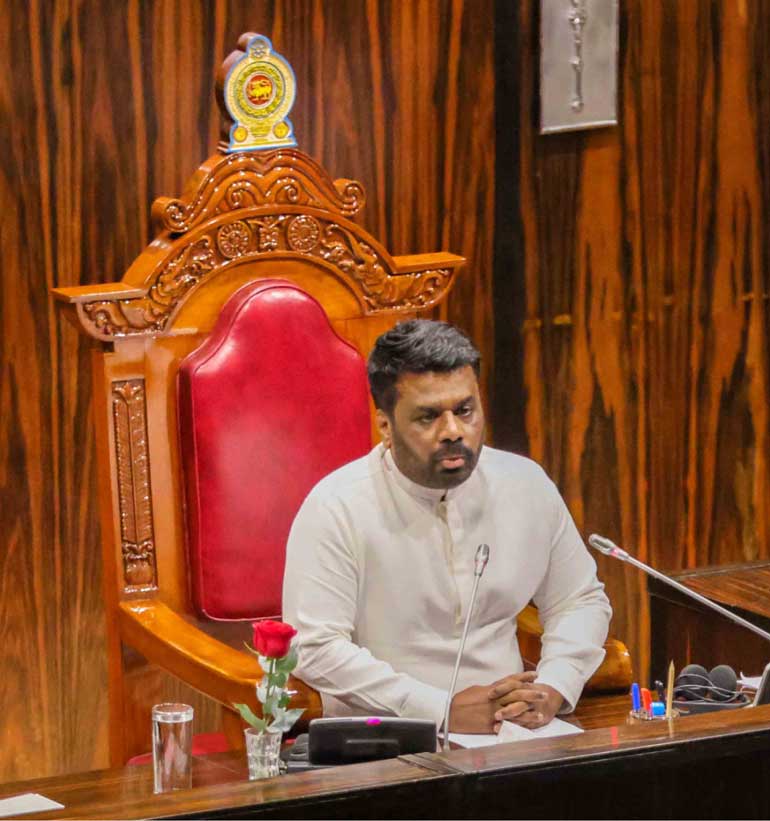
President Anura Kumara Dissanayake
By Transparency International
Sri Lanka
One year since the launch of the revised Government Action Plan of the new administration, Transparency International Sri Lanka (TISL) has a latest assessment of progress under the Government Action Plan linked to Sri Lanka’s commitments within the International Monetary Fund (IMF) program, highlighting a year marked by early legislative advances but continued delays in deeper institutional reform.
The Government Action Plan was developed in response to the IMF Governance Diagnostic, which identified structural weaknesses in governance framework. These reforms were intended to address corruption vulnerabilities that contributed to Sri Lanka’s economic crisis. The Government Action Plan Tracker (GAP Tracker) is an independent public oversight tool developed by TISL to monitor the government’s performance in implementing key priority governance and anti-corruption reforms within this plan.
This tool was launched in response to the absence of an official monitoring mechanism and limited public reporting on critical governance reforms. Through its GAP Tracker, TISL provides independent civil society oversight of the implementation process, assessing not only whether commitments are met, but also whether they are implemented meaningfully in a transparent, participatory, and effective manner.
Progress in strengthening governance and transparency
Several important reforms have advanced and laid foundations for stronger accountability and financial governance:
Delays and gaps in core governance reforms
Despite some progress, reform efforts remain uneven and incomplete. Key governance measures have faced delays or stalled implementation, particularly in areas consistently identified as high-risk for corruption.
It is important to note that the Government was expected to update and publish the revised GAP by February 2026. To date, this updated plan has not been published and progress on its drafting is unknown. At a critical stage in Sri Lanka’s reform process, the absence of timely publication of the updated Action Plan raises concerns about accountability and transparency, particularly given that these reforms were intended to restore public trust and institutional integrity.
The tracker reveals a pattern in which legislative enactments have outpaced institutional operationalisation. Passing laws is an important first step, but the impact of reforms ultimately depends on effective implementation, institutional capacity, adequate resourcing, and inter-agency coordination. Weak administrative coordination and limited transparency around operational progress risk undermining the transformative potential of these reforms.
Sri Lanka’s economic crisis was not solely the result of macroeconomic mismanagement, but also of long-standing governance failures, including opaque decision-making, weak oversight, and entrenched corruption risks. The IMF-supported reform agenda presents an opportunity to address these systemic weaknesses.
TISL emphasises that independent civil society monitoring remains critical at this juncture. Transparent reporting, meaningful public engagement, and consistent implementation are necessary to ensure that governance reforms do not stagnate once legislative milestones are achieved. Strengthening institutions, enhancing procurement integrity, improving oversight bodies, and embedding transparency mechanisms are indispensable to restoring public confidence and safeguarding public resources.
As Sri Lanka continues its recovery efforts, governance reform must remain a priority not only to meet international commitments, but to build a resilient and accountable public sector that serves the interests of its citizens. The Government Action Plan Tracker will continue to monitor performance and provide independent analysis to support this objective.



