Thursday Oct 22, 2026
Thursday Oct 22, 2026
Thursday, 9 April 2026 00:25 - - {{hitsCtrl.values.hits}}
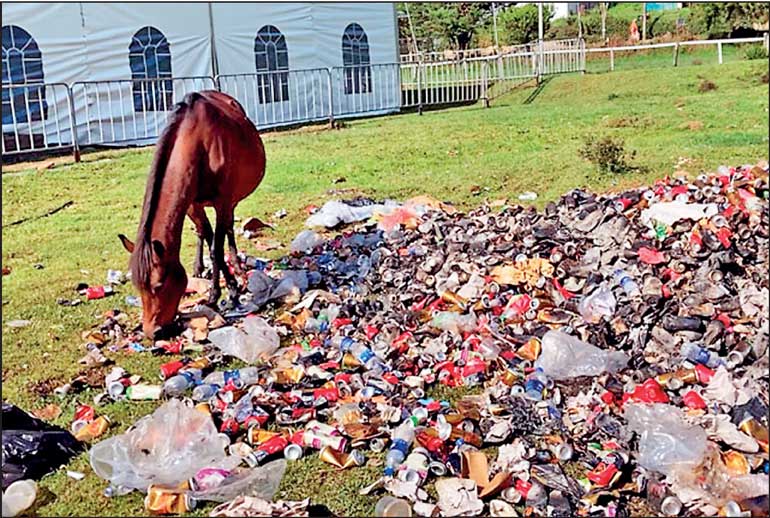
 Visiting Nuwara Eliya after a considerable lapse of time, I had almost forgotten how derelict the Nuwara Eliya town was.
Held out in our tourist brochures as a pristine holiday resort in a pleasant and picturesque hill country, you begin to wonder whether you are a victim of a hoax the minute you hit the ramshackle town. Old ugly buildings coated with soot, foul smelling drains, narrow roads jammed with motor vehicles impatiently sounding their horns, smoke belching lorries loaded beyond capacity; the typical third world shanty town.
And the endless mass; ragged and undistinguished. So many bedraggled beggars, emaciated dogs and cats, waiting for a morsel.
The people are everywhere, poor specimens; underweight, slovenly and chaotic. It was a weekday, I wondered why so many people had come to the town; perhaps the government departments were slow and bureaucratic, necessitating several visits for a simple service. Maybe most of them were unemployed or underemployed, in the town something could come their way, at least an opportunity to hustle a tourist. There was a throng before the taverns, deceptively called wine stores, they only sell ‘arrack’ and beer.
Loud Indian music emanates from the grubby eateries through the day, assailing the ears, not only of the diners but also the passersby. To avoid stepping on garbage and the spit on the pavements the visitor must have the sure feet of a ballet dancer. Down a wet and dirty lane there is a warm clothes place, the bale building. A vendor told me a trade secret, these are factory defects smuggled out of garment factories.
The visitor observes the streetside fruit stalls, the sight whets his imagination, luscious fruits of the cold climes, straight from nearby farms. It is only another place in his imaginary Nuwara Eliya, these are imported fruits, brought up in lorries from the Pettah Market in Colombo.
In the middle of Nuwara Eliya there is now a monstrosity of a hotel named after a low-country flower. An imposition so out of context (little England, English countryside!), it hurts!
Until recently there was one little stretch of Nuwara Eliya which evoked a sense of the English countryside: the Grand Hotel Road, winding between a beautifully manicured golf course and imposing British era tourist hotels. Tall shade giving trees, lovingly created gardens, trotting ponies, the area was a green bliss, a tourist attraction, contrasting sharply with the urban ugliness of the town only a few yards away. Across the road from the General’s Bungalow and the Hill Club used to be a beautiful vegetable plot, growing cabbages and flowers. The rich green of the flourishing vegetable patch was soothing to the eye.
It is no longer there. In a stunning violation the Nuwara Eliya urban authorities have bulldozed the vegetables, filled it up with a red soil and turned the place into a bus park.
If the city bosses were elected by the people loitering in the Nuwara Eliya town, aesthetics would not be a priority in their make-up. But this is a holiday resort, competing with hundreds of similar resorts all over the world for the tourist dollar. Even in Sri Lanka, Ella, a late comer, has left old Nuwara Eliya far behind, bringing in much more money than our ‘little England”.
Clearly, developing Nuwara Eliya as a world class hill country resort is beyond the capacities of its elected councillors. This is a task for a national body, with the support of the Tourism authorities and Urban Development.
It is an urgent task, before long the Nuwara Eliya Council might decide to turn the golf course into a potato cultivation.




