Monday Sep 14, 2026
Monday Sep 14, 2026
Friday, 6 March 2026 00:04 - - {{hitsCtrl.values.hits}}
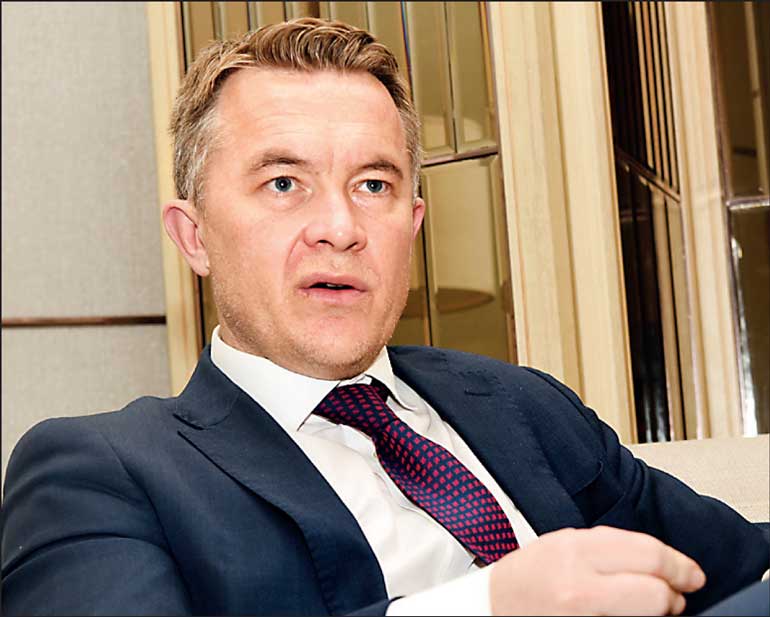
Norway Deputy Foreign Minister Andreas Motzfeldt Kravik
— Pic by Shehan Gunasekara
 Marking 75 years of diplomatic relations, Norway has signalled a renewed push to deepen its engagement with Sri Lanka; spanning reconciliation, governance reform, maritime cooperation and green investment with State Secretary/Deputy Foreign Minister Andreas Motzfeldt Kravik emphasising that stronger rule of law, human rights protections and economic predictability will be key to unlocking expanded trade and Norwegian capital flows.
In this exclusive interview with the Daily FT Kravik took time off to share his thoughts during a two-day official visit—the first high-level Norwegian political delegation to Colombo in several years.
The State Secretary underscored Norway’s intent to modernise what he described as an already “multifaceted” relationship, combining continued development and reconciliation support with a sharper focus on business partnerships, sustainable fisheries, renewable energy cooperation and strengthened multilateral engagement in an increasingly polarised global order.
Below are excerpts of the interview:
By Charumini de Silva
Q: What is the key purpose of your visit to Sri Lanka?
 A: There are several reasons for this visit. Last year, we celebrated the 75th anniversary of diplomatic relations between Norway and Sri Lanka. It is important to commemorate that milestone and use it as a springboard to look ahead, building on what we have achieved and setting new priorities for the relationship. Norway has been engaged in Sri Lanka for many years, particularly in development cooperation and peace and reconciliation efforts. Sri Lanka is a country we attach significant importance to. For relations to remain robust and long-standing, it is essential that we meet regularly. It has been several years since we last had a political delegation here, so I felt this visit was overdue.
Q: How does Norway view the future of bilateral cooperation, particularly in areas such as reconciliation, governance and economic reform?
A: Our relationship with Sri Lanka is multifaceted. We continue our development partnerships through international organisations such as the ILO and UNDP, which are doing important work here. We also support civil society organisations working on labour rights, human rights, judicial standards and related issues. Sri Lanka is in a different status at present, compared to 15 years ago. There are no hostilities, which is a major positive. However, the long conflict has left after-effects that still need to be addressed, and we want to be part of that process. During this visit, I met representatives of the Tamil minority and had meaningful discussions. I will also meet Government counterparts to explore how we can move reconciliation forward. The focus is on ensuring that minorities, including Tamils and Muslims have their rights respected, while helping to facilitate a society grounded in rule of law, judicial safeguards and minority protections, without encouraging sectarian divisions. At the same time, we are determined to modernise our relationship. We want stronger business partnerships, increased trade and collaboration on shared challenges such as healthy oceans, climate change and technological development. People-to-people relations are key to advancing these priorities.
 Q: Norway is a global leader in renewable energy and climate finance. How can countries like Sri Lanka partner with Norway to accelerate the green transition while managing economic recovery challenges?
A: Aid is important, but attracting investment and building strong business partnerships are equally and sometimes more important for economic growth. Norway has companies with expertise in extractive industries as well as advanced technology sectors, which could be relevant for Sri Lanka as it addresses economic and climate challenges. We would like to facilitate partnerships between our technology and financial sectors and encourage Norwegian capital to flow into Sri Lanka. However, for investments to follow, it is vital that Sri Lanka’s economy operates in a predictable manner, with strong rule of law, consistent policies and respect for basic human rights. When those fundamentals are in place, investment typically follows.
Q: Which sectors offer the greatest potential for investment opportunities?
A: The possibilities are broad, but maritime industries stand out. Both Norway and Sri Lanka are seafaring nations. There is significant potential for deeper cooperation in fisheries, and we look forward to hosting Sri Lanka’s Fisheries Minister in Oslo and Bergen in the near future. Energy is another major area. We all need to increase energy production in ways that meet environmental obligations. Addressing these challenges requires cooperation not only between governments, but also between businesses, universities, research communities and legal experts. This visit is partly about facilitating broader engagement between our respective communities across multiple sectors.
 Q: As two maritime nations, what opportunities do you see for enhanced cooperation between Norway and Sri Lanka in shipping, fisheries management, and the broader blue economy?
A: Sustainable fisheries management is crucial. We must ensure fisheries operate in line with international standards, including combating illegal, unreported and unregulated (IUU) fishing. Monitoring vast ocean areas requires advanced technology and strong legal frameworks. Norway has been at the forefront of initiatives such as the Port State Measures Agreement and the Fish Stocks Agreement, which are important tools in this effort. Cooperation and knowledge-sharing are essential. We also have experience in oil and gas, which we are willing to share if there is interest. However, addressing the climate crisis makes the transition to sustainable energy even more urgent. That requires cutting-edge technology, capital and expertise. I believe no country can achieve it alone and therefore partnerships are essential.
Q: Norway consistently advocates for human rights and multilateral engagement. How do you balance engagement with countries facing governance and accountability concerns?
A: Human rights are central to our foreign policy. We engage constructively, not by lecturing or pointing fingers, but by sharing experiences from our own system. While we are not perfect, Norway has achieved relatively high levels of human rights compliance. We also highlight the strong link between human rights and economic growth. Gender equality, for example, is both a moral obligation and an economic necessity. Respect for international law and strong multilateral institutions are fundamental to global stability and economic growth. We speak out when countries violate international law, without double standards. That applies whether it concerns Russia’s actions in Ukraine or Israel’s conduct in Gaza and the West Bank. We are also deeply engaged in reform efforts within the UN, the World Health Organisation (WHO) and the World Trade Organisation (WTO). We believe global institutions cannot function effectively without the meaningful participation and confidence of countries in the Global South, including Sri Lanka.
Q: What role can small and medium-sized countries play in an increasingly polarised world?
 A: Smaller and mid-sized countries can play an important role. As some larger powers step back from multilateral institutions, it is incumbent upon others to lean in and take responsibility. We must operate in conformity with international law and call out violations when necessary, even if that can be uncomfortable. At the same time, foreign policy must be multifaceted and it is possible to criticise certain actions, while continuing cooperation in other areas. Ultimately, if we want to preserve stability and inclusive economic growth, we need strong global institutions and respect for international law. Once that is clear, the path forward becomes evident—we must strengthen those institutions and the legal framework that underpins them.
Q: Any final thoughts?
A: I have only been here a few hours, but I have been struck by the hospitality and friendliness. Norway has a small, but important Sri Lankan diaspora, and they are highly valued members of our society. I have been looking forward to this visit and to the conversations I will have during my stay. The relationship between Sri Lanka and Norway is already strong, but there is significant potential for even greater collaboration. We are committed to further developing this partnership in the years ahead.




