Friday Sep 25, 2026
Friday Sep 25, 2026
Tuesday, 16 December 2025 00:24 - - {{hitsCtrl.values.hits}}
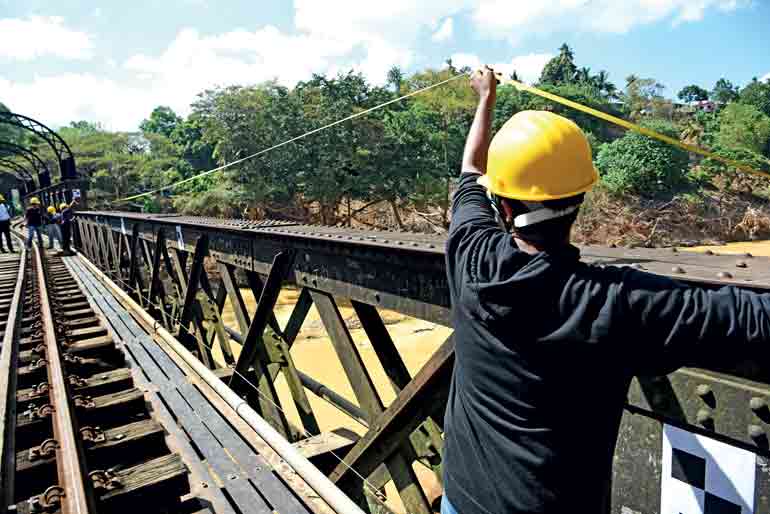
Workers busy rebuilding a damaged rail track in Central Province due to cyclone Ditwah recently - Pic by Shehan Gunasekera
Never waste a crisis- former Foreign Minister Ali Sabry called on the country’s leaders to use the national tragedy as an opportunity for transformative, long-term reform and reconstruction. He went on to say how Germany rebuilt industrial power from war ruins, how Japan re-engineered resilience after disaster, how the Philippines revived agriculture after total collapse and how Rwanda emerged from tragedy into stability and growth
 An opportunity to learn lessons and build a stronger Sri Lanka
The efforts being taken by the Government to restore and rebuild the country is quite evident although political detractors are doing their best to capitalise on the misery of millions of people who have and still are suffering. The message for President Dissanayake from all well-meaning people no doubt will be, as President Putin said recently, “look to the future and not the past, and not just do what is necessary, but more importantly, do things you have no right not to do for the sake of the country”
A special reference is made to Ali Sabry’s statement (https://x.com/alisabrypc/status/ 1996591205615063050) considering that he is the only non-Government politician who has said something sensible and futuristic as to how all Sri Lankans should view the tragedy that has befallen the country.
A point of view for every sensible citizen
While Opposition politicians, some commentators, and some media organisations as well as some responsible, educated citizens are behaving like bystanders around a person on the road who has been hit by a car and is seriously injured, enquiring who the persons father is, whether he is Sinhala or Tamil or Muslim, why he was on the road at the time he was hit, how he could have avoided the accident had he been walking on the pavement rather than on the road, and similar inopportune idiotic questions, without rushing the person to a hospital, Mr Sabry has articulated a point of view that every sensible citizen of the country should take heed of.
Great nations are not defined by what breaks them, but by what they build after they are broken
Social media posts are overflowing with opinions from many who have no knowledge of the behaviour of cyclones, and who have no understanding of the impact of an annual rainfall of the country falling in just five days and inundating most of the country and extracting such a physical and human cost. Landslides, soil erosion on a large scale that buried hundreds of human beings and their dwellings, damages to roads and bridges, are amply visible in aerial photographs that have been shown regularly. They show the enormity of the catastrophe. Yet rather than being united in addressing the issues faced by millions of people who have been affected and helping those on the ground who are leading rescue and rehabilitation efforts, some people unfortunately are knit picking and politicking while millions are suffering.
As Sabry says, “the grief is raw, and the destruction is real. But the question before us is not what we lost, it is what we will do with this moment. We must not waste this crisis. This tragedy forces us to choose: Do we rebuild what existed? Or do we rebuild a better, stronger, more resilient Sri Lanka?”
Short, medium and long-term needs
While the immediate task is to provide food and water to the millions of people affected, and restore and rebuild their homes, clean and clear roads and bridges that are still usable so that food and medicine can be transported to affected areas, provide electricity and potable water, and restore health services where they have been badly affected, all of which the Government is doing, the more medium to long term needs require careful and strategic planning.
Echoing Sabry again, “this is our turning point, a moment to modernise agriculture, replant with improved seeds, irrigation systems, smart farming, climate-resilient crops. Build storage, processing and value-addition, so farmers earn more than subsistence. Rebuild infrastructure, not replace it. New roads, rail, bridges and housing flood-resistant, elevated, climate-smart. Besides this, there must be better drainage, disaster proof construction zoning that protects lives”
Another important point raised by Sabry is that rebuilding Sri Lanka can become the single largest job-creation program since independence. Reconstruction of roads, railways, every irrigation channel restored will be employment. In the area of technology, this will be an opportunity to build digital infrastructure and innovations in ecosystems, GIS-mapping, early-warning systems, remote-sensing, and real-time flood modelling. Great nations are not defined by what breaks them, but by what they build after they are broken.
Let this be the moment we rise stronger, smarter, more united, and ready for the future we deserve
Sri Lanka at crossroads
Sri Lanka now stands at that crossroad. It is well to remember the words of George Bernand Shaw who said, “some people look at things as they are and ask why, while some others look at things as they never were and ask why not?” We could be like the former category and keep looking for scapegoats or be like the latter and rebuild, not as we were, but as we must become, turning devastation into development, pain into progress, and crisis into opportunity.
No doubt Sabry’s message is the same as what President Dissanayake presented to the country in the speech he made in Parliament winding the debate on the third reading of the 2026 budget two days ago appealing for people to let this be the moment we rise stronger, smarter, more united, and ready for the future we deserve.
The recent cyclone and the damage it havocked on virtually all of Sri Lanka provides opportunities to use new techniques and technology to rebuild the country. One should not just restore but rebuild. While some restoration will be necessary as short-term measures, the long-term strategic vision and objective should be to rebuild differently. If this is not done, besides the wasted opportunity, as Einstein said, ‘the country will be insane by expecting different results by doing the same thing’. Mr Sabry no doubt has taken note of Einsteins advice!
Identifying the reasons for the disaster
While immediate relief measures and some necessary renovation works are being done, hopefully efficiently and effectively so that redress will be provided for all affected people, an effort to understand why and how, and what factors contributed over the years to the severity of the disaster on this occasion needs to happen in parallel to the immediate relief efforts. The cyclone itself and the torrential rains it brought and the natural damage it caused are perhaps beyond the control of human beings. The power of natural phenomena like cyclones and tsunamis are immeasurable although some mitigation measures to limit the severity of the impact of such phenomena could well be within the ambit of human ingenuity and intelligence. Mismanagement of land, making landscapes unstable and prone to landslides and soil erosion, deforestation and disrespecting nature is not ingenuity and intelligence. It is the opposite. Over the years, many Sri Lankans led by all political persuasions have acted disingenuously and unintelligently considering only immediate superficial benefits.
While some restoration will be necessary as short-term measures, the long-term strategic vision and objective should be to rebuild differently
At times, construction of roads and bridges at the behest of politicians, land clearing for housing in areas that should not be cleared, deforestation and land filling of areas that should not be filled and many other acts that disturb the natural equilibrium of nature, are other areas that surely have contributed to the severity of cyclones and excessive rain fall.
Rather than as a finger pointing exercise, an evaluation of such contributory factors needs to be made to learn lessons from such short-sighted actions of the past, many of which would have occurred for political expediency. Shortcomings, if any, in flood management, reservoir management, in river management should also be known for the sole purpose of learning lessons and for taking corrective action for the future.
Thinking ‘out of the box’
Having said this, while such an evaluation is necessary and also useful, the more challenging act would be to think differently, laterally and as the saying goes, “out of the box”. Rebuilding requires such thinking coupled with technology and techniques that would overcome at least some potential threats as witnessed in Sri Lanka recently.
Rebuilding the physical damage that was experienced, requires an enormous amount of funding and finding such funding without resorting to huge borrowings will be a major challenge. The flow of funding and relief assistance to the country from many local and overseas sources is very commendable and shows the high esteem such donors hold Sri Lanka in. No doubt many of these donors would willingly contribute more once the country has come up with the structures, plans and mechanisms to address rebuilding efforts.
Considering the vast amounts of funds needed for rebuilding the country, a suggestion is made to harness financial support from expatriate Sri Lankans who according to available numbers, exceed three million people. This global population could play a major role in supporting the rebuilding efforts of the country. As an example, if half of this expatriate population, say 1.5 million people, contributes $1000 each, it will work out to $1.5 billion dollars (1.5% of the country’s GDP of $100 billion) or Rs. 426 billion at today’s rate of exchange. This will be a substantial contribution that will enable the country to rebuild not just its infrastructure but also its economy based on strategic plans developed by experts in consultation with all stakeholders including very importantly the input of people at the grassroots.
Considering the vast amounts of funds needed for rebuilding the country, a suggestion is made to harness financial support from expatriate Sri Lankans who according to available numbers, exceed three million people. As an example, if half of this expatriate population, say 1.5 million people, contributes $1000 each, it will work out to $1.5 billion dollars (1.5% of the country’s GDP of $100 billion) or Rs. 426 billion at today’s rate of exchange. This will be a substantial contribution that will enable the country to rebuild not just its infrastructure but also its economy based on strategic plans developed by experts in consultation with all stakeholders including very importantly the input of people at the grassroots
Appealing to the Sri Lankan disapora
A special appeal made jointly by the President and the leader of the Opposition, demonstrating the national political unity relating to such a rebuilding effort will no doubt attract a substantial number of contributors, many of whom could well contribute more than US $1000 each. Of course, such an appeal should be accompanied by a national rebuilding plan outlining the key components of the rebuilding effort, expected deliverables and time frames for achieving them. A key aspect of such an effort should be the depoliticisation of the activity and the empowerment of experts, including the bureaucracy, to implement the plan without hinderance and political interference.
Rebuilding the mental or psychological aspect of people relating to the factors that exacerbated the devastation however requires a different strategy which perhaps is more of a challenge than rebuilding the physical damage. Understanding and respecting nature, nurturing it and growing it is a key area where the psychology of people and the politicians who lead them, the civil society and the clergy will have to change. Rebuilding roads and bridges, rail networks, reservoirs and manging them, house and commercial building will have to be guided by the need for ensuring maintaining the equilibrium of nature. If human beings think foolishly that they can beat nature, they are more than foolish, they are insane.
In conclusion, the following suggestions are made.
1. A summit meeting of environmentalists, construction engineers, irrigation engineers, water management experts including reservoir managers, meteorological experts, and any other professionals associated with weather predictions and natural disaster management. Such a summit is suggested to undertake a lessons learnt exercise based on past policies and practices, shortcomings that may have contributed to exacerbation of natural disasters, and to establish appropriate protocols that would better manage responses to natural disasters in the future.
2. A summit meeting of national, provincial and district administration personnel, disaster management personnel, health workers, food producers and transporters and members of the tri-forces and Police to discuss challenges faced by them in managing disasters, including the most recent one, and the existing and new protocols arrived at the summit mentioned at (1) above. The summit should present a set of proposals based on the lessons learnt.
3. A meeting under the chairmanship of the President that includes heads of political parties represented in Parliament including the leader of the Opposition, to discuss and deliberate policy and administrative proposals arising from the above two summits. The end objective of the meeting should be the development of a new bi partisan national policy on (a) disaster management including early warning protocols, actions that should follow such warnings, prior identification of relief centres (schools, religious places etc located in suitable places) throughout the country with action plans for health, food and shelter provision that could be activated alongside early warning protocols and (b) on housing construction, including zoning, land management, infrastructure construction, water and environment management. The agreed policies should then be presented to Parliament as relevant Acts. These should include what punitive actions would be taken by anyone who is not complying with the Acts.
4.A special appeal by the President and the Leader of the Opposition to the Sri Lankan expatriate community to contribute $1000 each to the Rebuilding Fund towards achieving a target of $1.5 billion to support the national action plans for rebuilding Sri Lanka.
This is the time for the country’s leaders to leave aside their partisan political garbs and don a national unity garb and work together to overcome this national tragedy through transformative, long-term reform and reconstruction efforts. Hopefully this will lead to a cultural shift towards genuine nationalism and a system change that is based on that, and the evolution of a new political culture.




