Thursday Oct 22, 2026
Thursday Oct 22, 2026
Thursday, 19 March 2026 03:51 - - {{hitsCtrl.values.hits}}
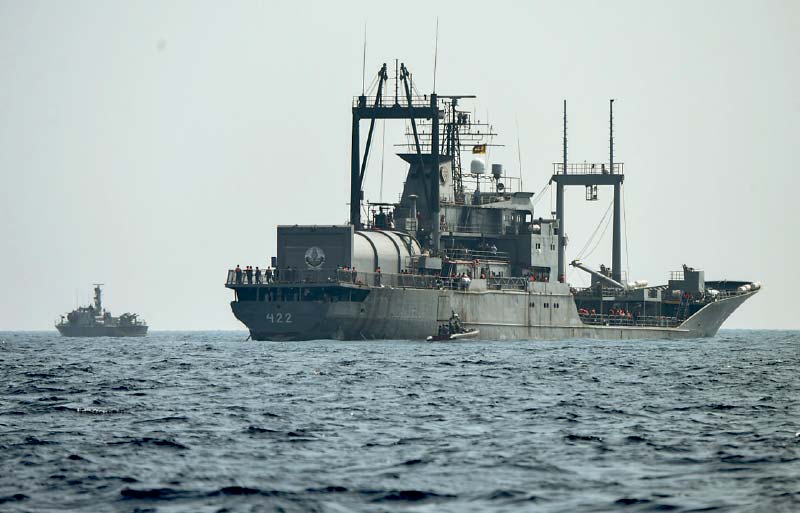
 If reports suggesting that the vessel concerned was returning from ceremonial duties and not engaged in combat operations are accurate, the legal assessment becomes more complex. International humanitarian law requires attacks to be directed against military objectives that contribute effectively to the conduct of hostilities. If a vessel poses no immediate operational threat questions may arise as to whether the principles of necessity and proportionality were satisfied
Naval hostilities off Sri Lanka’s maritime approaches raise serious questions under international maritime law and neutrality doctrine. The issue is not only the legality of military operations at sea but also the responsibility to preserve the Indian Ocean as a region of peace, stability and secure global navigation
 “The seas must remain open to all nations, governed not by force but by the rule of law.” Principle reflected in modern international maritime law.
The reported submarine attack on an Iranian naval vessel close to Sri Lanka’s southern maritime approaches raises important questions under international maritime law and neutrality doctrine. For Sri Lanka, located at the crossroads of one of the world’s most important maritime corridors, the stability of surrounding seas is a matter of national interest and international responsibility.
Sri Lanka lies next to one of the busiest shipping routes in the world. Sea lanes south of the island carry large volumes of global energy supplies and commercial shipping between the Middle East, Asia and Europe. Stability in these waters is therefore important not only for Sri Lanka but also for the global economy.
The conduct of naval warfare is governed by treaties, conventions, customary international law, judicial decisions and authoritative manuals developed over more than a century. Among the most relevant instruments are the United Nations Convention on the Law of the Sea (UNCLOS, 1982), Hague Convention XIII concerning the Rights and Duties of Neutral Powers in Naval War (1907), Additional Protocol I to the Geneva Conventions (1977) and the International Convention on Maritime Search and Rescue (1979).
The San Remo Manual on International Law Applicable to Armed Conflicts at Sea (1994) is widely regarded as an authoritative restatement prepared by international legal experts reflecting contemporary understanding of naval warfare law.
International law recognises that coastal states have legitimate rights and interests in the waters adjacent to their territory. Within the territorial sea, which extends twelve nautical miles from the baseline, the coastal state exercises full sovereignty. Any hostile military action within that zone without consent would violate international law and territorial integrity.
Beyond the territorial sea lies the Exclusive Economic Zone which may extend up to two hundred nautical miles from the coast. In the EEZ the coastal state enjoys sovereign rights relating mainly to natural resources, environmental protection and economic activities.
Other states retain freedom of navigation and certain military uses of the sea within the EEZ. These freedoms must however be exercised with due regard for the rights and interests of the coastal state. Article 58 of UNCLOS requires states exercising freedoms of navigation and other lawful uses of the sea in the EEZ to do so with due regard for the rights and duties of the coastal state.
Neutrality during armed conflict carries responsibilities. A neutral state must ensure that its territory, ports and waters are not used as a base for hostile operations by belligerent powers. The coastal state must also safeguard the safety of navigation within waters under its jurisdiction.
There is also a long-standing humanitarian obligation to assist persons in distress at sea. Under the International Convention on Maritime Search and Rescue (1979) coastal states must respond to distress calls and coordinate rescue operations.
Even during armed conflict states remain bound by the principles of international humanitarian law. Military necessity requires force to be directed towards a legitimate military objective. Proportionality requires that anticipated military advantage should not be outweighed by excessive harm. Distinction requires belligerents to distinguish between military targets and civilian or neutral objects.
Warships are generally regarded as lawful military targets during armed conflict. The legality of any particular attack must however be assessed in light of the operational circumstances and the threat posed by the vessel concerned.
International law also requires caution when military operations occur close to neutral territory. Belligerent states must ensure their actions do not endanger the territory or population of a neutral state, create environmental hazards affecting neutral waters or interfere with international navigation.
These principles are consistent with the jurisprudence of the International Court of Justice in the Corfu Channel Case (1949), which affirmed that states must exercise vigilance so that maritime activities do not harm the rights of other states.
If reports suggesting that the vessel concerned was returning from ceremonial duties and not engaged in combat operations are accurate, the legal assessment becomes more complex. International humanitarian law requires attacks to be directed against military objectives that contribute effectively to the conduct of hostilities. If a vessel poses no immediate operational threat questions may arise as to whether the principles of necessity and proportionality were satisfied.
Sri Lanka’s geographic position places the island close to the Indian Ocean’s main east-west maritime corridor. Any expansion of naval hostilities into this region could have consequences for maritime security, trade and environmental protection.
Sri Lanka’s engagement with maritime governance has long been guided by commitment to international law, multilateral cooperation and the peaceful use of the oceans.
Sri Lanka was also among the principal proponents of United Nations General Assembly Resolution 2832 (XXVI) adopted in 1971 declaring the Indian Ocean a Zone of Peace. The initiative sought to prevent militarisation of the region and preserve it as an area of peaceful cooperation and secure maritime commerce.
In a period of growing strategic competition among major powers Sri Lanka must remain attentive to developments affecting its maritime interests. Diplomatic engagement, stronger maritime awareness and cooperation among Indian Ocean states will remain important in promoting responsible conduct at sea.
The law governing naval warfare seeks to balance the realities of armed conflict with the rights of neutral states and the protection of international navigation. Incidents near the coast of a neutral state inevitably test that balance.
For Sri Lanka the stability of the surrounding seas is both a legal responsibility and a strategic necessity. As a country that has consistently supported international law and peaceful maritime cooperation Sri Lanka is well placed to advocate restraint and respect for maritime law.
The peace and stability of the Indian Ocean are not abstract ideals. They are enduring national interests that must be preserved for future generations.
(The writer is a former Minister of Justice, Finance and Foreign Affairs of Sri Lanka.)




