Tuesday Sep 15, 2026
Tuesday Sep 15, 2026
Friday, 5 June 2026 00:00 - - {{hitsCtrl.values.hits}}
 It has also been alleged that the Judicial Service Commission (JSC), has compromised the independence expected of it, by taking measures to penalise members of the subordinate judiciary and exercising administrative authority in a manner that adversely affected more than forty judicial officers
By Legal Eagle
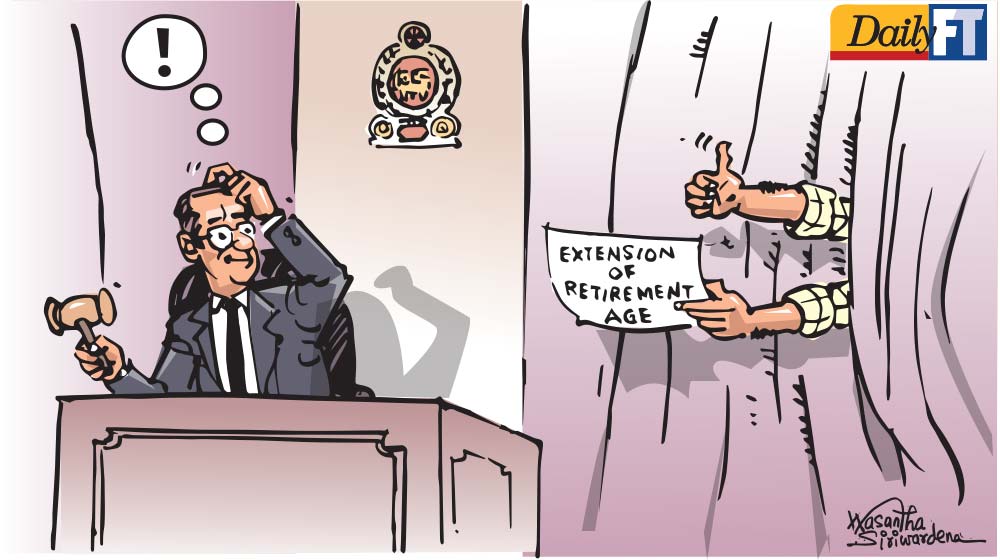
Under the 1978 Constitution of the Democratic Socialist Republic of Sri Lanka, the retirement age of a Judge of the Supreme Court is 65 years, while the retirement age of a Judge of the Court of Appeal is 63 years, as provided in Article 107(5).
It is contended that, under the present political circumstances, the Government's continued stability is heavily dependent upon the persecution of Opposition politicians. Therefore it becomes a prerequisite to have the current Judges in office beyond their mandatory age of retirement.
One has to analyse as to how a High Court Judge, subsequently rose to the position of President of the Court of Appeal and was thereafter appointed to an exalted seat, reportedly superseding other more senior Judges of the Apex Court. It has also been alleged that this individual retired from the Sri Lanka Navy, where he served in his youth, on medical grounds relating to his mental health. Critics contend that it is extraordinary that an individual who allegedly retired from public service on account of a mental health condition could later dispense justice at the highest level of the judiciary.
Reports circulating on social media have further alleged that this individual was involved in obtaining information relating to pending and ongoing cases before the High Courts’ involving political opponents of the current Government, and that such information was provided to the President and other Ministers for use in public pronouncements made during May Day events. Particular attention has been drawn to cases publicly referenced by the President, the Minister of Justice, the Minister of Foreign Affairs, and other Government representatives during their May Day addresses. These reports raise concerns regarding the propriety of access to, and dissemination of, information relating to pending judicial proceedings.
It has also been alleged that the Judicial Service Commission (JSC), has compromised the independence expected of it, by taking measures to penalise members of the subordinate judiciary and exercising administrative authority in a manner that adversely affected more than forty judicial officers.
Furthermore, it is claimed that information concerning cases involving Opposition politicians was obtained through channels that may become the subject of future administrative inquiries into the functioning of judicial administration. According to these allegations, certain serving High Court Judges who are said to have provided such information may, under a future administration, be called upon to give evidence regarding the circumstances under which the information was requested and supplied. It is further alleged that some of these judges have privately indicated that they would be prepared to testify before an appropriate forum if called upon to do so.
Against this backdrop, it is reported that on 1 June 2026, President Anura Kumara Dissanayake convened a meeting at the Presidential Secretariat with representatives of the High Court Judges' Association and the Judicial Services Association. Those reportedly in attendance included Nirosha Fernando, Chathura Gunatilaka, Pasan Amarasena, the Chief Magistrate of the Colombo Fort Magistrate's Court, and Additional District Judge of Nugegoda, Suranga Munasinghe. It is further alleged that these individuals met privately with the President in his ante-room and conveyed that members of the High Courts and the subordinate judiciary supported extending the retirement age of judicial officers. However, it is alleged that no such decision had been communicated by the membership and that these representatives had no mandate to make such representations. Critics contend that these representatives acted at the behest of their superior, either to curry favour for personal gain or under duress. It is further alleged that no resolution was presented to the membership and that no mandate was obtained from the membership.
Critics of the Government contend that the administration is making every effort to overshadow allegations of corruption and mismanagement within the Government, together with concerns regarding the country's economic trajectory, by manipulating the judiciary
Subsequently, an official meeting was reportedly held in the presence of Justice Ministry Secretary Ayesha Jinasena, who previously served in the Attorney General's Department and concluded her career there as Solicitor General. Critics allege that she played a significant role in facilitating the preparation of documentation relating to the proposed constitutional amendments aimed at increasing the retirement age of judges, including by forwarding material to the Legal Draftsman's Department prior to Cabinet approval. It has further been alleged that the documents were not submitted directly to the Legal Draftsman but instead to a junior officer of the Department who is said to be a known supporter of the JVP. According to these allegations, such actions were undertaken to advance the interests of the Government and to secure an extension of her own tenure.
The formal meeting was also reportedly attended by Justice Minister Harshana Nanayakkara, together with other officials of the Ministry of Justice. Observers have noted the reported absence of the Attorney General from what has been described as a significant and potentially controversial discussion concerning proposed constitutional reforms affecting the judiciary.
More broadly, critics of the Government contend that the administration is making every effort to overshadow allegations of corruption and mismanagement within the Government, together with concerns regarding the country's economic trajectory, by manipulating the judiciary. According to these critics, such actions are intended to prolong the hardships faced by ordinary citizens, while the Government has demonstrated an inability to address the pressing issues confronting the state. They further argue that these difficulties have been exacerbated by what they describe as an incompetent President, Cabinet of Ministers, and public administration largely composed of JVP cadres at the helm of crucial administrative positions.
It is also noteworthy that certain social media activists who are generally supportive of the Government have reportedly rejected what they characterise as an anti-democratic initiative. Consequently, some commentators argue that the proposed constitutional amendment represents a difficult and uphill task for President Anura Kumara Dissanayake.




